
Jacksonville heat destroys high-mileage engine oil faster than most drivers realize. I see it every week on vehicles stuck in I-95 traffic, crossing the Buckman Bridge, or idling through Beach Blvd congestion. Long idle times in Northeast Florida heat can thin engine oil enough to trigger low pressure, VVT timing problems, and bearing wear before most drivers even realize damage is starting.
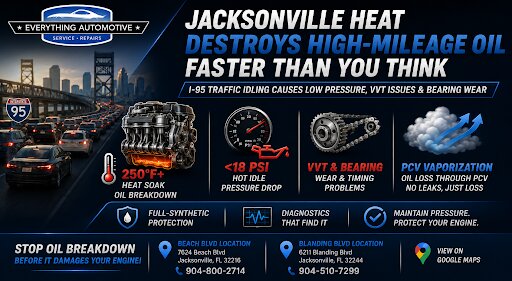
Jacksonville Heat Soak
A lot of the engine damage I diagnose in Jacksonville starts with thermal soak, humidity, and long hours sitting in interstate traffic.
When traffic stalls on the Buckman Bridge or backs up through I-95 construction zones, engines lose the cooling airflow they normally depend on. At the same time, pavement temperatures can exceed 140°F, radiating heat directly into the oil pan.
Once oil temperatures climb beyond normal operating range, oxidation accelerates rapidly. During Jacksonville summer traffic, I routinely see oil degrading four to eight times faster than during open-road highway driving.
After 35 to 45 minutes of interstate idle time, some high-mileage engines begin showing hot-idle pressure instability. On older GMC 5.3L and Pentastar engines, I have documented pressure dropping below 18 PSI once sump temperatures exceed roughly 250°F.
Honestly, this is where a lot of Jacksonville drivers get caught off guard. The vehicle still starts, still drives, and still feels mostly normal until oil pressure begins collapsing hot in traffic.
Common Warning Signs I See
Drivers usually notice:
- timing chain chatter
- flickering oil lights
- rough idle at stoplights
- delayed throttle response
- VVT hesitation leaving intersections
I regularly pull dipsticks on overheated Jacksonville commuter vehicles and find oil that smells burnt, feels watery, and no longer maintains proper film strength.
How Oil Breaks Down
By the time oil temperatures exceed 248°F (120°C), the lubricant is already beginning to shear apart.
Motor oil depends on long-chain hydrocarbons to maintain viscosity under load. Under sustained heat stress, those molecular chains begin breaking apart through thermal cracking.
Once that happens, the oil stops holding pressure consistently.
Oil Loss Without Leaks
As lighter oil fragments break down, they vaporize through the PCV system and burn during combustion.
This is why many Jacksonville drivers notice disappearing oil without visible leaks. Coastal heat, bridge traffic, and repeated idle cycles accelerate evaporation loss dramatically on high-mileage engines.
I commonly see this on:
- Hyundai CVVT systems
- GMC AFM engines
- Toyota VVT-i platforms
- Chrysler Pentastar engines
A lot of customers assume the engine must have a leak somewhere because they keep adding oil between services. Most of the time, the oil is slowly burning off through heat-related vaporization long before it ever drips onto the driveway.
Vehicles commuting daily across the Buckman experience repeated bridge-load heat cycles followed by long idle periods descending into congestion. That combination is brutal on aging oil.
VVT Timing Problems
Once lighter molecules burn away, portions of the remaining oil turn into varnish while other sections lose viscosity completely.
That instability directly affects Variable Valve Timing (VVT) systems.
The giveaway is usually hot-idle cam drift. The engine sounds normal cold, but once coolant temperatures stabilize, the intake cam begins hunting because the oil film can no longer stabilize the phaser.
I keep seeing the same pattern on high-mileage Jacksonville commuter vehicles. The engine runs quietly in the morning, then starts rattling or stumbling once the vehicle sits in afternoon interstate traffic.
Symptoms I Commonly Diagnose
Most Jacksonville thermal-failure vehicles arrive with:
- sluggish VVT response
- intermittent cam correlation faults
- ghost timing codes
- varnished solenoid screens
- hesitation leaving stoplights
If your vehicle stumbles while idling on Beach Blvd, at the JTB/I-95 interchange, or hesitates leaving Southside Boulevard intersections, degraded oil may already be affecting actuator response times.
Bearing Wear
The damage does not stop with viscosity breakdown.
Jacksonville humidity introduces moisture into the crankcase system, especially during short-trip driving where oil never reaches full evaporation temperature. Near Atlantic Blvd and Atlantic Beach, saline air exposure accelerates oxidation even further.
Once oxidized oil combines with moisture and oxygen, acidic compounds begin forming inside the lubricant. Those acids attack the soft bearing materials supporting the crankshaft.
As bearing clearances widen, hot-idle oil pressure begins collapsing.
And once that starts happening, things go downhill fast.
What I Usually Find
Most drivers think a flickering oil light is electrical. In the bay, I usually find:
- excessive bearing clearance
- oil shear from prolonged idle exposure
- thermal viscosity breakdown
- worn high-mileage internals
On severe Jacksonville heat-soak vehicles, I sometimes see acceptable cold-start pressure around 40 PSI collapse into the low teens after extended idle conditions.
Advanced Diagnostics
I do not diagnose thermal oil failure by guessing or simply recommending thicker oil.
Pressure Testing
I install high-speed pressure sensors to monitor oil pressure fluctuation during hot-idle conditions. Dashboard gauges often hide developing pressure collapse.
Oscilloscope Testing
I scope VVT solenoid waveforms and camshaft response behavior in real time.
If the control signal becomes delayed after heat soak, I can often identify degraded oil viscosity before a permanent timing fault appears.
Scan Tool Analysis
I monitor:
- cam phaser response times
- adaptive timing corrections
- pending correlation faults
- temperature-linked timing retard behavior
Many Jacksonville vehicles begin showing ghost timing activity long before a check engine light appears.
Protecting High-Mileage GMC, Chrysler, and Toyota Engines
I have been turning wrenches since 1983, and Jacksonville traffic is harder on high-mileage engines now than it was twenty years ago.
Between Buckman congestion, construction zones, short-trip commuting, and coastal humidity, standard maintenance intervals are no longer enough for aging engines.
At Everything Automotive, my team and I use a diagnostic-first approach built around the real driving conditions Jacksonville vehicles face every day.
Instead of relying on generic bulk mineral oil, I frequently move high-mileage engines toward full-synthetic formulations with stronger thermal stability and elevated anti-wear additive packages like ZDDP where appropriate.
Why Oil Choice Matters
The wrong oil breaks down quickly in Jacksonville stop-and-go traffic.
I use synthetics designed to:
- maintain hot-idle pressure
- resist thermal shear
- stabilize VVT operation
- survive prolonged interstate idle heat
Most catastrophic bearing failures I see in Jacksonville started months earlier as hot-idle pressure instability during summer traffic.
When Small Oil Problems Turn Into Engine Damage
I tell Jacksonville drivers this all the time: if the engine sounds different hot than it does cold, pay attention to it early. Most major oil-related failures start with small symptoms that gradually get worse in traffic.
If you are dealing with flickering oil pressure lights, rough hot-idle conditions, or VVT timing problems in Jacksonville traffic, my team and I can help you identify what is actually happening before the damage becomes permanent.
Everything Automotive
7624 Beach Blvd, Jacksonville, FL 32216
6211 Blanding Blvd, Jacksonville, FL 32244
Frequently Asked Questions
Does heat really make my oil disappear without a leak?
Yes. Once oil temperatures exceed roughly 250°F during prolonged idle time, lighter oil molecules begin vaporizing through the PCV system and burn during combustion.
Is a flickering oil light at a stoplight serious?
Yes. In most high-mileage cases, it means hot-idle oil pressure has dropped below the minimum safe threshold needed to protect bearings and internal engine components.
Does Jacksonville humidity affect motor oil?
Yes. High humidity introduces moisture into the crankcase, accelerating oxidation, sludge formation, and acid development inside the lubricant.
Why are traffic jams harder on engines than highway driving?
Because engines depend heavily on airflow for thermal stability. During prolonged idle traffic, heat accumulates rapidly while oil temperatures continue climbing without sufficient cooling airflow.
