
In Jacksonville’s extreme heat and humidity, the Thermal Expansion Valve (TXV) in your AC system can fail, leading to poor cooling and costly compressor damage. Learn how moisture and debris affect TXV performance and how Everything Automotive’s precision diagnostics can prevent expensive repairs.
The Jacksonville Traffic Trap – Why Stop-and-Go Kills Your AC
If you’re in Jacksonville, you know firsthand how brutal the heat and humidity can be on your car’s AC. I see it every week—cars stuck in traffic, idling in the sweltering heat, and then suddenly, the AC can’t keep up. More often than not, the culprit is the Thermal Expansion Valve (TXV). If you don’t catch it early, you’re looking at a pricey compressor replacement. Trust me, we see this too often, and we can fix it before it becomes a much bigger issue.
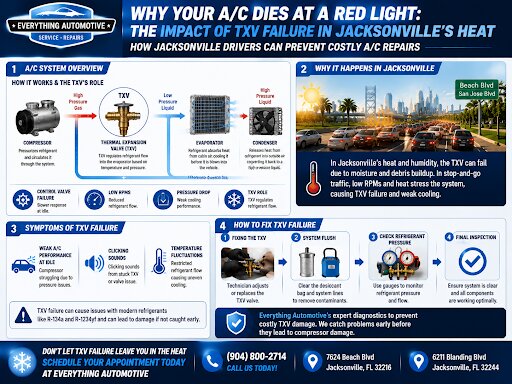
Jacksonville Traffic and the Strain on Your AC System
Ever get stuck at a red light at San Jose Blvd or in the middle of Beach Blvd congestion? The temperature gauge on your car climbs, and suddenly, the cold breeze coming from your vents turns to warm, muggy air. That’s the start of TXV failure.
Here in Jacksonville, it’s not just the heat—it’s the humidity and traffic that really puts stress on your AC. When you’re driving at speed, like on the Buckman Bridge, the system works fine. But when you’re in stop-and-go traffic, the pressure on the system increases. And if that TXV starts sticking even a little, the whole system can break down.
What Happens When Your TXV Fails
The TXV controls the amount of refrigerant flowing into the evaporator, and if it stops working, you’re in trouble. There are two main ways a TXV can fail:
The Starvation Scenario
If the needle valve inside the TXV gets stuck or the sensing bulb loses its charge, the valve doesn’t open properly. That means your evaporator doesn’t get enough refrigerant. The result? The air from your vents is cool but never really cold. You might even hear a faint hissing sound, which means the refrigerant is being forced through a restricted valve.
The Flooding Scenario
This one’s even worse. If the valve sticks open, too much refrigerant floods the evaporator. The liquid refrigerant doesn’t get a chance to evaporate, and instead, it heads straight for your compressor. Liquid refrigerant in the compressor is a huge problem. It can lead to what’s called “slugging,” and since liquids can’t compress, it can destroy the compressor’s pistons or scrolls.
Why Jacksonville’s Humidity Makes AC Problems Worse
After fixing cars for decades in Jacksonville, I can tell you that the humidity here is a major problem. When you bring your car into a shop for a quick AC recharge without fully evacuating the system, that humidity stays in the lines. It’s like adding a ticking time bomb to your system.
Moisture, when mixed with refrigerants like R134a, creates a corrosive sludge that can wreck your TXV. That’s why I don’t just slap some refrigerant in your system. I use a high-cfm vacuum pump to pull out all the moisture before sealing up the system. If I don’t, your TXV will eventually seize, and you’ll be looking at a big repair bill.
How We Catch TXV Failures Early
In most shops, the TXV failure doesn’t trigger a check engine light until the compressor’s already shot. But I don’t wait for that to happen. We use advanced diagnostic tools like the Snap-on Zeus diagnostic suite and digital manifold gauges. This way, we can monitor the superheat and subcooling in real-time, so if the TXV is sticking, we catch it before it’s too late.
I’m not here to guess what’s wrong with your AC. We use pressure testing and oscilloscopes to monitor your system’s behavior and catch issues before they turn into full-blown disasters. It’s all about doing things the right way, not just fixing the symptom.
The Right Way vs. The Quick Fix
When I see a failed TXV, it’s rarely just the valve that’s the problem. Usually, the desiccant bag inside your receiver-drier has ruptured, sending tiny silica beads into the system. Some shops will just swap out the valve and call it a day, but not us. At Everything Automotive, we don’t just replace the TXV. We do a full system flush, replace the drier, and check the condenser to make sure it’s clear.
We don’t believe in quick fixes. We back all our work with a 36-month/36,000-mile nationwide warranty, because when we fix your system, we fix it right.
Protecting Your AC in Jacksonville’s Heat
Look, I get it. You can’t change the weather. But you can protect your AC system from failing prematurely by keeping up with regular maintenance. Here’s what I recommend:
- Change Your Cabin Air Filter: A clogged filter makes your AC system work harder and causes unnecessary wear on the TXV.
- Keep Your Condenser Clean: Road grime and salt air here in Jacksonville can coat your condenser and raise head pressures, stressing the TXV.
- Don’t Ignore the Hiss: If you hear any strange sounds coming from the AC system, that’s a clear sign your TXV might be struggling.
Don’t Let TXV Failure Leave You in the Heat
If your AC is giving you trouble or you’re noticing strange sounds, don’t wait until the compressor gives out. Catching a TXV issue early can save you from a much bigger repair down the road. My team and I are here to help with precise diagnostics and expert repairs to keep your AC running smoothly in Jacksonville’s brutal heat.
Everything Automotive
- Location 1: 7624 Beach Blvd, Jacksonville, FL 32216 (904-800-2714)
- Location 2: 6211 Blanding Blvd, Jacksonville, FL 32244 (904-813-7097)
Jacksonville’s authority for precision AC diagnostics and repair.
Frequently Asked Questions
Can I just unstick a TXV with a chemical additive?
No. Using additives or pro-sealers can make the problem worse. These chemicals often gum up the needle valve, causing a complete system blockage.
Is an intermittent AC a sign of TXV failure?
Yes. If the AC works for a while and then stops cooling, it could mean the TXV is freezing due to moisture or a failing internal spring. This problem can get worse if left unchecked.
Does Everything Automotive offer a warranty on AC repairs?
Yes. We offer a 36-month/36,000-mile nationwide warranty on all our AC repairs, including TXV replacements, to cover both parts and labor.
