
Slow refrigerant leaks and high coastal humidity force Jacksonville vehicle air conditioning systems to run hot and dry, destroying essential lubrication. Heat cooks the PAG oil into thick black sludge that destroys the compressor from the inside. Spending a small amount on a timely recharge and leak test prevents complete, system-wide, catastrophic mechanical failure.
Stop and Go Traffic and Coastal Air Create the Ultimate AC Stress Test
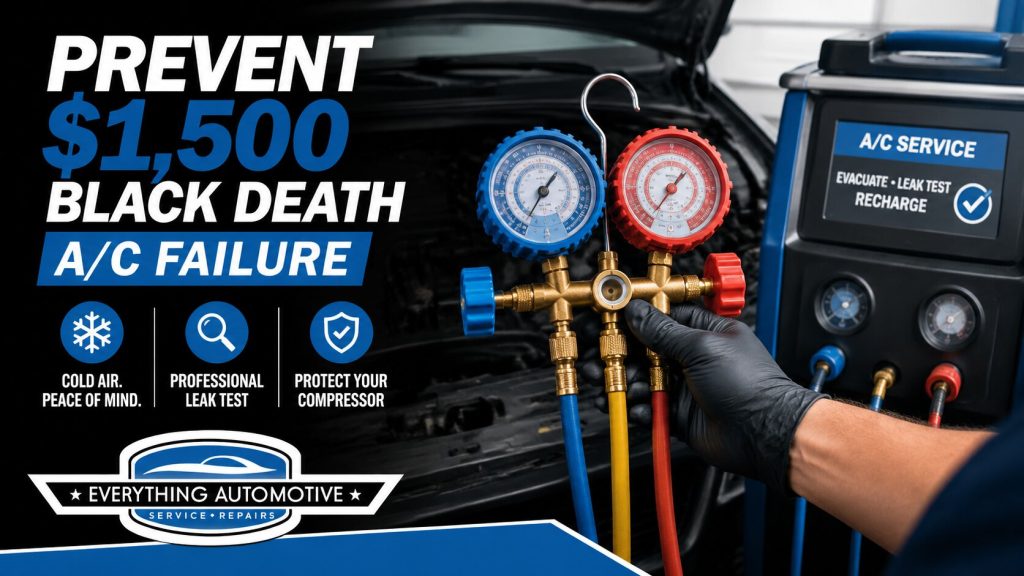
Jacksonville’s eight-to-nine-month air conditioning season puts up to three times the wear on local climate control systems compared to northern vehicles. Daily stop-and-go commuting along Southside Boulevard, Beach Boulevard, and JTB forces engines to idle with zero natural, convective airflow. Without moving air to cool the front-mounted condenser, under-hood temperatures near Tinseltown can soar past 130°F , driving up system pressures and mechanical strain.
This intense heat is compounded by high coastal humidity and salt air. As salty moisture settles onto the condenser’s thin aluminum fins, it triggers rapid galvanic corrosion. Over time, this chemical decay eats microscopic pinholes through the metal, causing slow, progressive refrigerant leaks that silently drain your system’s charge.
The Chemistry of AC Black Death and the Death of PAG Oil
To understand how A/C “Black Death” develops when vital lubricating oil fails, it helps to look at the process as a chain reaction of mechanical and chemical events:
- Refrigerant Acts as the Lubricant Carrier: Your vehicle’s air conditioning system utilizes refrigerant not just to cool the air, but to continuously carry synthetic Polyalkylene Glycol (PAG) oil. This specialized oil is designed to dissolve directly into the refrigerant so it can circulate through the compressor’s internal pistons, bearings, and seals.
- Loss of Charge Starves the Compressor: If refrigerant leaks out through a corroded condenser or dry seal, the flow rate and pressure within the system drop. Because the oil relies on the refrigerant to travel, it gets left behind and pools in the low areas of the system, leaving the high-speed compressor running bone-dry.
- The Compressor Starts Grinding Itself Apart: Without a protective film of oil, the compressor’s aluminum pistons scrape directly against steel cylinder walls. The extreme friction places a massive mechanical load on your engine, dragging down your fuel efficiency while the system fails to cool your cabin.
- Metal Debris Enters the System: This continuous metal-on-metal grinding produces extreme operational heat and sheds microscopic aluminum shavings directly into your vehicle’s air conditioning lines.
- Moisture Reacts to Create Destructive Acids: As moisture-rich Jacksonville air leaks into the low-pressure side of the empty system, it chemically reacts with the remaining refrigerant and degraded PAG oil. This moisture contamination forms highly corrosive hydrochloric and hydrofluoric acids.
- Black Death Takes Over: These corrosive acids eat away at the internal aluminum components, turning the remaining oil into a thick, tar-like, black carbonized sludge. This abrasive mixture circulates through the entire loop, clogging the microscopic paths of your condenser and expansion valve, ultimately seizing your compressor.
Pinpointing Microscopic Leaks with Ultraviolet Dye Tests
I have been turning wrenches since 1983, and I can tell you that diagnosing an A/C leak is not something you can do with a cheap set of plastic gauges. Generic shops will often hook up a manifold, add a quick, temporary squirt of refrigerant, and send you out the door without finding the root cause. That is a disservice to your wallet because that fresh refrigerant will simply leak right back out, dragging more precious PAG oil with it.
- Vacuum Evacuation: We connect your vehicle to our dedicated climate service station to recover any remaining refrigerant. We then draw a deep mechanical vacuum on the system, pulling down past 29 inches of mercury (Hg). This intense vacuum lowers the boiling point of water inside the closed loop, boiling off any destructive suspended atmospheric moisture so it can be vacuumed safely out of the system.
- Finding the Exact Leak: Once the system is verified to hold a vacuum, we inject a precise dose of highly reflective, solvent-free ultraviolet (UV) dye along with the exact OEM-specified weight of fresh PAG oil. We run the system and trace every line, joint, and connection with an ultraviolet light source. The leak reveals itself as a brilliant, glowing neon green residue under the UV light, showing us exactly where a seal or hose has failed.
- Electronic Sniffer Analysis: For hidden components—such as the evaporator core buried deep behind your dashboard—we insert a highly sensitive electronic leak detector probe into the climate control drain tube. This detects halogenated gas molecules down to a fraction of an ounce per year, ensuring we catch microscopic leaks before they destroy your compressor.
The Right Way versus the Cheap Can Quick Fix
Many well-meaning drivers try to save a buck by buying over-the-counter recharge cans from retail auto parts stores. This is a dangerous gamble. These consumer cans often contain generic universal oils, stop-leak chemical additives, or non-approved refrigerant blends.
Manufacturers like Sanden explicitly warn that adding non-approved chemicals will instantly void your compressor’s warranty and destroy its internal seals. Stop-leak additives work by chemically reacting with air and moisture to form a hard, solid plug. When injected into your A/C loop, these sealants immediately harden inside the tiny passages of your expansion valve or dryer, causing immediate blockages and total oil starvation.
Furthermore, if your system is contaminated with sludge, simply swapping out the compressor is completely useless. The abrasive carbonized sludge remaining in your lines will wash straight into the new unit, destroying its pistons within hours.
You must also understand the difference in component materials:
- Serpentine Condensers (Cleanable): Older, single-tube serpentine condensers have wide, continuous passages. If contamination occurs, these can sometimes be safely flushed out using professional chemical solvents.
- Parallel Flow Condensers (Non-Serviceable): Modern aluminum condensers feature incredibly narrow, parallel micro-tubes to maximize heat transfer in small spaces. These tiny channels permanently trap metal debris and carbonized sludge. Flushing solvent will simply follow the path of least resistance through the unclogged channels, leaving the blocked tubes dirty.
Proactive AC Maintenance Strategies for Southside Commuters
Investing in an annual early spring A/C inspection at our Southside shop is a highly cost-effective decision. A standard leak test and professional refrigerant evacuation and recharge cost a fraction of the price of a full system rebuild.
If you ignore a weak, blowing-warm A/C system until the compressor suffers a catastrophic lockup, your repair bill will skyrocket. You will be forced to pay for a new compressor, a new parallel flow condenser, a new expansion valve, a new receiver-drier, and hours of intensive labor to flush out the remaining lines. In total, this catastrophic failure will easily cost you over $1,500 in system replacement parts and specialized service labor.
By catching a slow leak early and performing a professional dye test, we can replace a simple $10 rubber O-ring, pull out moisture, and recharge your system with pure, virgin refrigerant. This restores essential oil circulation and keeps your compressor running cool, quiet, and efficient through the brutal summer months.
Do not let a slow refrigerant leak turn into a costly, system-wide mechanical failure. Bring your vehicle to Everything Automotive for a professional diagnostic check to restore reliable, ice-cold comfort today.
- Visit us at our Eastside location— (7624 Beach Blvd, Jacksonville, FL 32216 | 904-800-2714)
- Our Westside location— (6211 Blanding Blvd, Jacksonville, FL 32244 | 904-510-7299)
Frequently Asked Questions
Will a low refrigerant charge cause my AC compressor to seize?
Yes. Refrigerant serves as the primary transport carrier for your compressor’s PAG lubricating oil, meaning a low charge drops the circulation velocity, starves the internal pistons of lubrication, and causes the compressor to lock up.
Can a contaminated parallel flow condenser be flushed clean?
No. Modern parallel flow condensers feature extremely narrow micro-passages that permanently trap metallic debris and carbonized sludge, meaning any attempt to flush them will only bypass the clogs and ruin your new compressor.
Is it safe to use retail A/C recharge cans with stop-leak additives?
No. Canned stop-leak additives chemically react with airborne moisture inside your system to form hard, solid blockages that clog your expansion valve and destroy the critical lubrication film on your compressor’s pistons.
