
Modern vehicles operating in Jacksonville’s intense heat frequently experience erratic idling and overheating due to outdated engine control software. Updating your Engine Control Module calibration stabilizes fuel trims and optimizes radiator cooling fan speeds, resolving mysterious check engine lights and preventing catastrophic engine failures without unnecessary and expensive component replacements.
Long Idles in the Duval County Heat Expose Outdated Computer Calibration
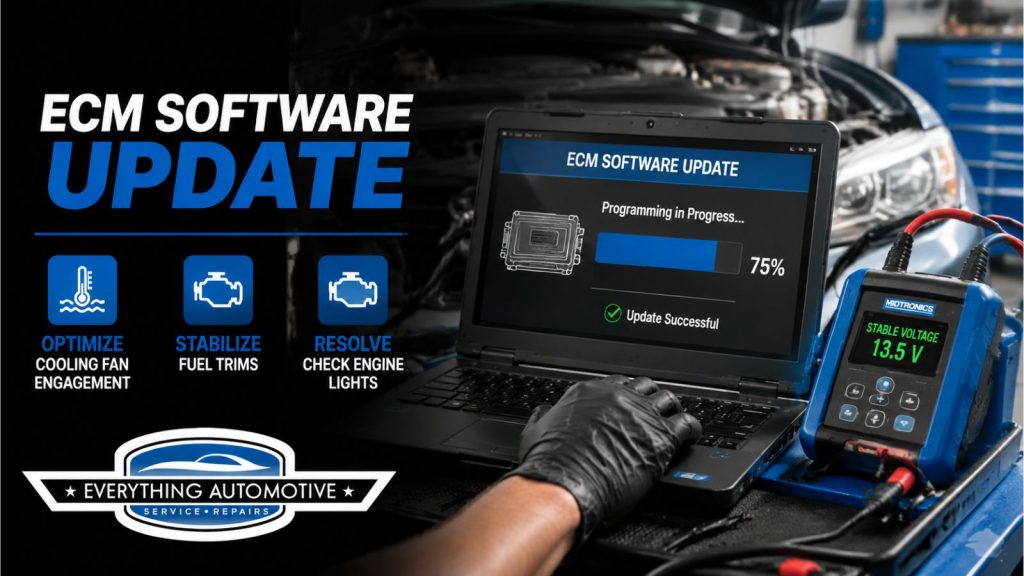
Jacksonville summers regularly push temperatures into the mid-90s, driving the heat index past 100 degrees. Commuters trapped in gridlock on the Fuller Warren Bridge on I-95 or at the Beach and Southside Boulevard cloverleaf face extreme under-hood thermal stress. Without convective airflow from forward movement, your vehicle relies entirely on its electric cooling fan to reject heat. Sitting in traffic with the A/C blasting forces engine temperatures to soar, accelerating motor oil degradation.
A heavy engine shudder, fluctuating idle, or sweet smell of hot coolant often indicates your factory software is struggling under this real-world stress. Outdated programming parameters frequently delay high-speed cooling fan engagement, allowing localized hot spots to form in the cylinder head before the system attempts to compensate.
The Technical Physics of Fuel Trims and Delayed Fan Engagement
Inside your Engine Control Module (ECM), complex software lookup tables constantly calculate the precise amount of fuel and cooling required based on real-time sensor data. Under normal conditions, the ECM reads feedback from the oxygen sensors to maintain a perfect air-fuel ratio.
If the computer detects too much oxygen in the exhaust, it commands a positive fuel trim correction to keep the engine from running too lean.
- Fuel Trim Drift: When your vehicle operates on outdated factory calibration files, the software can misinterpret normal sensor voltage changes. This causes the long-term fuel trim to drift past positive 15 percent, triggering a misleading check engine light and causing the engine to stumble or hesitate when you accelerate.
- Delayed Cooling Fan Commands: Outdated ECM software often fails to command high-speed radiator fan operation when under-hood temperatures spike. The computer waits too long to activate the fan, causing the engine to run dangerously hot. This delayed command triggers diagnostic trouble codes such as P0480 (Fan 1 Control Circuit) or P0116 (Engine Coolant Temperature Circuit Range/Performance), warning you of a potential cooling system failure.
| System State | Primary Failure Mechanism | Visual or Sensory Symptom | Correct Technician Action |
| Early-Stage Software Glitch | Outdated calibration files misinterpreting sensor signals | Check engine light illuminated with erratic idling | Update module with J2534 pass-through programming |
| Late-Stage Hardware Damage | Thermal cycling cracking circuit board solder joints | Complete cooling fan failure or random engine stalling | Install a VIN-matched replacement module and reprogram |
Bricking the Box versus the Precision of J2534 Pass-Thru Reprogramming
Reprogramming a vehicle’s computer is like digital surgery. To make this complex process safe and reliable for our customers, we follow a strict, high-tech protocol:
- Direct Factory Calibration Updates: We connect directly to official manufacturer databases using dedicated SAE J2534 pass-through programming tools. This ensures your vehicle receives the exact, updated software calibrations released by the factory to fix driveability or emissions issues.
- Immense Electrical Power Demand: During an update, your car’s ignition is on, automatically running high-draw systems like electric cooling fans, fuel pumps, and blower motors.
- The Serious Risk of Bricking: If battery voltage falls below 12.5 volts during the data transfer, the flash will fail. This permanently corrupts (or “bricks”) the computer, making the expensive module completely useless.
- Locking in Stable Voltage: We never program a car on battery power alone. We connect a specialized Midtronics battery maintainer or a DCA-8000 diagnostic power supply to lock the vehicle’s electrical system at a rock-solid 13.5 volts, protecting your vehicle’s sensitive electronics throughout the entire process.
The Right Software Reflash versus the Parts Cannon Approach
I have been turning wrenches since 1983, and I have watched countless shops make the mistake of guessing at complex electronic issues. When a vehicle arrives with a P0480 cooling fan code or a lean fuel trim fault, generic repair facilities immediately fire the “parts cannon.” They start throwing expensive new parts at your car—such as brand-new radiator fan assemblies, cooling fan relays, and oxygen sensors—without ever checking the underlying software.
When those new parts fail to solve the issue because the real culprit is a software glitch, the customer is left with a massive, unnecessary bill. At Everything Automotive, we prioritize root-cause diagnostics over unverified part replacement. In many cases, a factory Technical Service Bulletin (TSB) confirms that the physical hardware is working perfectly—the ECM simply requires an updated software calibration to alter its sensor voltage thresholds and run more efficiently in our hot climate.
Furthermore, we must distinguish between early-stage software glitches and late-stage physical hardware failure:
- Early-Stage Software Glitches: These are digital errors where the physical computer is healthy, but its internal lookup tables contain outdated or corrupted data. These issues are completely resolved by flashing the module with the latest manufacturer updates.
- Late-Stage Hardware Failure: This occurs when years of extreme engine heat and vibration physically damage the computer. Solder joints crack on the internal circuit board, or the analog-to-digital converter burns out, resulting in a total loss of signal that requires a full, VIN-matched module replacement and programming.
- Our Guarantee: Whether we are performing a simple software reflash or installing a brand-new programmed module, our work is backed by our signature 36-month / 36,000-mile nationwide warranty on parts and labor.
Preventive Diagnostic Strategies for Jacksonville Drivers
Proactively updating your vehicle’s software is one of the most effective ways to maintain long-term reliability and fuel efficiency in Florida’s harsh environment. For example, when you are accelerating up the Belfort Road ramp to JTB, a sluggish “flat spot” or hesitation in your throttle response is often caused by outdated transmission or engine torque management software. A quick calibration update can instantly restore smooth throttle transition and protect your drivetrain.
Regularly scheduling an ECM software inspection during your major service intervals ensures your vehicle always operates with the latest diagnostic thresholds. This prevents false check engine lights, keeps your catalytic converters from overheating, and ensures your radiator fans engage at the exact moment they are needed to keep your engine safe.
Do not let outdated software cause mysterious engine issues or costly diagnostic headaches. Bring your vehicle to Everything Automotive for a professional diagnostic check to ensure your vehicle is running on the latest factory programming today.
- Visit us at our Eastside location: 7624 Beach Blvd, Jacksonville, FL 32216 | 904-800-2714
- Our Westside location: 6211 Blanding Blvd, Jacksonville, FL 32244 | 904-813-7097
Frequently Asked Questions
Do independent shops have the ability to program vehicle computers?
Yes. Under the SAE J2534 standard, independent repair facilities have legal access to factory software databases, allowing certified technicians to perform identical module reflashing to a new car dealership.
Can outdated engine software cause a car to overheat?
Yes. Outdated software calibration files can misinterpret coolant temperature sensor voltages, delaying high-speed radiator fan engagement and causing localized thermal hot spots that damage head gaskets.
Will a software update clear a persistent check engine light?
Yes. If the stored diagnostic trouble code is caused by a known software calibration error or an overly sensitive sensor threshold, flashing the engine control module with the latest manufacturer update is the only permanent solution.
