
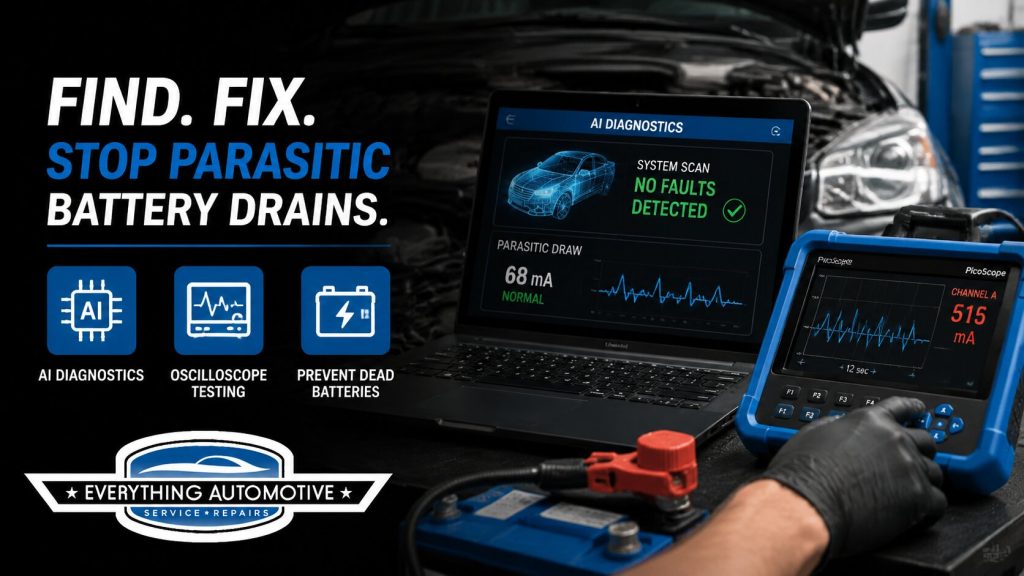
Modern vehicle electronics in Jacksonville’s high humidity frequently suffer from silent parasitic battery drains. Everything Automotive utilizes advanced AI diagnostic platforms and high-frequency oscilloscopes to map CAN bus communication and isolate these hidden electrical leaks, resolving complex starting issues before they leave local drivers stranded along flood-prone San Marco streets.
Jacksonville Humidity And San Marco Flooding Trigger Parasitic Draws
Parking your SUV overnight near low-lying, flood-prone San Marco corridors—such as LaSalle Street, Hendricks Avenue, or Landon Avenue—exposes the undercarriage to high relative humidity and brackish water from the St. Johns River. This damp, salty environment triggers galvanic corrosion on electrical connectors and fuse block terminals. Over time, this corrosion creates high-resistance electrical paths, allowing microcurrents to leak even when the ignition is off. This continuous power leak creates a parasitic draw, keeping onboard ECUs awake and scrambling high-speed CAN bus communications.
The Technical Science Of The Ghost Drain And The Fuse Volt Drop Method
To understand the science behind a “ghost” drain and how our technicians hunt it down, it helps to look at your SUV’s electrical network in a few simple stages:
- The Rolling Computer Network: A modern SUV is essentially a rolling computer network containing up to 80 independent Electronic Control Units (ECUs). When you park your car and turn off the ignition, these computers must transition into a low-power mode.
- Quiescent Current Limits: The quiescent standby draw after the vehicle goes to sleep should be under 50 milliamps (mA), with typical systems operating around 20 to 30 mA.
- The Parasitic Drain: If a module (like the Body Control Module) fails to sleep, or an internal relay remains stuck closed, the system continuously draws 100 to 500 mA, draining a healthy battery to a no-start state in hours.
- The Flaw of Pulling Fuses: Historically, shops pulled fuses one by one to find drains. On modern cars, pulling a fuse breaks contact and instantly wakes the entire computer network. This resets all sleep timers, forcing the technician to wait another 20 to 60 minutes for the network to return to sleep.
- The Fuse Voltage Drop Method: Instead of pulling fuses, we use the Fuse Voltage Drop Test. This non-intrusive method relies on the physics of electrical flow: any circuit with current running through it exhibits a microscopic voltage drop across its fuse.
- Zero Network Disruption: Using a high-resolution multimeter set to millivolts, we probe the tiny exposed test pins on top of each fuse. By measuring a drop down to tenths of a millivolt, we calculate the exact current draw without waking up the vehicle’s network. For example, a tiny reading of just 0.5 millivolts on a 10-amp fuse tells us that a silent 68-milliamp drain is actively bleeding your battery.
The Power Of AI Diagnostics In Solving Complex CAN Network Failures
Chasing down intermittent electrical leaks used to require hours of manual research through complex factory wiring diagrams. At Everything Automotive, we have modernized this process by integrating DiagTech.AI as our primary diagnostic thinking partner.
When your vehicle enters our shop, our certified technicians scan your unique 17-character Vehicle Identification Number (VIN). The AI diagnostic assistant immediately decodes the exact year, make, model, and engine configuration. We then input the specific customer complaint—such as a battery that goes flat after sitting parked near Hendricks Avenue.
In seconds, the AI diagnostic platform cross-references your vehicle’s specific symptoms against millions of real-world repair logs, Technical Service Bulletins (TSBs), and OEM-sourced database networks. It maps out the exact communication structure of the CAN bus.
Instead of forcing a technician to manually trace dozens of wires, the AI evaluates the relationship between your fault codes and sensor readings, providing us with a probability-ranked test plan to isolate the failing circuit.
Using AI-assisted diagnostics, we reduce manual tracing by 30–60 minutes per vehicle while generating a precise test plan to identify the failing circuit.
Capturing Intermittent Electrical Glitches With A PicoScope Oscilloscope
While a digital multimeter is excellent for steady electrical draws, many parasitic leaks are highly intermittent. A module might sleep normally for ten minutes, suddenly wake up and draw power for ten seconds, and then fall back asleep. A standard multimeter only shows a slow average, completely missing these rapid current spikes.
To capture these elusive glitches, we connect a multi-channel PicoScope digital oscilloscope to your vehicle’s electrical lines. We run a specialized low-current amp clamp around a fused jump cable connected to the main battery ground, ensuring the clamp jaws can close completely for maximum accuracy.
The PicoScope acts as a high-speed camera, recording up to millions of electrical voltage and current samples per second and plotting them on a real-time visual graph on our laptop.
This high-speed tracking leads directly to our diagnostic verdict—the moment of clarity. As we monitor the live waveform graph on our scope screen, we observe a series of irregular, high-frequency voltage spikes.
Exactly every 12 seconds, the current draw spikes to 515 milliamps. This rhythmic current signature is the visual proof we need. It reveals a Body Control Module that is constantly being woken up by a short-circuited heated seat relay, draining your battery while you park.
Comparing A Structured Diagnostic Sequence To Cheap Blind Parts Replacement
I have been turning wrenches since 1983, and I have seen too many shops treat complex electrical diagnostics like a guessing game. When an SUV fails to start, generic quick-lube or big-box facilities immediately fire the “parts cannon”. They install a brand-new battery or replace the alternator, charging the customer hundreds of dollars without ever checking for an underlying parasitic draw.
Within days, the new battery drained flat because the real issue was never resolved. At Everything Automotive, we prioritize structured diagnostics over random parts replacement.
When we inspect your electrical system, we carefully evaluate the quality of the materials and the exact stage of the component failure.
| Diagnostic Category | Component Quality Differences | Symptoms and Progression | Technician Solution |
| Material Quality | Pure zinc alloy fuses vs cheap generic aluminum | Aluminum corrodes in salt air, causing high resistance | Replace with high-quality zinc fuses to stabilize voltage |
| Early Stage Failure | Module software glitch or a single stuck relay | Parasitic draw drains battery overnight; engine cranks slowly | Perform precise circuit volt drop test and update module software |
| Late Stage Failure | Severely degraded lead-acid battery plates | Repeated deep discharges cause battery sulfation; failed alternator | Replace damaged battery and install a new alternator assembly |
If a module is caught in an early-stage failure, the physical battery and alternator are usually completely healthy. The issue can be resolved with a targeted circuit repair or a module software re-flash.
If left unaddressed, the vehicle progresses to late-stage failure. Repeated deep discharges cause lead-sulfate crystals to harden on the battery plates, permanently destroying its capacity and forcing your alternator to run at maximum load in intense under-hood heat until its internal diodes fail.
Early detection allows us to repair minor circuits or modules before they damage the battery or alternator. Whether we are tracing a minor short circuit or replacing a complex control module, all our electrical work is backed by our industry-leading 36-month / 36,000-mile nationwide warranty on parts and labor.
Visit us at our Eastside location: 7624 Beach Blvd, Jacksonville, FL 32216 | 904-800-2714
Our Westside location: 6211 Blanding Blvd, Jacksonville, FL 32244 | 904-813-7097
Frequently Asked Questions
Can A Cheap, Low-Quality Fuse Cause My Battery To Drain?
Yes. Cheap aluminum blade fuses are highly susceptible to galvanic corrosion in Jacksonville’s high humidity, which introduces high electrical resistance and voltage drops that can repeatedly wake up sensitive modules and cause a parasitic drain.
Is The Normal Parasitic Draw On A Modern Vehicle Actually Zero?
No. Modern vehicles continuously draw a small amount of quiescent current—typically between 20 and 30 milliamps—to support essential keep-alive memory systems, such as your radio presets, clock settings, and keyless entry receivers.
Can An AI Diagnostic Assistant Replace A Master Technician’s Tests?
No. While advanced AI systems like DiagTech.AI dramatically speed up troubleshooting by identifying likely root causes from millions of repair logs in seconds, they act as a decision-support layer and still require a technician to physically verify ground integrity and circuit voltage.
Visit us at our Eastside location: 7624 Beach Blvd, Jacksonville, FL 32216 | 904-800-2714
Our Westside location: 6211 Blanding Blvd, Jacksonville, FL 32244 | 904-813-7097
