
Stop-and-go idling on Interstate 295 and Blanding Boulevard degrades automatic transmission fluid through extreme heat. A complete fluid flush replaces virtually all degraded fluid and sludge, protecting sensitive valve-body solenoids. This professional machine service outperforms a basic top-off, preventing premature wear and avoiding expensive transmission replacement.
High Heat And Heavy Gridlock On The Buckman Bridge Cook Your Transmission Fluid
Duval County traffic raises ATF temperatures above 220°F during peak congestion. The Interstate 295 West Beltway is one of the most heavily congested corridors in the region. Commuters crossing the Buckman Bridge during peak afternoon hours face massive traffic bottlenecks that slow traffic to a crawl. Stop-and-go traffic at 95°F heats ATF rapidly, exceeding normal operating limits.
When you sit stationary in traffic with the air conditioning running at maximum capacity, there is zero natural, convective airflow passing under the chassis to cool the transmission pan.
Worse, keeping your foot pressed on the brake pedal while the transmission remains in the Drive position forces the torque converter to continuously churn the automatic transmission fluid (ATF). This fluid churning generates massive internal friction and heat, rapidly driving fluid temperatures past safe operating limits.
The Technical Science of Oxidized Fluid and Valve Body Sludge
Automatic transmission fluid plays several critical physical and chemical roles, but it is highly vulnerable to extreme heat. Under the thermal load of local stop-and-go gridlock, your fluid undergoes a rapid, destructive transformation:
- ATF Plays Multiple Vital Roles: Automatic transmission fluid (ATF) acts as a hydraulic medium to execute gear changes, a lubricant for moving parts, and a coolant to manage system heat.
- Extreme Heat Triggers Chemical Breakdown: When exposed to the high temperatures of bumper-to-bumper traffic, the organic molecules in the ATF degrade through a chemical reaction called oxidative polymerization.
- Oxidation Rates Double Rapidly: This chemical breakdown is highly sensitive to temperature, with the rate of fluid oxidation approximately doubling for every 18°F (10°C) increase above normal limits.
- Loss of Viscosity and Protection: As the fluid breaks down, it loses its viscosity (thickness) and shear stability, leaving gears and clutches without an adequate protective lubrication film.
- Sludge Forms and Blocks Passages: The oxidized fluid polymerizes into a thick, sticky varnish and carbonaceous sludge.
- Solenoids Stick and Clutches Slip: This abrasive sludge clogs the tiny passages inside your transmission’s valve body and causes sensitive electronic shift solenoids to stick, leading to severe pressure drops and clutch slippage.
| ATF Temperature | Chemical and Mechanical Condition | Fluid Lifespan and Operational Impact |
| 175F to 195F | Normal operating temperature | Up to 100,000 miles of service, stable viscosity |
| 220F | Elevated thermal stress | Lifespan cut to 25,000 miles, early fluid oxidation |
| 235F | Additives begin to boil | Varnish starts to form on internal components |
| 255F to 260F | Rubber seals harden | Internal and external fluid leaks, slipping |
| 295F | Severe fluid breakdown | Clutch plates burn out and slip badly |
| 315F | Catastrophic failure | Seals and clutches are completely fried |
As the fluid thins under extreme heat, it loses its hydraulic properties, leading to delayed gear engagement and harsh, jerky shifting. The oxidized fluid polymerizes into a thick, sticky varnish and carbonaceous sludge.
This debris circulates through the system and settles inside the microscopic channels of the valve body—the hydraulic brain of the transmission.
This sludge clogs the highly sensitive electronic shift solenoids, causing them to stick. Stuck solenoids prevent the transmission from maintaining correct line pressure, which causes the clutches to slip, generating even more heat and initiating a rapid path toward total transmission failure.
The Limitations Of A Standard Transmission Fluid Top Off
Many generic auto repair shops recommend a basic drain and fill or top off service. During a standard pan drop, the technician simply drains the fluid from the bottom of the transmission pan, replaces the filter, and tops up the level. While this sounds simple, it is a highly incomplete service.
A standard drain and fill only replaces about 30 to 50 percent of the total transmission fluid. The remaining 50 to 70 percent of the dirty, oxidized fluid remains trapped inside the torque converter, the valve body, and the external cooling lines.
Mixing new fluid with 50–70% oxidized fluid rapidly reduces lubrication and friction control. The severe contaminants and depleted additives in the old fluid quickly overwhelm the new fluid, degrading its lubricating and friction properties almost instantly.
Additionally, a basic top off does not flush out the heavy varnish and carbonaceous sludge that has already settled inside your delicate shift solenoids and valve body passages.
Precision Fluid Exchange Technology Replaces Virtually All Contaminated Fluid
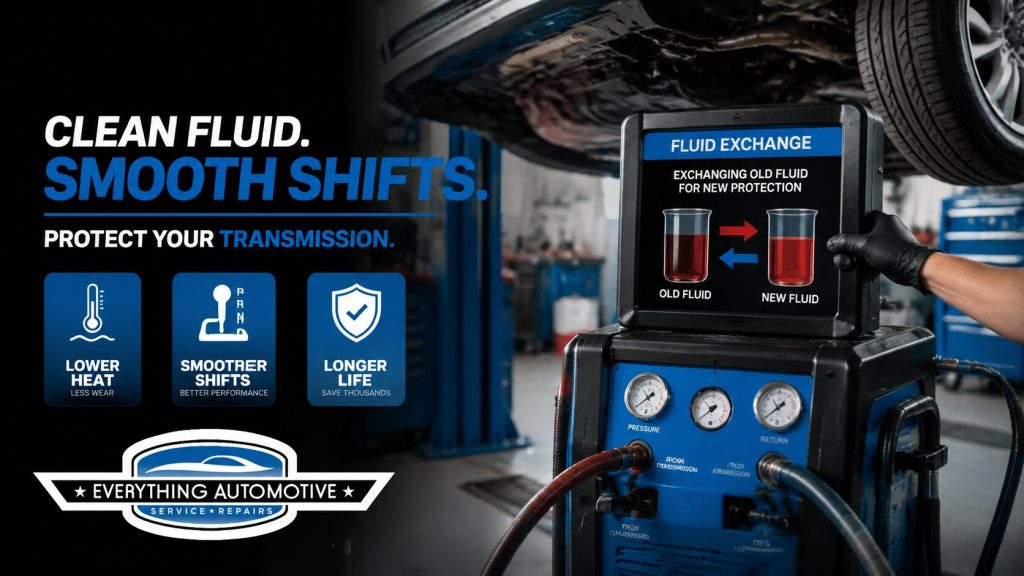
I have been turning wrenches since 1983, and I can tell you that the only way to properly protect modern transmissions from heat-induced sludge is with a complete fluid exchange. At Everything Automotive, we utilize professional-grade fluid exchange machinery to perform this service.
Our fluid exchangers use the vehicle’s pump to push out old fluid while simultaneously injecting fresh ATF. It utilizes your transmission’s own internal oil pump to naturally push out the old, dirty fluid while simultaneously injecting fresh, high-quality synthetic fluid in equal volumes.
The machine replaces over 90% of ATF and purges the torque converter without overpressurizing seals.
- Near Total Replacement: The machine achieves a fluid exchange rate of over 90 percent in under 20 minutes.
- Torque Converter Purge: It completely extracts the degraded fluid trapped deep inside the torque converter, which a standard pan drop can never reach.
- System-Wide Flush: The continuous fluid exchange washes away accumulated carbon sludge, metallic wear particles, and varnish from the cooler lines, the external radiator cooler, and the intricate passages of the valve body.
Proactive Fleet And Commuter Transmission Maintenance In Duval County
For standard step-gear automatic transmissions, we recommend a complete fluid exchange every 30,000 to 60,000 miles. If your vehicle is used for severe-duty driving—such as daily rush-hour idling on I-295 or commercial fleet towing—this interval should be shortened to 15,000 to 30,000 miles.
However, we must emphasize that different transmission types require highly specific service methods:
- Step-Gear Automatics: These conventional transmissions benefit immensely from a high-efficiency machine fluid exchange to clean out internal clutches and valve bodies.
- Nissan CVTs: Continuously Variable Transmissions (such as those requiring Nissan NS-3 fluid) are highly sensitive to fluid levels and flow pressures. For these vehicles, we favor a series of gentle, manual drain-and-fill services rather than high-flow machine flushes to protect their delicate internal seals and solenoids.
- Limits of a Flush: If your transmission is already experiencing severe mechanical slipping, delayed shifting, or grinding noises, a flush will not fix the problem. These symptoms point to physical clutch wear or internal damage.
- Remanufactured Solutions: When physical wear is too severe for maintenance, we offer professional, high-quality Jasper remanufactured transmission replacements.
Do not let extreme summer heat and heavy stop-and-go traffic ruin your transmission. Bring your vehicle to Everything Automotive for a professional diagnostic check to restore smooth, dependable performance today.
- Visit us at our Eastside location (7624 Beach Blvd, Jacksonville, FL 32216 | 904-800-2714)
- Our Westside location (6211 Blanding Blvd, Jacksonville, FL 32244 | 904-813-7097)
Frequently Asked Questions
Will A Transmission Flush Fix A Slipping Transmission?
No. A transmission flush is a preventative maintenance service rather than a corrective fix; if your transmission is already slipping due to worn clutches or physical gear damage, a fluid change cannot restore the lost friction material.
Is A Full Fluid Exchange Safe For All Types Of Transmissions?
No. While standard step-gear automatic gearboxes benefit greatly from machine flushes, delicate Continuously Variable Transmissions—especially Nissan CVTs requiring NS-3 fluid—are best maintained with manual drain-and-fill services to avoid over-pressurizing internal seals.
Does Extreme Heat Shorten The Lifespan Of Automatic Transmission Fluid?
Yes. High operating temperatures accelerate the chemical process of fluid oxidation, with every 20°F increase in fluid temperature above the normal 175°F threshold cutting the fluid’s service life in half.
