
Sustained June heat and stop-and-go driving along San Marco streets trigger electric inverter coolant pump failures in Lexus and Toyota hybrids. When these secondary cooling loops fail, the high-voltage system quickly overheats, setting code P0A93. Proactive flow testing and careful system bleeding protect expensive hybrid drive modules.
The Unseen Secondary Cooling Loops of Modern Hybrid Drivetrains
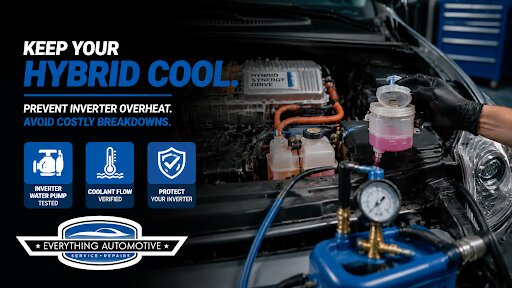
Lexus and Toyota hybrid vehicles—including the Prius, Camry Hybrid, and Lexus RX series—utilize a completely independent, secondary cooling loop to manage high-voltage heat. This secondary system operates completely separate from the internal combustion engine (ICE) cooling system. While the combustion engine uses a traditional belt-driven water pump, the hybrid transaxle relies on a dedicated, electric auxiliary inverter water pump, a separate radiator section, and its own distinct coolant reservoir.
The auxiliary loop independently cools the inverter, converting DC to AC for the motors while managing thermal load from regenerative braking. The inverter acts as the power converter of the drivetrain, translating high-voltage direct current (DC) from the traction battery pack into three-phase alternating current (AC) to drive the electric motors.
During deceleration, the process reverses: the inverter captures AC power from your regenerative braking system and converts it back into DC to charge your battery. This continuous electrical conversion generates immense thermal energy, making consistent coolant flow a critical safety requirement.
The Thermal Physics of High-Voltage June Commutes in San Marco
Driving a hybrid vehicle on the First Coast puts high stress on these electrical cooling loops, especially during our intense summer months. June in Northeast Florida routinely brings temperatures in the mid-90s, with heavy humidity pushing the local heat index past 100 degrees.
For hybrid owners navigating the low-lying, historic streets of San Marco—such as Hendricks Avenue and San Marco Boulevard—the stop-and-go driving patterns dramatically increase heat generation. Every single transition between electric acceleration and regenerative braking forces the inverter to process massive spikes of electrical current.
This electrical stress is severely worsened during afternoon backups exiting the Fuller Warren Bridge on I-95. When you sit stationary in peak 4 p.m. traffic with zero natural, convective airflow passing through your front grille, under-hood temperatures soar. Without moving air to cool the radiator, the small electric inverter pump must run at maximum duty cycle to keep the system cool, accelerating the breakdown of its internal copper windings.
How Inverter Pump Starvation Leads to Emergency Limp Mode
A failing hybrid inverter pump usually provides distinct sensory warning signs before it dies completely.
- Sensory Warning Signs: Sitting parked near the San Marco Square historic fountain of lions, you may hear a faint, rhythmic buzzing, gurgling, or high-pitched whining noise coming from the front driver’s side of your engine compartment. This is the sound of the pump’s internal bearings failing or the motor struggling against trapped air.
- The Transition to Failure: If the electric pump’s internal motor coil wire breaks due to thermal fatigue, coolant circulation stops entirely. Without active coolant flow, the temperature of the inverter’s silicon semiconductors spikes in seconds.
- Emergency Protection: To prevent the multi-thousand-dollar inverter from melting under this extreme heat, the hybrid vehicle control computer immediately illuminates the dashboard “Red Triangle of Death” (Master Warning Light). The system sets Diagnostic Trouble Code (DTC) P0A93, representing “Inverter Cooling System Performance”.
- Limp Mode Activation: To protect itself, the vehicle drops into a low-power “fail-safe” or “limp” mode, heavily limiting acceleration or shutting the high-voltage system down completely, leaving you stranded on the San Marco Boulevard ramp onto I-95.
A Master Diagnostic Guide to Verifying Coolant Flow and Pump Operation
I have been turning wrenches since 1983, and I have seen many general repair shops misdiagnose a P0A93 hybrid code. They lack the specialized training for high-voltage systems and immediately try to sell the customer an entire new inverter assembly—a repair that easily costs thousands of dollars.
- The In-Bay Flow Test: With the vehicle safely parked, we switch the car into “Ready” mode. We locate the small, independent inverter coolant reservoir next to the main hybrid drive unit. We carefully unscrew the reservoir cap and look inside. A healthy pump produces active sloshing, swirling, or wave-like turbulence. If the coolant is completely still, the pump has failed.
- Electrical Circuit Integrity Testing: We disconnect the pump’s connector and use a digital multimeter to verify that the hybrid control computer is actually delivering a solid 12 volts and a clean ground to the pump. This prevents replacing a pump when the real issue is a broken wire or blown fuse.
- Bidirectional Scan Tool Diagnostics: We connect our advanced Autel diagnostic tablets to command the pump to turn on and off manually, checking the current draw and verifying real-time operation.
| Pump Quality Grade | Component Construction | Thermal Tolerance and Lifespan | Wash-Off and Wear Resistance | Warranty and Reliability |
| Genuine OEM (Aisin/Denso) | High-purity copper motor windings and heavy-duty sealed bearings | Engineered to endure intense under-hood heat cycles past 100,000 miles | High; durable housing prevents casing cracks and coolant leaks | 36-month / 36,000-mile nationwide warranty |
| Cheap Aftermarket | Thin, low-grade coil wires and cheap plastic impellers | Prone to thermal fatigue and binding within 10,000 miles | Low; weak brackets and seal failure risks | No long-term nationwide coverage |
Avoiding Pitfalls by Vacuum Bleeding the Loop the Right Way
Once our diagnostics confirm a failed pump (such as OEM part G9040-48060), replacing the unit requires meticulous service procedures. The single most common mistake made by DIYers and generic shops is improper system bleeding.
Because the hybrid inverter cooling loop is extremely long and twists through the transaxle and dedicated radiator, air easily becomes trapped inside the hoses. Running the system with trapped air pockets prevents the coolant from circulating. The pump will loudly “chew” on these air bubbles, leading to localized hot spots and triggering the P0A93 code again within days of the repair.
At Everything Automotive, we do not rely on slow, manual bleeding methods. We utilize a professional vacuum coolant refilling tool (an AirLift-type device) connected directly to the inverter reservoir.
This tool uses shop air to pull a deep vacuum of 29 inches of mercury (Hg) on the entire closed loop, collapsing the soft rubber coolant hoses and pulling every pocket of atmospheric air out of the transaxle and radiator.
We then open the valve to draw fresh, pre-diluted Toyota Super Long Life Coolant directly into the vacuum, ensuring a completely bubble-free, perfectly filled system.
Our business has served Duval County families since 2012 with honest, diagnostic-led auto repair. We use OEM-grade pumps and verify coolant flow after installation to prevent recurring P0A93 faults.
Do not wait for a failed hybrid water pump to ruin your expensive inverter. Bring your Lexus or Toyota hybrid to Everything Automotive for a professional inspection to restore peak cooling efficiency today.
- Visit us at our Eastside location (7624 Beach Blvd, Jacksonville, FL 32216 | 904-800-2714)
- Our Westside location (6211 Blanding Blvd, Jacksonville, FL 32244 | 904-813-7097)
Frequently Asked Questions
Can I drive my hybrid with a failed inverter coolant pump?
No. Operating your vehicle with a failed inverter water pump will quickly cause the hybrid inverter to overheat, forcing the vehicle into a low-power limp mode or shutting down the high-voltage system completely.
Is the hybrid inverter cooling system connected to the main engine radiator?
No. Toyota and Lexus hybrids use an entirely independent secondary cooling loop with its own dedicated electric water pump, radiator section, and plastic coolant reservoir to keep hybrid electronics separate from engine heat.
Will a failed hybrid inverter water pump trigger a check engine light?
Yes. When the hybrid control computer detects a lack of coolant circulation or a thermal spike inside the power module, it will immediately illuminate the check engine light and store diagnostic trouble code P0A93.
