
Jacksonville flash flooding and brackish road spray often flood active wheel speed sensors in vehicles throughout the Arlington neighborhood. This water intrusion directly disrupts the electrical reference voltage supplied by the Anti-lock Braking System (ABS) module, disabling traction control. Professional diagnostics with oscilloscopes pinpoint these faults, preventing expensive and unnecessary brake component replacements.
Jacksonville Humidity and Arlington Flooding Expose Brake Sensors to Extreme Strain
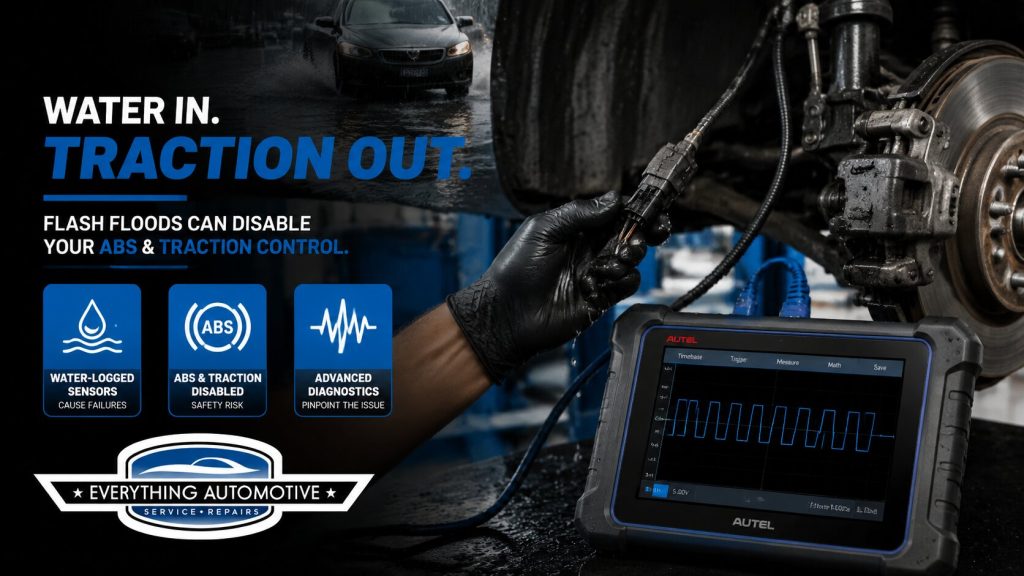
Arlington commuters navigating the Arlington Expressway daily know how fast a heavy summer downpour can transform the road under the Cesery Boulevard underpass into a deep, impassable lake. When your tires splash into that standing water at 45 mph, high-pressure road spray shoots directly into your wheel wells, forcing moisture past the weatherpack silicone seals of your wheel speed sensor connectors.
This road spray is highly corrosive. The St. Johns River is an estuary with high, fluctuating salinity levels ranging from 8.25 ppt to 35.45 ppt in Jacksonville. Flash flooding near tidal tributaries carries highly conductive dissolved chloride ions. When this brackish mixture bridges the electrical contacts inside your sensor harness, it creates a direct electrical short-circuit.
Northeast Florida’s year-round relative humidity exceeds 70 percent, preventing water-logged connectors from drying naturally. Once brackish water enters the plug, the salt remains chemically active 24/7, accelerating galvanic corrosion on the metal terminal pins.
Active Wheel Speed Sensors and Reference Voltage Failures
Modern vehicles rely on active Hall-effect wheel speed sensors to feed real-time rotational data to your braking and traction control systems. It is vital to understand the difference between passive and active sensor designs:
| Sensor Type | Operational Method | Reference Voltage | Output Waveform | Low Speed Performance | Source Citations |
| Passive Sensors | Electromagnetic induction | None required | AC analog sine wave | Poor; signal drops at low speeds | |
| Active Sensors | Hall-effect semiconductor | 5V reference supplied | DC digital square wave | Excellent; accurate down to stationary |
Unlike older passive sensors that generate their own weak AC voltage, active sensors require an external power source to function. The ABS control module supplies these active sensors with a clean, regulated 5-volt reference voltage. As a magnetic encoder ring inside your wheel bearing rotates past the sensor, it creates a digital DC square-wave signal.
When brackish water penetrates the connector, the reference voltage short-circuits.
Lost Speed Pulses Disable Traction Control and Increase Stopping Distances
Because your ABS, traction control, and electronic stability control (ESC) networks all rely on the same speed signals, losing a single wheel’s speed data triggers an immediate fail-safe shutdown. Your dashboard lights up with “Service Traction” and “ABS” warnings, and your vehicle reverts to standard hydraulic braking.
Reverting to standard braking is a serious safety hazard. If you have to apply firm braking while crossing the wet steel-grid grating of the Mathews Bridge without ABS, your tires will lock up and slide, significantly increasing your stopping distance and risking a catastrophic loss of steering control.
Isolating Intermittent Sensor Faults with Advanced Oscilloscopes
I have been turning wrenches since 1983, and I have seen too many general shops try to diagnose intermittent ABS faults by reading codes and guessing. If you have a stored C0035 (left front) or C0040 (right front) wheel speed sensor code, simply clearing the code will not fix the issue.
At Everything Automotive, we prioritize systematic diagnostics over part replacement.
- Live Data PID Monitoring: We connect our diagnostic tablets to monitor all four wheel speed signals in real time while driving. A failing sensor circuit will show a flat-line zero or erratic, jumping speeds compared to the other healthy wheels.
- Back-Probing and Voltage Testing: With the vehicle on our lift, we back-probe the harness connector to measure the incoming reference voltage, ensuring the ABS module is actually delivering the correct voltage to the sensor.
- Oscilloscope Waveform Analysis: If the fault is intermittent, we connect a multi-channel digital oscilloscope. The scope captures the raw square-wave signals as we spin the wheel and wiggle the wiring harness, allowing us to find the exact millisecond the signal drops out.
Structured Wiring Repairs Over the Guesswork of the Parts Cannon
Many big-box facilities or dealerships will immediately tell you that you need to replace the entire wheel hub assembly or the ABS module because it is easier and more profitable for them. At Everything Automotive, we focus on honest diagnostics and transparent repairs. We carefully evaluate the exact stage of your component failure to recommend the most cost-effective fix:
- Early-Stage Moisture Intrusion: If we catch the issue early, we can simply blow out the damp connector, clean the copper contacts with electrical cleaner, treat the plug with dielectric grease to repel future moisture, and secure the weatherpack boot.
- Late-Stage Pin Corrosion: If brackish water has sat in the connector for weeks, it will eat away the delicate copper-alloy pins. Instead of replacing the entire sensor harness, we cut out the damaged connector and perform a high-quality repinning repair using heat-shrink sleeves to keep out the elements.
- Module Regulator Replacement: If repeated short-circuits have damaged the internal voltage regulator of your ABS control module, we will replace the module with a VIN-matched unit and program it to your vehicle’s CAN bus network.
Do not let a Service Traction warning light or water-logged brake sensor compromise your safety during heavy rains. Bring your vehicle to Everything Automotive for a professional diagnostic check to restore peak safety and performance today.
- Visit us at our Eastside location (7624 Beach Blvd, Jacksonville, FL 32216 | 904-800-2714)
- Our Westside location (6211 Blanding Blvd, Jacksonville, FL 32244 | 904-813-7097)
Frequently Asked Questions
Can driving through a deep puddle immediately disable my traction control?
Yes. Water entering a compromised wheel speed sensor connector instantly short-circuits the reference voltage supplied by the ABS module, disabling your traction and stability control systems.
Will an ABS sensor fail if my wheel bearing is worn out?
Yes. Since modern active sensors are often integrated into the hub assembly, excessive bearing play or vibration can damage the internal magnetic encoder ring, causing the sensor to misread wheel speed.
Can I safely clean a water-logged sensor connector myself?
No. Saltwater intrusion creates a chemical reaction that eats your wiring from the inside out. Since the copper pins degrade so quickly, you must hire a technician to repin the connector. This keeps your power flow stable and reliable.
