
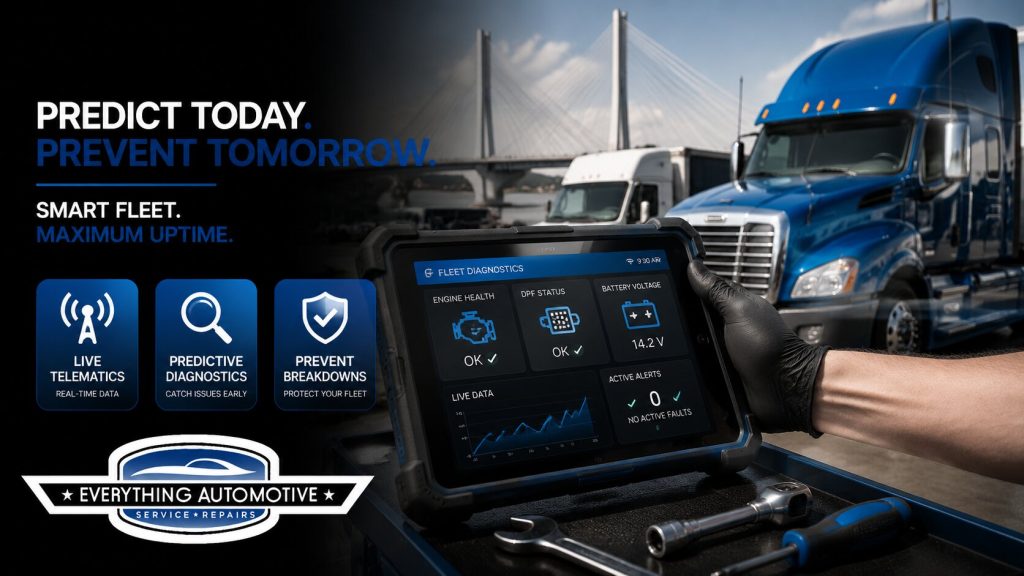
Integrated telematics and predictive diagnostics protect commercial vehicle fleets from unexpected highway breakdowns. By analyzing live engine data before warning lights appear, fleet managers can schedule proactive maintenance. This continuous monitoring prevents high-cost roadside repairs, preserves vehicle uptime, and keeps the local economy moving forward without disruptive shipping delays.
Stop and Go Port Routes and the Dames Point Bottleneck
Jacksonville operates as a massive logistics hub, with a heavy concentration of commercial trucks, cargo vans, and delivery vehicles moving continuously through our industrial corridors. Neglecting maintenance here often leads to DPF clogs or limp-mode activations on high-load routes like Dames Point. Daily shipping routes frequently require heavy-duty vehicles to cross the iconic Dames Point Bridge—a massive 6,600-foot-long cable-stayed structure that carries six lanes of Interstate 295 traffic over the St. Johns River.
Climbing the steep, high-rise span of the Dames Point Bridge puts an immense mechanical load and thermal stress on a truck’s engine, transmission, and exhaust aftertreatment systems.
When a commercial van is fully loaded with cargo and climbing this steep grade, you can often feel a distinct, heavy groan from the diesel engine and a slight shudder through the floorboards. If your vehicle is operating with neglected maintenance or undetected component wear, this high-load climb is exactly where the system will fail.
When a heavy-duty truck breaks down near the 175-foot peak of the bridge, all traffic grinds to a halt, blocking lanes for hours and disrupting time-sensitive deliveries across Duval County.
The Technical Parameters of J1939 Fleet Telematics
To prevent these disruptive highway failures, modern commercial fleets utilize advanced telematics devices plugged directly into the vehicle’s diagnostic port. Instead of relying on basic, consumer-grade OBD-II protocols, heavy-duty commercial trucks communicate via the highly structured SAE J1939 standard over a high-speed Controller Area Network (CAN) bus. This network continuously streams real-time sensor parameters, allowing fleet managers to monitor vehicle health and spot microscopic anomalies before they turn into hard trouble codes.
Our technicians monitor and analyze these critical J1939 parameters to maintain complete diagnostic visibility over your fleet:
| J1939 Parameter | Technical Function | Diagnostic Indicator |
| Suspect Parameter Number (SPN) | Identifies the specific component or system currently experiencing a fault | Tells the technician exactly which sensor or solenoid is failing |
| Failure Mode Identifier (FMI) | Defines the type of failure such as voltage out of range or high temperature | Identifies the physical nature of the electrical or thermal fault |
| Occurrence Count (OC) | Tracks the exact number of times the fault has been triggered during operation | Helps separate a loose wiring connection from a permanent failure |
| Differential Pressure | Measures the exhaust backpressure before and after the diesel particulate filter | Predicts diesel particulate filter blockages before limp mode occurs |
How Untreated Sensor Drift Leads to Catastrophic Engine Protection Derates
A major cause of roadside breakdowns on the Dames Point Bridge is the sudden activation of an engine protection derate—commonly known as limp mode. To protect expensive components from melting under high heat, your engine’s control module will automatically cut power output by up to 50 percent when it detects a critical fault. This catastrophic drop in power usually stems from a predictable, early-stage wear pattern in the emission system that went undetected:
- Early-Stage Sensor Drift The diesel particulate filter (DPF) differential pressure sensor, which measures exhaust backpressure to calculate soot loading, begins to experience electrical drift or becomes clogged with soot. The sensor reports a moderate pressure increase (between 20 and 40 hPa) under load, but the engine control module fails to initiate a timely self-cleaning regeneration cycle.
- Failed Active Regeneration Because local fleet vans frequently run short, stop-and-go trips around Arlington and Southside, the exhaust never maintains the sustained heat required to burn off soot naturally. Active regeneration fails repeatedly, and the particulate filter becomes heavily packed with abrasive carbon.
- Severe Backpressure and Oil Dilution As the DPF becomes completely obstructed, differential pressure surges past 80 to 100 hPa. This extreme backpressure prevents exhaust gases from purging cleanly, forcing soot and unburnt fuel backward past the piston rings into the oil pan. This fuel dilution strips the oil of its viscosity, causing the lubrication film on your crankshaft bearings to collapse.
- Derate Activation When the DPF pressure exceeds the manufacturer’s maximum limit, the computer illuminates the warning system and instantly commands a protective derate, leaving your loaded truck struggling to climb the bridge.
Specialized Diagnostic Precision Over General Code Scanning
Generic repair shops often guess at complex J1939 DPF codes, replacing expensive particulate filters or EGR valves without testing the underlying circuits. Our team uses advanced Autel and Snap-on diagnostic suites paired with AI diagnostic assistants to cross-reference real-world repair data and pinpoint the exact failure point.
If we suspect communication dropouts on the vehicle’s computer network, we connect an OBD2 breakout box directly to the diagnostic port to expose the communication lines. By hooking up a digital oscilloscope, we inspect raw square-wave data packets for voltage drops or signal noise without resetting vehicle computers. This high-level testing isolates the exact broken wire, corroded ground, or drifted sensor, saving your fleet business from thousands of dollars in unnecessary parts.
Proactive Fleet Maintenance Strategies for Northeast Florida
To keep your fleet running smoothly in Jacksonville’s hot, humid climate, standard mileage-based maintenance schedules must be adjusted. Vehicles that spend hours idling in heavy traffic along Southside Boulevard or Blanding Boulevard put massive wear on their engines without adding miles to the odometer.
A work van that idles for four hours a day experiences the equivalent of 40 to 60 road miles of engine wear per session.
For this reason, we recommend that Jacksonville businesses implement a dual-trigger fleet maintenance program that schedules service based on whichever threshold—odometer miles or engine hours—reaches its limit first.
We also perform routine oil analysis to monitor fuel dilution, verify that your diesel particulate filters are cleaned before they suffer severe soot loading, and test your coolant’s Supplemental Coolant Additives (SCAs) to prevent wet-sleeve cylinder liner cavitation.
Do not let a preventable breakdown halt your business operations. Protect your fleet with advanced fleet maintenance at Everything Automotive to keep your commercial vehicles running safely and efficiently.
- Visit us at our Eastside location (7624 Beach Blvd, Jacksonville, FL 32216 | 904-800-2714)
- Our Westside location (6211 Blanding Blvd, Jacksonville, FL 32244 | 904-813-7097)
Frequently Asked Questions
Can telematics really predict an engine breakdown before the check engine light turns on?
Yes. Advanced telematics systems continuously analyze real-time data from the CAN bus—such as exhaust backpressure, battery voltage drops, and fuel trim drifts—to identify slow, progressive component wear up to 30 days before a hard fault code is logged.
Is monitoring mileage alone enough to schedule fleet maintenance?
No. Heavy-duty fleet vehicles that spend significant time idling in stop-and-go Jacksonville traffic accumulate massive engine wear hours without adding miles to the odometer, meaning a dual-trigger schedule based on both hours and mileage is essential to prevent over-extended service.
Will a faulty DPF differential pressure sensor trigger a protective engine derate?
Yes. If a failed sensor or clogged silicone tube sends inaccurate backpressure data to the engine control module, the computer will prevent proper regeneration cycles, allow the particulate filter to become completely choked, and trigger a protective limp mode to prevent fire.
