
Restricted air conditioning condensers and failing radiator fans cause extreme pressure spikes during stationary idling in heavy traffic. This thermal overload forces safety switches to deactivate the compressor at long red lights. Professional diagnostic pressure testing and condenser cleaning restore consistent cooling performance during hot summer stop and go commutes.
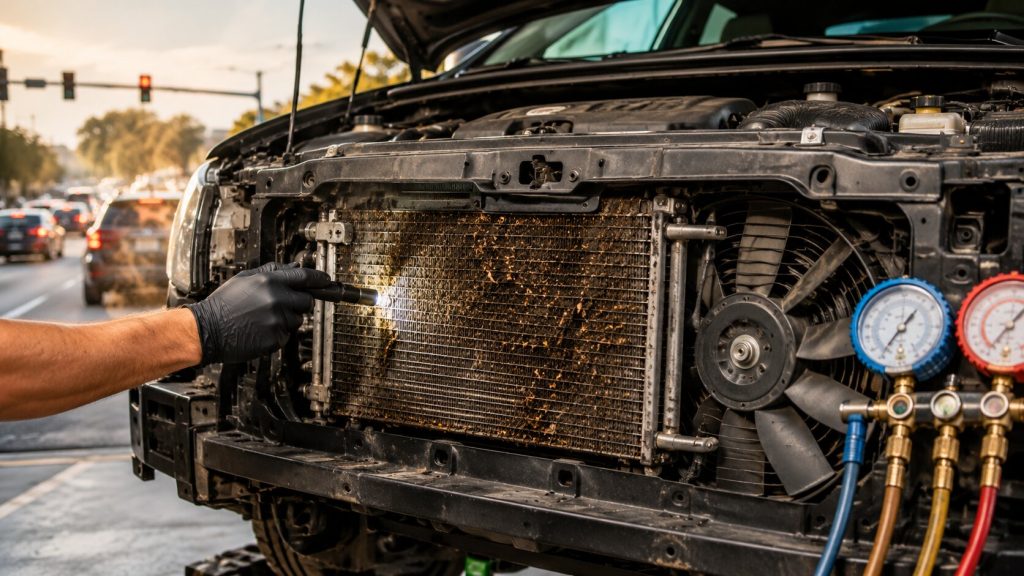
Heavy Traffic in Deerwood Restricts Vital Airflow
Operating a vehicle in Duval County means putting its air conditioning system through a continuous high-temperature stress test. Jacksonville’s A/C season routinely stretches from March through November, demanding eight to nine months of near-continuous compressor operation—approximately three times the usage of vehicles driven in northern states.
For families and commuters in the Deerwood area, this thermal stress is heavily compounded by local traffic patterns. Driving through heavily congested Southside Boulevard corridors, navigating the roundabouts on Touchton Road, or sitting in bumper-to-bumper holiday traffic near the St. Johns Town Center at Gate Parkway forces vehicles to spend significant time idling in intense heat.
That kind of Deerwood traffic cooks condensers and fan motors. High-speed highway driving on J. Turner Butler Boulevard (JTB) provides a constant rush of natural, convective wind to cool your front-mounted A/C condenser.
But when you are stationary at a long red light on Southside Boulevard, that natural airflow drops to zero. The under-hood engine bay temperature quickly soars past 130°F, trapping extreme heat directly against the cooling fins of your condenser and forcing the system to work under maximum load with zero cooling relief.
The Thermodynamics of Condenser Heat Dissipation and Pressure Spikes
To understand why your air conditioning suddenly cuts out and blows warm, muggy air while waiting at a long red light, it helps to look at the process as a step-by-step chain of events:
- The Condenser’s Primary Job: Your vehicle’s A/C condenser is a critical heat exchanger designed to release the heat absorbed from your cabin into the outside atmosphere, converting high-pressure, superheated refrigerant gas back into a cooled liquid.
- The Impact of Stationary Idling: When your vehicle is parked at a long Southside Boulevard red light, the natural, convective airflow that normally cools the front-mounted condenser drops to zero, putting the entire cooling load on your radiator fan.
- Rapid Under-Hood Heat-Soak: Deprived of cooling air, under-hood temperatures quickly climb past 130°F, severely reducing the condenser’s ability to reject heat.
- Pressure Spikes Under Heat Load: In a closed, constant-volume system, any sharp rise in temperature forces the internal refrigerant pressure to skyrocket.
- Reaching the Danger Zone: While a healthy system operates between 150 and 220 PSI, heat-soak from a blocked condenser or failing fan can push high-side pressures past 350 PSI.
- Safety Switch Deactivation: To prevent a catastrophic hose rupture or compressor seal damage, the high-pressure safety transducer instantly cuts power to the compressor clutch. This safety cutout shuts down the system, leaving the vents blowing warm, humid air until forward movement forces fresh air back through the grille to cool the condenser down.
Tracking Condenser Blockages and Fan Failures Stage by Stage
If the fan slows down, the condenser plugs up, or the pressure sensor lies to the ECM, the whole system starts falling apart at idle. We track the physical and chemical progression of heat-soak failures across these critical areas:
| System Component | Failure Mechanism | Real World Symptom | Technician Solution |
| Condenser Fins | Road debris and oak leaves block parallel-flow channels, restricting heat rejection. | Lukewarm air while idling at Touchton roundabouts; cools down once the vehicle gains highway speed. | High-pressure washing with specialty coil cleaners or complete condenser replacement. |
| Cooling Fan Motor | High under-hood heat cycles cause internal coil short circuits, causing complete motor seizure. | A/C cuts out completely at red lights; engine temperature gauge rapidly climbs toward the red zone. | Perform bi-directional scan tool command tests and replace the failed fan motor assembly. |
| Fan Relay or Fuse | Voltage spikes or high resistance melt terminal pins inside the under-hood fuse junction box. | Intermittent fan operation or a complete loss of power to the high-speed fan circuit. | Inspect the relay terminal block, perform a voltage drop test, and install a fresh OEM relay. |
| Pressure Transducer | Sensor fails internally, reporting inaccurate voltage signals to the engine control module. | False system deactivations or compressor lockout despite normal physical system pressures. | Back-probe the transducer harness, verify the five-volt reference signal, and replace the sensor. |
Diagnostic Precision with High and Low Side Pressure Gauges
I have been turning wrenches since 1983, and I have seen too many general repair shops attempt to diagnose weak A/C performance by simply adding more refrigerant to the system. If your vehicle’s cooling failure is caused by an airflow restriction or a bad cooling fan, adding more gas is a costly mistake. Overcharging a heat-soaked system will drive high-side pressures even higher, resulting in liquid slugging that will instantly seize and destroy your compressor.
- Physical Pressure Analysis: We connect professional manifold gauges to the high and low-side service ports to monitor real-time operating pressures under load. If we observe the high-side pressure climb rapidly to 350 PSI while the low-side remains normal, we immediately check for a blocked condenser or an inoperative fan.
- Electrical Control Diagnostics: We utilize advanced Autel and Snap-on diagnostic tablets to perform active, bidirectional command tests. We manually activate the low-speed and high-speed cooling fan circuits from the tablet. If the fan engages under command but fails to run during normal operation, we know the motor is healthy and the issue lies in the coolant temperature sensor or ECM programming.
- Visual Airflow Inspections: We utilize high-resolution video borescopes to inspect the tight, hidden space between your vehicle’s radiator and A/C condenser, ensuring no hidden dirt, dead bugs, or leaves are blocking the cooling air path.
Professional System Restoration Beats Cheap Stop Leak Additives
If you are experiencing weak cooling at red lights in stop-and-go traffic, reaching for an over-the-counter “quick fix” recharge can is a highly dangerous gamble. These consumer cans often contain cheap universal lubricants and aggressive chemical stop-leak additives. These sealants chemically react with internal moisture and atmospheric air inside your system, hardening into a solid, plastic-like block. This solid gunk permanently plugs the microscopic parallel-flow channels of your modern aluminum condenser, restricting vital oil flow and causing your compressor to run dry and seize.
At Everything Automotive, we have proudly served Jacksonville and Duval County families with honest, transparent diagnostics since 2012. Tony Mossuto and our certified technicians do not cut corners. If we find your condenser’s ultra-thin parallel channels are restricted by internal wear or carbonized sludge, we replace the unit and perform a thorough chemical flush of the remaining lines to prevent cross-contamination.
Don’t let a clogged AC condenser destroy your compressor during hot Jacksonville commutes. Bring your car to Everything Automotive to restore ice-cold cabin comfort today.
- Visit us at our Eastside location (7624 Beach Blvd, Jacksonville, FL 32216 | 904-800-2714)
- Our Westside location (6211 Blanding Blvd, Jacksonville, FL 32244 | 904-813-7097)
Frequently Asked Questions
Will a bad cooling fan cause my A/C to blow warm at idle?
Yes. The electric cooling fan is the sole source of heat-expelling airflow when the vehicle is stationary, meaning a fan failure causes the condenser to immediately heat-soak and shut down the compressor.
Can a clogged condenser cause my engine to overheat?
Yes. The A/C condenser sits directly in front of your vehicle’s radiator, meaning any dirt or leaf blockages on the condenser face will restrict the vital airflow required to cool your engine’s radiator, leading to skyrocketing coolant temperatures.
Is it safe to use retail A/C stop-leak sealants to fix a high-pressure leak?
No. These chemical sealants react instantly with atmospheric moisture inside your climate loop, forming solid plastic-like blockages that permanently clog modern parallel-flow condensers and destroy your compressor.
