
High relative humidity and brackish floodwaters in San Marco cause water intrusion and galvanic corrosion inside body control modules. This electrochemical decay damages sensitive solid state switches, causing flickering headlights and window failures. Everything Automotive uses advanced diagnostics and J2534 tools to trace and resolve these hidden electrical leak paths.
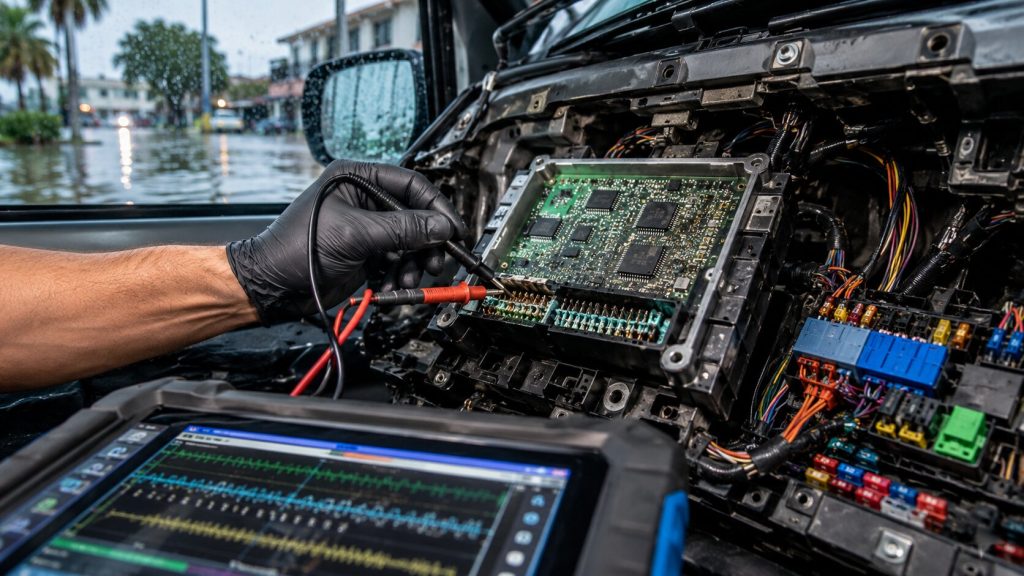
Jacksonville Humidity and San Marco Floodwaters Infiltrate Vehicle Electronics
Operating a vehicle in Jacksonville means exposing its complex electrical network to a relentless coastal climate where the relative humidity routinely exceeds 70 percent year-round . For residents of historic San Marco, this environmental stress is heavily compounded. Low-lying corridors like LaSalle Street, Hendricks Avenue, and Riviera Street—familiarly known to locals as “River Street” because of its chronic drainage issues—experience severe tidal and stormwater flooding from the adjacent St. Johns River .
Plunging through these flooded streets splashes brackish water directly into the undercarriage. This saltwater carries highly conductive dissolved chloride ions that trigger rapid galvanic corrosion .
When hot, humid air inside a parked car cools overnight, moisture condenses rapidly on under-dash electronics, including the Body Control Module (BCM) . Because salt is highly hygroscopic, any airborne salt residue drawn into the cabin acts as a sponge, pulling this condensation directly into the BCM’s sensitive printed circuit board (PCB) . This continuous moisture loop accelerates galvanic corrosion, destroying copper-alloy circuit board traces and solder joints 30% faster than in moderate inland climates .
The Technical Science of Solid State Drivers and Pulse Width Modulation
The Body Control Module is the central coordinator of your vehicle’s convenience electronics, managing everything from interior dome lights and door locks to power windows and exterior lighting . In modern automotive architecture, manufacturers have replaced legacy electromechanical relays with solid state drivers, also known as high-side MOSFETs or Intelligent Power Devices .
- The Power of Solid State: Instead of a physical mechanical arm clicking open and shut, these solid state switches use semiconductors to distribute power . The BCM’s microprocessor regulates this power distribution using high-speed Pulse-Width Modulation (PWM). By rapidly cycling the voltage on and off thousands of times per second, PWM allows the system to soft-start headlights, dim interior dome lamps, or control the precise speed of power window motors .
- The Corrosion Breakdown: When brackish moisture penetrates the BCM housing, it creates high-resistance electrical paths between adjacent connector pins . This corrosion can bridge the main 12-volt power rail directly to the signal lines, scrambling communication across the vehicle’s Controller Area Network (CAN) or Local Interconnect Network (LIN) bus .
- The Safety Cutout: If a smart solid state driver detects this short-circuit or an overcurrent condition, its built-in safety logic immediately deactivates the affected circuit to prevent a wiring harness fire . This protective shutdown is what passengers experience as a flickering headlight, erratic door locks, or a completely non-responsive power window .
Tracking Body Control Module Corrosion Stage by Stage
To prevent sudden starting failures and secure your vehicle’s electronic networks, our technicians track BCM decay across several distinct phases:
| Failure Stage | Physical and Chemical Progression | Observable Passenger Symptoms | Correct Diagnostic Action |
| Stage 1 Moisture Ingress | Brackish moisture seeps into the housing, beginning galvanic oxidation on PCB traces. | Intermittent flicker of dome lights or weak window motor travel. | Inspect BCM case seals and clean connector contacts with electrical cleaner. |
| Stage 2 Pin Bridging | Salt-laden corrosion forms a high-resistance bridge between adjacent connector pins. | Headlights flicker at idle on Hendricks Avenue; windows fail randomly. | Back-probe the connector, measuring reference voltage and grounds. |
| Stage 3 Sleep Mode Failure | Internal logic gates remain active, keeping the vehicle’s CAN bus awake. | The vehicle battery drains flat overnight, dropping static voltage below 11.5V. | Measure circuit voltage drop across BCM fuses with a digital voltmeter. |
| Stage 4 Solid State Shutdown | The BCM’s smart high-side drivers detect a short-circuit and cut power entirely. | Total loss of window, lock, or exterior lighting operation. | Disconnect the battery, perform continuity testing, and replace the BCM if internal drivers are shorted. |
Tracing Hidden Parasitic Draws with Digital Voltmeters
I have been turning wrenches since 1983, and I have seen too many general repair shops attempt to find electrical leaks by using the outdated method of pulling fuses one by one . On modern vehicles, pulling a fuse breaks physical contact and instantly wakes up the entire CAN bus . This resets the vehicle’s sleep timers, forcing you to wait up to an hour for the modules to fall back asleep .
At Everything Automotive, we prioritize systematic, non-intrusive diagnostics over parts-guessing . When a vehicle exhibits a dead battery after sitting parked overnight near San Marco Square, we perform the Fuse Volt Drop Test :
- Preparation: We lock the vehicle, latch the hood mechanism so the computer thinks the car is closed, and wait 30 to 60 minutes for the network to enter its low-power sleep state .
- Multimeter Setup: We set a high-resolution digital voltmeter to the millivolt scale . Standard multimeters that only read down to 1 millivolt are not sensitive enough; we use diagnostic meters that measure down to tenths of a millivolt (0.1 mV) .
- Probing the Pins: Any electrical circuit with current flowing through it will exhibit a minute voltage drop across its fuse . We touch our insulated needle-point probes directly to the two small exposed metal test pins on top of each blade fuse .
- Calculating the Draw: If we read a voltage drop of 0.5 mV across a standard 10-amp BCM fuse, we can reference our diagnostic chart to determine that a steady 68-milliamp drain is actively bleeding your battery . This precise, non-intrusive method allows us to isolate the exact short-circuited relay or awake module without disturbing the vehicle’s sleep cycle.
Professional J2534 Module Reprogramming Over Cheap Fuse Slaps
Chasing down a malfunctioning BCM is a complex job that requires advanced, dealer-level technology. Cheap scan tools cannot access the private communication gateways of modern vehicles, and simply replacing a blown fuse is a temporary band-aid if the underlying short circuit remains unresolved .
Our certified technicians utilize advanced Autel and Snap-on diagnostic suites paired with J2534-1 and J2534-2 compliant pass-through vehicle interfaces . This pass-through hardware acts as a secure digital bridge, connecting your vehicle directly to official manufacturer databases .
If we replace a damaged BCM, we do not just plug it in and hope for the best. We use our J2534 tools to program the new module to your vehicle’s specific VIN, ensuring it communicates flawlessly with your engine control module, security system, and lighting networks .
Most importantly, we connect a specialized DCA-8000 diagnostic power supply to lock your vehicle’s electrical system at a rock-solid 13.5 volts throughout the programming sequence, completely eliminating the voltage drops that can corrupt a module’s memory during a software write.
Whether we are performing a simple wiring repair or installing a brand-new programmed module, our work is backed by our signature 36-month / 36,000-mile nationwide warranty on parts and labor through the Parts Plus network.
Do not let erratic lights or a dead battery compromise your safety. Contact Everything Automotive of Jacksonville, Inc. to schedule an expert auto electrical diagnostic check.
- Visit us at our Eastside location (7624 Beach Blvd, Jacksonville, FL 32216 | 904-800-2714)
- Our Westside location (6211 Blanding Blvd, Jacksonville, FL 32244 | 904-813-7097)
Frequently Asked Questions
Can high local humidity cause my headlights to flicker?
Yes. Excessive moisture and salt air can seep into your vehicle’s body control module, creating high-resistance bridges across circuit board pins that cause solid-state lighting drivers to cycle erratically and flicker .
Will a bad body control module drain my battery when the car is off?
Yes. A corrupted BCM or an internal short circuit can keep internal logic gates active, preventing your vehicle’s computer networks from entering their low-power sleep state and causing a major parasitic battery drain .
Can independent shops program a replacement body control module?
Yes. Under the SAE J2534 standard, independent repair facilities have legal access to factory software databases, enabling our certified technicians to perform identical module programming, coding, and updates to a local new-car dealer .
