
Investing in advanced electrical diagnostics protects your vehicle from repeated battery failures and catastrophic wiring harness fires. Finding short circuits early prevents high current thermal events caused by intense coastal humidity, ensuring your vehicle’s complex electronic control modules communicate safely.
Jacksonville Humidity and High Salt Air Fuel Silent Corrosion
I know firsthand how hard our Northeast Florida climate is on a vehicle’s electrical architecture. Having served Jacksonville drivers at Everything Automotive since 2012, I have seen our regional humidity and coastal salt air destroy delicate wiring systems from the inside out. Our average relative humidity routinely hovers above 70 percent year-round. When you commute along Beach Boulevard or Blanding Boulevard, your car’s undercarriage is constantly exposed to damp, salt-laden air.
This moisture seeps past rubber connector seals, triggering galvanic corrosion on metal terminal pins.
The resulting green copper corrosion acts as a high-resistance electrical bridge, allowing current to track across circuit terminals even when your key is out of the ignition. This constant electrical leakage keeps your vehicle’s onboard computers awake, quietly draining your battery while your vehicle sits parked overnight in your driveway.
I routinely see vehicles arrive after two or three batteries have already been installed somewhere else. The original problem is usually still active because nobody verified sleep-state amperage after shutdown. If the network does not settle below roughly 30–40mA after timeout, the fault was never fixed.
The Technical Reality of Parasitic Draws and Short Circuits
To understand why your vehicle’s battery keeps dying, you have to look at how a short circuit behaves. In my forty-plus years of troubleshooting automotive electrical systems, I have taught my technicians to separate faults into two distinct categories:
- Grounded Short Circuits: This occurs when a hot, power-carrying wire chafes against a sharp metal edge of the chassis. This metal contact creates an unrestricted, low-resistance path directly to ground, drawing massive amperage that instantly blows the protecting fuse to prevent a wire meltdown.
- Power Short Circuits: This is a much more silent, destructive threat. When multiple wires inside a bundled engine harness degrade from years of extreme engine heat, their protective insulation cracks. The raw copper conductors touch each other inside the harness. This contact allows 12-volt battery power to cross over to another circuit, bypassing switches and feeding power continuously to accessories that should be completely shut off.
Understanding Standby Battery Draw and the Threat of Catastrophic Harness Failure
When your vehicle is turned off, its onboard computers must enter a low-power sleep state. If a corroded connector or short circuit keeps these modules awake, they create an active parasitic draw.
I use the following standby current draw thresholds to track the severity of an electrical drain on a standard 12-volt battery:
| Standby Draw Level | System Classification | Battery Lifespan and Risk Impact |
| 20 to 50 mA | Quiescent draw | Safe; battery maintains its starting charge for weeks with minimal internal wear. |
| 75 to 100 mA | Mild parasitic draw | Marginal; battery drains within weeks, placing a heavy load on your alternator. |
| 150 to 250 mA | Severe parasitic draw | Critical; battery goes dead in days, causing permanent lead-sulfate plate damage. |
| 500 mA or more | Fault or short circuit | Danger; battery drains in hours, risking high-current thermal events and wiring fires. |
If you ignore a high-current fault, the continuous flow of unrestricted current generates extreme heat. This thermal stress can quickly melt the protective vinyl insulation off adjacent wires inside your harness, resulting in a catastrophic vehicle fire.
Finding Ghost Parasitic Draws Without Pulling Fuses
chaser-type electrical problems used to require hours of manual research. At Everything Automotive, we never guess or rely on outdated testing methods. Many general repair shops still try to find battery drains by pulling fuses out of the fuse box one by one while watching an ammeter. On modern, computer-networked vehicles, this is a dangerous shortcut. Pulling a fuse breaks the circuit and instantly wakes up the entire CAN bus communication network, resetting the vehicle’s sleep timers and giving completely false readings.
Instead, I require my technicians to use the non-intrusive Fuse Volt Drop Test.
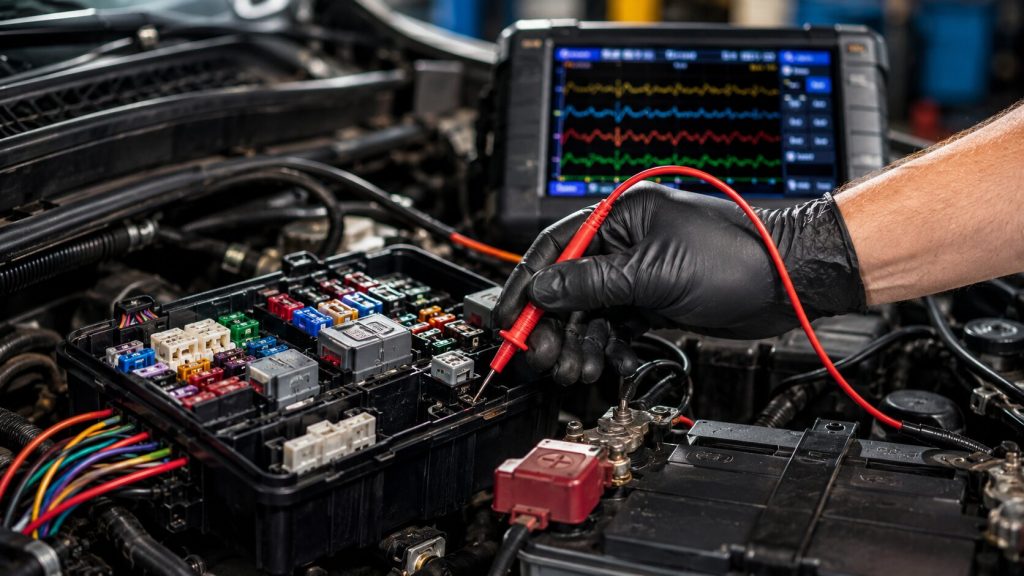
We set a high-resolution digital voltmeter to its lowest millivolt scale, measuring down to tenths of a millivolt. We touch our needle-point probes directly to the two small exposed metal test pins on top of each blade fuse. Because any active circuit with current flowing through it will exhibit a microscopic voltage drop across its fuse, we can calculate the exact current draw of that circuit without ever pulling a fuse or disturbing the vehicle’s sleep state.
Last week, an SUV was towed to my Beach Boulevard shop with a battery that died every two days. I could smell the faint, acrid scent of hot plastic when I opened the engine bay fuse block.
Our diagnostic breakthrough came when we connected our PicoScope digital oscilloscope to the main vehicle grounds.
By analyzing the high-frequency current waveforms, we captured a rhythmic 515-milliamp spike occurring exactly every 12 seconds. This specific electrical signature led us straight to a short-circuited body control module that was constantly waking up the vehicle’s network. We located the shorted wire, repaired the harness, and restored the vehicle’s normal 20-milliamp sleep state without replacing any expensive computers.
The Real Financial Math of Early Electrical Diagnostics
Many drivers hesitate to invest in advanced electrical diagnostics because they view it as an unnecessary expense. In my experience, this is a major financial mistake:
- Irreversible Battery Damage When you ignore a parasitic draw and allow your battery to drain completely flat multiple times, you permanently damage its internal lead plates, rendering it unserviceable.
- The Endless Battery Cycle Simply buying a new battery without resolving the underlying short circuit only restarts the clock. The active draw will quickly drain your fresh battery, leading to repeated, costly replacements.
- Alternator Burnout Consistently jump-starting or driving with a flat battery forces your alternator to run at maximum capacity in our intense Jacksonville summer heat, leading to premature alternator failure.
- Wiring Harness Fires Most importantly, an unresolved short circuit can cause wiring insulation to melt, triggering an electrical fire that can completely destroy your vehicle’s harness and risk a total vehicle loss.
By investing in professional, root-cause diagnostics at my shop early on, you protect your vehicle’s safety, preserve your electrical system, and protect your investment.
Do not let an electrical leak drain your battery or risk a wiring fire. Contact me at Everything Automotive of Jacksonville, Inc. to schedule a professional auto electrical repair check.
- Visit us at our Eastside location (7624 Beach Blvd, Jacksonville, FL 32216 | 904-800-2714)
- Our Westside location (6211 Blanding Blvd, Jacksonville, FL 32244 | 904-813-7097)
Frequently Asked Questions
Is a dead battery always just a battery problem?
No. A dead battery is frequently a symptom of an underlying parasitic draw or charging system issue, and simply replacing the battery without diagnosing the root cause will result in the new battery draining flat within days.
Can a short circuit cause a car fire?
Yes. A high-current short circuit that bypasses a fuse or occurs on an unfused circuit can cause wire insulation to melt, potentially sparking a thermal event or complete vehicle fire inside your engine bay.
Will diagnostic testing find an intermittent electrical leak?
Yes. By utilizing advanced digital oscilloscopes like a PicoScope, my technicians can capture real-time current and voltage waveforms over hours, catching erratic draws and communication dropouts that standard code readers miss.
