
ADAS calibration restores the accuracy of lane-keep assist, collision avoidance, and adaptive cruise control systems after wheel alignments, suspension repairs, or ride-height changes. Even minor steering geometry deviations can cause radar and camera systems to misinterpret lane position and braking distance.
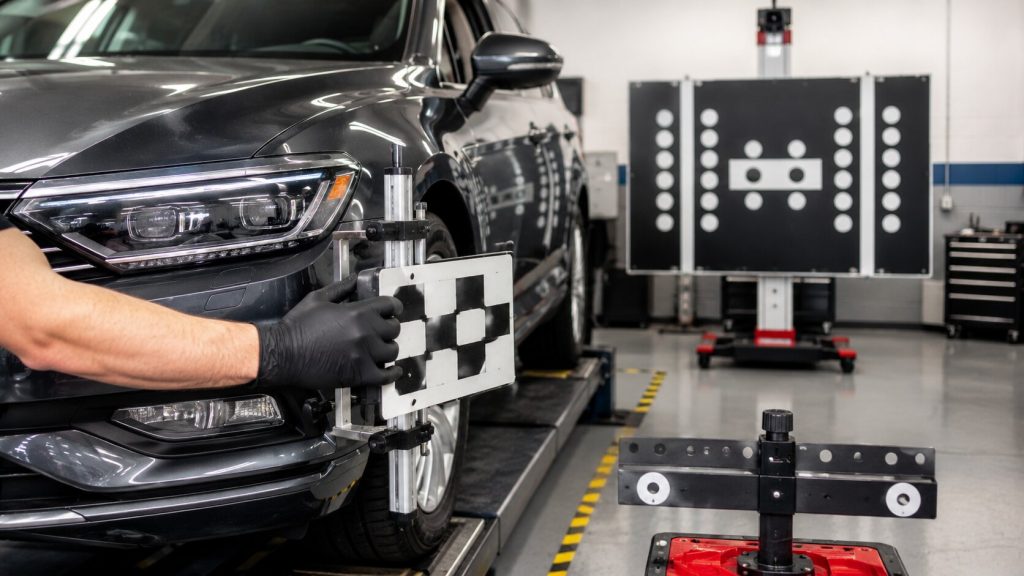
Under Car Suspension Work Directly Knocks Safety Sensors Out of Alignment
I have been working as a professional diagnostic technician and mechanic since 1983, and since establishing Everything Automotive of Jacksonville, Inc. I started tracking car tech in 2012. Back then, parts were mostly mechanical, but today they operate through massive software loops. Today, standard family SUVs and commuter sedans are equipped with Advanced Driver Assistance Systems (ADAS). These safety-critical systems use forward-facing cameras, radar modules, and blind-spot sensors to manage lane-keep assist, adaptive cruise control, and automatic emergency braking.
Your car’s electronic safety features depend on a solid foundation. When locals on Blanding Boulevard or Southside Boulevard replace worn-out shocks and control arms, they are actually fixing the hardware that talks to the vehicle’s computer.
When we perform mechanical repairs underneath your vehicle, we alter the physical geometry of your steering and suspension.
If you drive home through the busy, stop-and-go intersections near the St. Johns Town Center without recalibrating these sensors, your vehicle’s safety systems will rely on an obsolete, incorrect physical reference point.
The camera or radar will remain physically tilted, causing your lane-keep assist to drift freely or your automatic braking to misjudge stopping distances on high-speed expressways like JTB.
The Technical Impact of Minor Thrust Angle and Caster Deviations
In my forty-plus years of diagnostics, I have seen how even microscopic physical misalignments can completely blind a vehicle’s safety sensors. When we perform a four-wheel alignment, our primary goal is to reset your vehicle’s thrust angle to a perfect 0.00 degrees. The thrust angle represents the direction your rear wheels point relative to your car’s centerline.
If your thrust angle is off by just 0.01 degrees, your vehicle will “dog-walk” slightly down the highway, forcing you to keep your steering wheel off-center to drive straight.
This physical offset severely scrambles your Steering Angle Sensor (SAS), which monitors your steering wheel’s exact position.
The physical tolerance margins for ADAS sensors are exceptionally tight:
- Sensor Tilt Sensitivity: A tiny 2.2-millimeter shift in a suspension adjustment bolt tilts your camera or radar sensor by 1.3 degrees.
- Targeting Errors: That minor 1.3-degree tilt causes the radar or camera to misjudge the position of obstacles by 20 to 100 feet down the road, making your adaptive cruise control brake too late.
- Ride Height Impact: Even a minor quarter-inch change in ride height from brand-new struts or different tire pressures changes the pitch of your forward-facing radar, pointing the beam directly into the pavement instead of scanning the road ahead.
Comparing Calibration Methods for Modern Advanced Driver Assistance
To help you understand how we restore these delicate safety sensors to factory standards after suspension work, I have outlined the differences between the two primary calibration methods we use in our shop:
| Calibration Method | Technical Process | Required Equipment and Environment |
| Static Calibration | Completed inside our flat-floor bay using physical OEM-approved target boards. | Laser-guided alignment frames, precise target stands, and highly consistent, controlled shop lighting. |
| Dynamic Calibration | Completed on the road under specific driving speeds and conditions. | An OEM-compatible scan tool plugged into the OBD-II port to log real-world camera inputs. |
Some vehicles require only one of these methods, while many modern Asian and Domestic makes require both to fully certify the safety network.
Laser Guided Target Systems Deliver Precision Over Inaccurate Manual Strings
I regularly see vehicles leave suspension shops driving straight mechanically but still failing ADAS calibration because the steering angle sensor and forward camera no longer agree on the vehicle’s centerline. In highway traffic, that mismatch can cause unstable lane-keep corrections or delayed adaptive cruise braking.
I refuse to take shortcuts when your family’s safety is on the line. At Everything Automotive, we made a diagnostic breakthrough by investing in the Autel IA900AST All Systems ADAS calibration system paired with our high-resolution Hunter HawkEye Elite laser alignment machine.
Our advanced system uses six high-definition tracking cameras to physically map out your vehicle’s exact thrust line in real time.
Instead of manual string measurements, the machine uses automated, laser-guided frames to position our physical targets—such as adaptive cruise control corner reflectors—at the exact millimeter-level distance and angle specified by the manufacturer.
This precise, high-tech process ensures your forward-collision and lane-departure sensors are perfectly centered before we execute the electronic sensor reset.
Choosing Professional Calibration Protects Your Family on Local Highways
When you are looking for complex diagnostics and auto repair in Jacksonville, choosing a shop with true ADAS capability is vital. Simply getting a cheap front-end alignment without resetting your vehicle’s electronic sensors leaves your safety systems blind. If your lane-keep assist veers unexpectedly on the highway or your automatic braking activates for no reason, your sensors are fighting your vehicle’s physical alignment.
Since 2012, our family-owned shop has been the trusted independent name for Jacksonville drivers. We do not fire the “parts cannon” or recommend unnecessary component replacements; we focus on root-cause analysis and data-driven calibrations.
Whether we are performing routine brake repairs on your family SUV or executing a complete, laser-guided ADAS recalibration on your late-model Domestic or Asian vehicle, our work is backed by our signature 36-month / 36,000-mile nationwide warranty through the Parts Plus Car Care Center network.
Before a misaligned safety camera or radar sensor compromises your safety on the highway, contact me at Everything Automotive of Jacksonville, Inc. to schedule a professional ADAS calibration check.
- Visit us at our Eastside location (7624 Beach Blvd, Jacksonville, FL 32216 | 904-800-2714)
- Our Westside location (6211 Blanding Blvd, Jacksonville, FL 32244 | 904-813-7097)
Frequently Asked Questions
Do I really need ADAS calibration after a simple wheel alignment?
Yes. A wheel alignment changes your vehicle’s physical thrust angle and steering centerline, meaning your forward-facing cameras and radar sensors must be recalibrated so they can interpret your vehicle’s actual path of travel correctly.
Will my dashboard show a warning light if a safety sensor is misaligned?
No. Many modern vehicles do not display any dashboard warning lights or log fault codes even if an ADAS camera or radar is physically out of calibration, leaving your safety systems to behave erratically without notifying the driver.
Can a minor fender bender in traffic knock my safety sensors out of calibration?
Yes. Even a minor low-speed impact can shift a bumper bracket or grille mount, misaligning your radar sensor by just over one degree and causing the system to target objects dozens of feet off its intended path.
