
Mysterious engine idling issues and sluggish throttle response during hot driving often stem from outdated vehicle computer calibrations. My shop uses advanced J2534 pass-through programming to reflash your engine control module, updating the factory software to optimize power output, restore fuel economy, and prevent cooling failures under extreme heat.
Heavy Traffic and July Heat Strain Your Vehicle’s Operating System
In my forty-plus years of diagnosing drivability issues, I have seen how intense Northeast Florida summers place immense physical and electrical strain on vehicles. If your daily commute involves crawling along congested stretches of Blanding Boulevard on the Westside or Southside Boulevard on the Eastside, your engine is under constant thermal stress.
Sitting stationary at long traffic lights with your air conditioning running at maximum capacity prevents natural, cooling airflow from passing through your front grille. Under these high-load idling conditions, temperatures inside your engine compartment can easily climb past 140 degrees.
When your vehicle is subjected to this level of heat soak, minor software inefficiencies in your vehicle’s computer can escalate into active driving hazards. In my diagnostics, rough idle complaints often trace back to calibration issues rather than failed sensors or actuators.
Oftentimes, the root cause is outdated factory computer programming that cannot handle extreme thermal loads and high ambient humidity. OEM updates I’ve installed through J2534 often adjust idle airflow targets and fan trigger thresholds that were miscalibrated in earlier revisions.
The Technical Cause of Idle Instability and Sluggish Throttle Response
Your Engine Control Module (ECM) manages your engine’s combustion cycles by referencing multi-dimensional lookup tables called calibration maps. These maps dictate the exact fuel injector pulse width and throttle plate angles based on real-time data from various sensors. In my shop, I frequently see older ECM software struggle to process sensor inputs accurately when the weather turns hot and humid.
Jacksonville’s relative humidity routinely hovers above 70 to 90 percent year-round. In Jacksonville humidity, I routinely see airflow-based fuel trims shift because the ECM miscalculates air density under sustained high moisture conditions. When your engine breathes this hot, wet air, the actual oxygen content per volume drops.
Some older calibrations struggle to adapt quickly to rapid air density changes during heat-soaked idle conditions. When this happens, I typically see long-term fuel trims climb into the +10% to +20% range at idle during scan sessions.
If the mixture runs too lean under load, combustion chamber temperatures spike, triggering pre-ignition or spark knock. Your knock sensors instantly detect this high-frequency vibration, forcing the ECM to retard ignition timing to protect your pistons. This timing reduction reduces your engine’s volumetric efficiency, which you feel as a sluggish “flat spot” in acceleration or a sudden, stumbling idle when you come to a stop with the A/C blasting.
I’ve seen earlier calibrations delay fan activation thresholds enough that coolant temps climb higher than necessary in stop-and-go traffic. In our climate, this delay allows localized hot spots to form inside your cylinder heads, degrading your motor oil and stressing your head gaskets before a warning light ever turns on.
Identifying the Warning Signs of Outdated Engine Calibration
Understanding when your engine’s computer needs a software refresh is essential to preventing premature component wear. I have outlined the most common symptoms we diagnose in the table below:
| Diagnostic Symptom | ECM Operational Error | Real World Driving Impact |
| Stumbling or erratic idle | Legacy lookup tables fail to adjust for low density humid air | Rough idling when coming to a stop with the A/C blasting |
| Accelerator pedal lag | Slow throttle actuator control system processing of sensor data | Sluggish hesitation or flat spots when merging onto JTB |
| Sudden engine stalling | Unable to maintain correct target air to fuel ratios | The engine dies at traffic lights or during sudden stops |
| Random pinging noise | Severe lean fuel trims under high load spike combustion temperatures | High-frequency metallic rattling during acceleration |
| Decreased fuel economy | Ignition timing is retarded to protect against engine knock | A noticeable drop in average miles per gallon at the pump |
Advanced Software Recalibration with J2534 Pass Through Technology
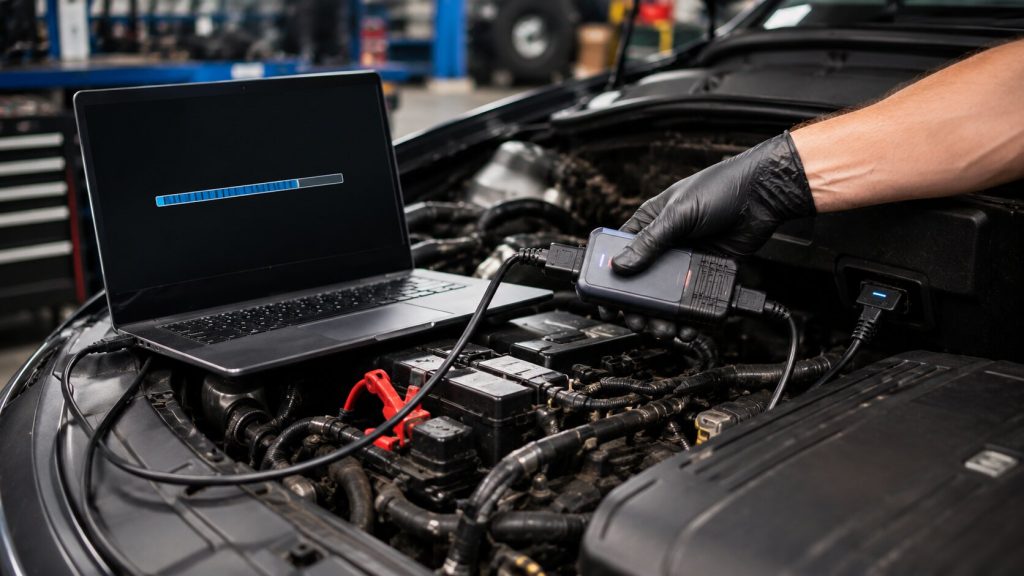
Performing an engine control module update is a highly precise digital procedure that requires specialized, professional-grade equipment. At Everything Automotive, we do not use basic code readers. My technicians and I utilize advanced J2534 pass-through programming interfaces connected directly to the manufacturers’ secure servers. This allows us to access direct, factory-level subscriptions including GM Techline Connect, Ford FDRS, and Toyota GTS+ to write the latest calibration files directly to your ECM’s non-volatile EEPROM memory.
Maintaining absolute electrical stability is the most critical factor during any software flash. When we turn your ignition key on to initiate a flash write, high-draw components like your electric radiator fans, fuel pumps, and blower motors automatically activate.
If the battery’s voltage drops below 12.5 volts during this data transfer, the write sequence will fail. An interrupted flash will permanently corrupt the EEPROM sectors, “bricking” the computer and rendering the expensive module completely useless.
To prevent this catastrophic failure, we never reflash a vehicle using battery power alone. We connect a specialized, voltage-regulated diagnostic power supply (such as the DCA-8000) to lock your vehicle’s electrical system at a rock-solid 13.5 volts throughout the entire programming procedure. With a stabilized voltage supply, ECM programming is typically completed without interruption or data corruption.
Reprogramming the Computer versus Buying Unnecessary Parts
I have served Jacksonville drivers since 2012 with honest, diagnostic-led auto repair, and I still see cases where shops replace sensors before checking calibration versions or TSB updates. When uncertified mechanics scan a car and find codes like P0171 (System Too Lean) or P0480 (Fan Control Circuit), they immediately start replacing oxygen sensors, mass airflow sensors, or complete radiator fan assemblies. They charge you for expensive physical hardware when your underlying issue is actually a software glitch.
We prioritize root-cause diagnostics. When your vehicle comes into our Beach Boulevard or Blanding Boulevard shop, we compare your current software calibration ID against the latest technical service bulletins (TSBs).
Often, we find that your hardware is in perfect working order, but a newer factory calibration is available to resolve the issue. When calibration is the root cause, updating the ECM often resolves lean codes and restores proper fan engagement strategy without hardware replacement. All of our precision diagnostics and major mechanical repairs are backed by our signature 36-month or 36,000-mile nationwide warranty through the Parts Plus Car Care Center network.
Do not let a minor software glitch or low-voltage issue turn into an expensive diagnostic headache. Contact me at Everything Automotive of Jacksonville, Inc. to schedule a professional engine computer diagnostic and programming check . Visit me at our Eastside location (7624 Beach Blvd, Jacksonville, FL 32216 | 904-800-2714) or our Westside location (6211 Blanding Blvd, Jacksonville, FL 32244 | 904-510-7299) to keep your vehicle running at its absolute best.
Frequently Asked Questions
Can an engine software update fix a rough idle?
Yes. ECM calibration updates can correct idle instability caused by outdated fuel and airflow tables.
Will a bad engine computer cause my car to overheat?
Yes. Incorrect cooling fan calibration can delay fan activation and allow coolant temperatures to rise during extended idle conditions.
Can independent repair shops perform the same programming as dealerships?
Yes. Certified independent shops equipped with professional J2534 pass-through programming tools and official OEM subscriptions can flash the exact same manufacturer-approved calibration files as a franchise dealer.
Is it safe to update my engine computer if my battery is weak?
No. A low-voltage condition during programming will cause the data write sequence to fail, which corrupts the EEPROM memory and permanently ruins the engine control module.
