
Honda Accord no-start problems are often caused by corroded battery terminals, not a dead battery. Jacksonville heat, humidity, and salt exposure increase resistance at the battery connection. A voltage drop test during cranking identifies terminal failure and prevents unnecessary battery replacement.
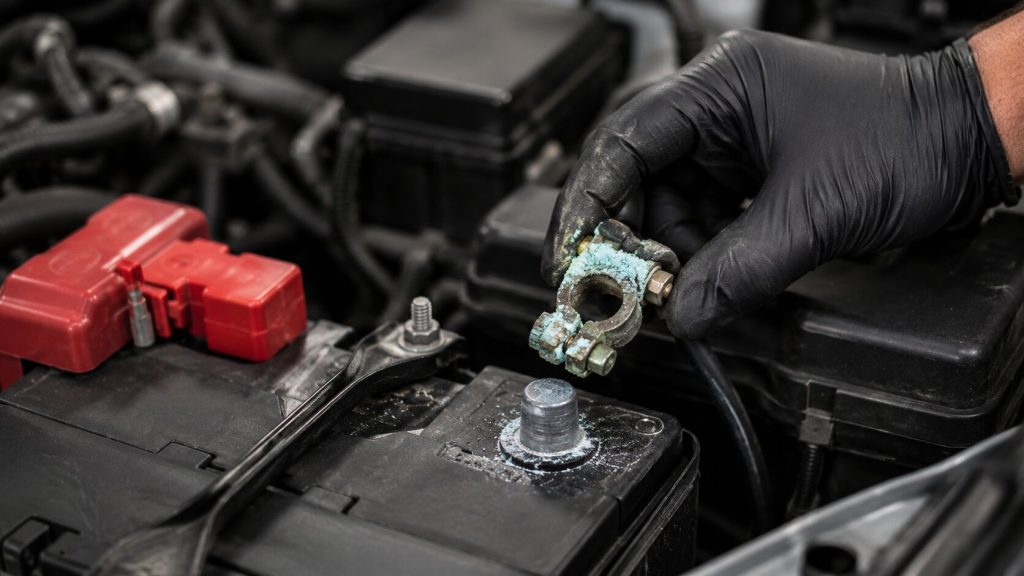
A Honda Accord that clicks, cranks slowly, or suddenly loses electrical power may not have a failed battery. In many Jacksonville vehicles, the failure begins at the battery terminal connection itself. Heat, humidity, and coastal salt exposure accelerate corrosion between the battery post and terminal clamp, creating enough resistance to block the high current needed by the starter motor.
The result is a common pattern: the battery tests are acceptable, but the vehicle still will not start.
| Category | Diagnostic Detail |
| Common Symptoms | Rapid clicking, slow cranking, intermittent no-start condition |
| Failed Component | Battery post and terminal clamp connection |
| Main Failure Mode | High electrical resistance caused by corrosion buildup |
| Diagnostic Tools | Digital multimeter, voltage drop testing, battery conductance analyzer |
| Environmental Stress | Jacksonville heat, humidity, and salt exposure near coastal areas |
| High-Risk Driving | Short trips, stop-and-go traffic, Beach Boulevard and Arlington routes |
Why Jacksonville Heat Accelerates Battery Terminal Failure
Lead-acid batteries naturally release small amounts of hydrogen gas and acidic vapor during operation. Under normal conditions, this process is controlled. However, Jacksonville summers create a more aggressive environment. When outside temperatures stay above 90°F, underhood temperatures can climb significantly higher after driving. This heat increases electrolyte evaporation and accelerates corrosion at the battery posts.
The corrosion is not always visible from above. Some of the worst failures develop underneath the terminal clamp, where the connection surface between the clamp and battery post begins breaking down.
The typical progression of battery terminal failure in hot, humid, coastal conditions can be summarized as follows:
| Factor | Effect on Battery Terminal |
| High ambient temperature and underhood heat | Accelerates electrolyte evaporation and vapor release |
| Acidic vapor from battery operation | Reacts with metal surfaces, initiating corrosion |
| Coastal salt exposure | Catalyzes galvanic reactions at the terminal-clamp interface |
| Corrosion buildup | Pitting and loss of metal contact area between post and clamp |
| Electrical impact | Higher resistance reduces current flow to the starter, causing slow cranking or no-start |
| Visual indicators | Blue-green powder indicates copper corrosion; white/gray deposits indicate lead corrosion |
Regardless of the color or composition of the deposits, the result is the same: the terminal connection cannot carry starter current efficiently, leading to intermittent or complete starting failures.
What a Failing Battery Terminal Looks Like During Diagnosis
A common mistake is replacing the battery immediately after a no-start complaint.
A battery may show 12.6 volts at rest and still be unable to deliver power through a damaged connection. Starting requires a large current draw, often well over 100 amps. A small amount of resistance at the terminal can create a major voltage loss under load.
A typical diagnostic case involves a customer reporting:
- “The Accord clicks when I turn the key.”
- “The battery was replaced recently.”
- “It starts after a jump but fails again.”
In these cases, the battery may not be the problem.
A voltage drop test often reveals the actual failure.
For example, a Honda Accord arriving with a good battery test may show:
- Battery resting voltage: 12.6 volts
- Battery test result: Pass
- Positive terminal voltage drop during crank: 350–400 millivolts
That reading indicates the connection is restricting current flow. Cleaning the terminal or replacing the damaged clamp restores the electrical path.
Proper Battery Terminal Testing Procedure
Visual Inspection
The first step is checking for:
- White, green, or powdery deposits around the terminal
- Loose clamps
- Cracked terminal ends
- Pitting on the battery post
- Stretch marks or damage that prevent proper tightening
A terminal that reaches the end of its adjustment range but still feels loose is usually damaged and should be replaced.
Voltage Drop Testing
A resting voltage test only shows battery charge level. It does not measure connection quality.
The correct procedure:
- Set a digital multimeter to DC millivolts.
- Place one probe directly on the center of the battery post.
- Place the second probe on the terminal clamp metal.
- Crank the engine.
- Record the voltage difference.
A healthy connection should show very little voltage loss.
A reading above approximately 0.2 volts (200 millivolts) during cranking indicates excessive resistance at the connection point.
Battery Conductance Testing
After confirming the terminal connection, a battery analyzer can measure:
- Cold cranking capacity
- Internal resistance
- State of health
High internal resistance may indicate battery aging or sulfation. However, condemning the battery before testing the connections can lead to unnecessary replacement.
Jacksonville Driving Patterns That Increase battery terminal corrosionRisk
Driving habits can influence how quickly they develop. Vehicles used for frequent short trips, Arlington commutes, or stop-and-go traffic along routes like Beach Boulevard experience repeated starting cycles and underhood heat exposure.
These conditions can contribute to:
- Higher battery temperatures during repeated heat cycles
- More frequent charging and discharging events
- Increased stress on battery connections
- Faster corrosion buildup at the terminal interface
- Shortened battery and terminal service life
Coastal air alone does not immediately damage a battery, but Jacksonville’s combination of salt exposure, high humidity, and summer heat creates an environment where corrosion can progress faster, especially when vehicles are repeatedly exposed to heat cycles without longer drives that allow the charging system to fully recover the battery.
Check the Connection Before Replacing the Battery
When a Honda Accord has a no-start complaint, the first question should not always be “Is the battery dead?”
The more accurate question is:
Can the battery deliver current through the connection?
A battery with normal voltage can still fail to start the engine if corrosion has created excessive resistance between the post and terminal clamp.
Testing the connection with a voltage drop measurement identifies the actual failure point and prevents unnecessary parts replacement.
Preventing Repeat Battery Terminal Problems
A reliable starting system depends on more than installing a quality battery. The battery post and terminal clamp connection must maintain a clean, secure contact surface that can handle the high current demand of the starter motor.
To help prevent future no-start conditions, inspect the battery terminals during routine maintenance and address corrosion before it spreads into the contact area between the clamp and battery post. A terminal that is loose, stretched, cracked, or unable to tighten securely should be repaired or replaced rather than simply cleaned.
If starting problems appear, a voltage drop test can identify hidden resistance that a standard battery test may miss. After any terminal repair, checking the charging system confirms the alternator and battery are operating correctly and helps prevent repeat electrical issues.
Ignoring battery terminal corrosion can lead to intermittent starting problems, charging irregularities, and unnecessary parts replacement. Identifying high resistance early is usually faster and more cost-effective than replacing a battery, starter, or charging component that is not actually failing.
For Jacksonville Honda owners, especially those driving in coastal heat, humidity, and salt exposure, regular battery connection inspections can help prevent unexpected breakdowns. Everything Automotive uses proper electrical testing procedures to identify whether the issue is the battery, terminal connection, or charging system before recommending repairs.
Their work is backed by a 36-month / 36,000-mile nationwide warranty. Visit their Jacksonville locations at 7624 Beach Blvd., Jacksonville, FL 32216, where the team can be reached at 904-712-2974, or at 6211 Blanding Blvd., Jacksonville, FL 32244, with service available at 904-827-7601.
Frequently Asked Questions
Can a Honda Accord battery test well but still fail to start?
Yes. A Honda Accord can have a healthy battery and still fail to start if corrosion creates excessive resistance between the battery post and terminal clamp.
What are the symptoms of a corroded battery terminal on a Honda Accord?
Common symptoms include rapid clicking, slow engine cranking, intermittent starting problems, or complete loss of electrical power. Some vehicles may start after a jump-start but fail again later because the battery is not the issue—the corroded terminal connection is restricting current flow to the starter.
How do you test a Honda Accord battery terminal for corrosion-related failure?
The most accurate test is a voltage drop test performed while the engine is cranking. A technician places one multimeter lead on the battery post and the other on the terminal clamp to measure resistance across the connection. A reading above approximately 0.2 volts (200 millivolts) indicates excessive resistance that can prevent proper starter operation.
Can Jacksonville humidity and salt air damage Honda Accord battery terminals?
Yes. Jacksonville’s combination of coastal salt exposure, high humidity, and summer heat accelerates corrosion at battery connections.
