
A Honda Civic overheating at idle is often caused by a failed radiator fan, electrical control issue, or airflow problem. Symptoms include rising temperature in traffic, warm A/C at stops, and normal operation while driving. Proper diagnosis requires fan command testing, voltage checks, and current draw measurements.
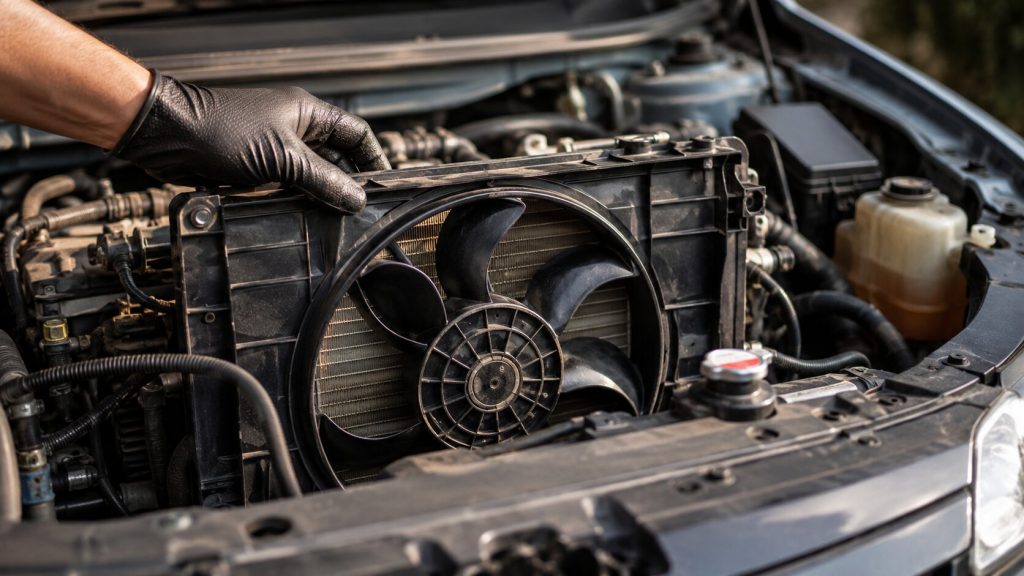
A Honda Civic that stays cool on the highway but overheats while sitting in traffic often has an airflow problem, not a coolant problem. When the electric radiator fan stops moving air through the radiator, the engine can quickly lose its ability to control temperature during Jacksonville’s hot, humid summer traffic conditions.
Quick Facts
| Item | Details |
| Common Symptom | A/C turns warm at idle, temperature rises in traffic, cools down while driving |
| Failed Component | Electric radiator cooling fan motor, fan relay, wiring, or control circuit |
| Diagnostic Tools | Bidirectional scan tool, digital multimeter, current clamp, automotive oscilloscope |
| Local Stress Factors | Southside Boulevard congestion, Regency corridor traffic, 95°F+ summer temperatures |
| High-Risk Driving Pattern | Long idle periods during afternoon traffic with little vehicle airflow |
Fan Failure in Jacksonville Traffic
At highway speeds, your Honda Civic receives natural airflow through the radiator. Once speeds drop below roughly 30–35 MPH, that airflow decreases significantly. During a traffic backup on Southside Boulevard or around Tinseltown, the radiator depends almost entirely on the electric cooling fan.
The failure pattern I see is usually this: the Civic runs normally while moving, but coolant temperature begins climbing after several minutes of sitting still. The driver may also notice the A/C blowing warm because many Honda systems reduce cooling performance when engine temperatures rise.
The fan motor is exposed to repeated heat cycles. During a hot Jacksonville afternoon, radiant heat from asphalt surfaces combined with humid air keeps underhood temperatures elevated even after the vehicle stops moving. Over time, that heat can weaken internal motor components, increase electrical resistance, and cause excessive current draw.
A failing fan motor does not always quit immediately. Many begin by pulling more amperage than normal. That extra electrical load creates additional heat inside the motor, accelerating wear until the fan slows down or stops completely.
Diagnosing Fan Motor vs Control Failure
A Civic overheating complaint should not automatically lead to replacing the fan assembly. The first step is determining whether the ECM is commanding the fan and whether the electrical circuit can deliver power.
A typical diagnostic process looks like this:
Customer complaint:
“Temperature rises when sitting in traffic, but drops back down when driving.”
First test:
Connect a bidirectional scan tool and command the radiator fan on.
If the scan tool commands the fan but the fan does not operate, the fault is likely in the power supply, ground circuit, relay, wiring, or fan motor.
If the ECM does not command the fan, the technician must investigate inputs such as coolant temperature sensor readings, relay control, or ECM operation.
Voltage Drop Testing for Electrical Faults
A common mistake is checking only for 12 volts at the fan connector. A circuit can show battery voltage but still fail under load because of corrosion, damaged wiring, or poor grounds.
I test the fan circuit while the motor is commanded on.
Typical acceptable readings:
- Power-side voltage drop: less than 0.2 volts
- Ground-side voltage drop: less than 0.1 volts
Higher readings point toward resistance in the circuit rather than a failed motor.
This matters because replacing a fan motor will not fix a corroded connector or damaged harness.
Current Draw Testing for Fan Failure
The most useful test for many electric fan failures is measuring current draw with a current clamp.
On many Honda Civic applications, a healthy fan motor commonly operates in the 8–12 amp range depending on model year and fan speed command.
A failure pattern I look for:
- Normal voltage at the connector
- Good ground circuit
- Fan commanded ON with scan tool
- Excessive amperage draw or no amperage draw
For example, a Civic that shows a 16+ amp spike before the fan stops turning points toward internal motor drag or bearing failure. A motor showing 0 amps with proper power and ground indicates an open internal circuit, such as failed brushes or broken windings.
That diagnostic information prevents replacing the wrong part.
Signs Your Civic Cooling Fan May Be Failing
Common warning signs include:
- A/C becomes warm when stopped but cools while driving
- Temperature rises during traffic or extended idling
- Cooling fan does not activate when commanded
- Fan runs slowly or intermittently
- Overheating occurs only on hot days
A Civic that overheats only at idle is often showing a cooling airflow problem before it becomes a major engine repair.
When I diagnose these vehicles, the key question is not “Is the fan bad?” The key question is “Why did the fan fail?”
A proper diagnosis confirms:
- The ECM is requesting fan operation.
- The relay and wiring can carry current.
- The motor receives proper voltage and ground.
- The motor’s current draw matches expected operation.
If those tests pass except for the motor current measurement, replacing the fan assembly is justified. If the electrical circuit fails testing, repairing the wiring or control side prevents repeat failures.
Preventing Honda Civic Overheating During Jacksonville Summers
A cooling fan failure usually becomes obvious at the worst possible time: sitting in afternoon traffic when outside temperatures are highest. A Honda Civic may appear completely normal during highway driving but quickly lose cooling capacity once airflow depends on the electric radiator fan.
If your Civic overheats near Southside Boulevard, Regency, or other Jacksonville stop-and-go routes, proper electrical diagnosis is more valuable than replacing parts through trial and error.
At Everything Automotive (7624 Beach Blvd, Jacksonville, FL 32216 / 6211 Blanding Blvd, Jacksonville, FL 32244), cooling system and electrical issues are diagnosed by testing the fan circuit, control signals, and component operation before recommending repairs. This approach helps identify the actual failure point and prevents unnecessary part replacement.
Frequently Asked Questions
Does a bad radiator fan cause a Honda Civic to overheat at idle?
Yes. A failed radiator fan can cause a Honda Civic to overheat while idling because the radiator loses the airflow it needs when vehicle speed is low. The problem often appears in traffic but may disappear during highway driving when natural airflow returns.
Why does my Honda Civic A/C get warm when stopped?
A failing radiator fan can cause the A/C to blow warm at idle. When the cooling fan is not moving enough air through the condenser and radiator, the A/C system may lose cooling performance, especially during hot Jacksonville weather.
How do you test a Honda Civic radiator fan motor?
A technician tests the radiator fan by checking command operation, voltage supply, ground quality, and current draw. A bidirectional scan tool can command the fan on, while a multimeter and current clamp confirm whether the motor and electrical circuit are operating correctly.
Can a Honda Civic fan motor have power but still be bad?
Yes. A radiator fan motor can receive 12 volts and still fail if internal components such as brushes, windings, or bearings are damaged. Current draw testing helps identify a motor that is electrically connected but mechanically failing.
How quickly can a Honda Civic overheat if the cooling fan stops working?
A Honda Civic can begin overheating within minutes under the right conditions. Extended idling in hot weather removes the airflow the radiator depends on, allowing coolant temperature to rise quickly if the fan is not operating.
