
A Honda Odyssey alternator may lose charging output after prolonged idling with both climate-control zones operating, especially when the alternator is already worn, heat-damaged, or contaminated by an engine-oil leak. A proper diagnosis should include battery testing, loaded charging-voltage checks, circuit voltage-drop testing, scan-data review, and AC-ripple waveform analysis.
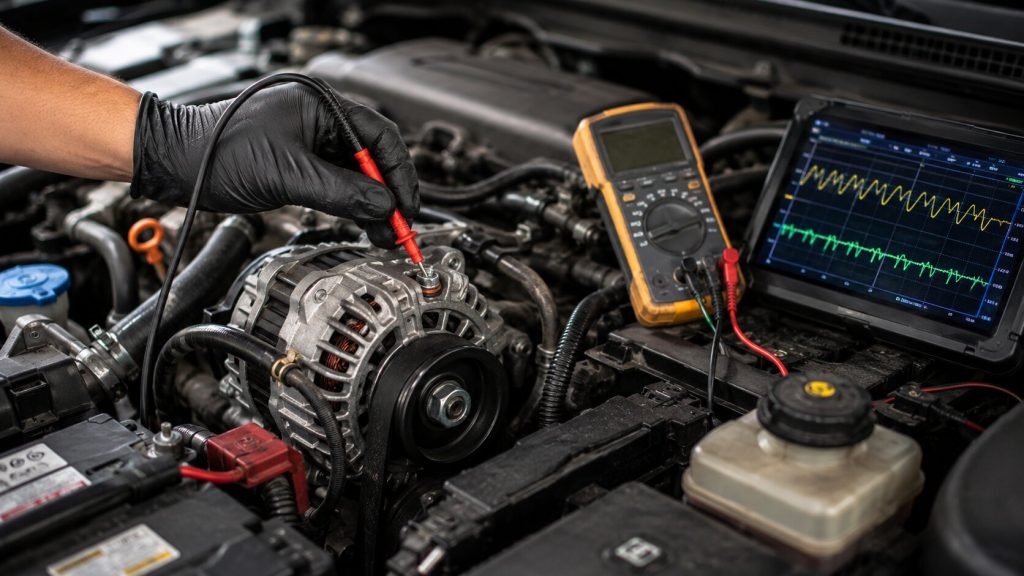
Quick Technical Summary
The most common warning signs include an illuminated battery light, flickering displays, slow power accessories, steering warnings, repeated low-voltage faults, or engine stalling.
The internal components most likely to cause this pattern are the rectifier bridge, voltage regulator, brushes, stator, or damaged internal connections.
The preferred diagnostic tools are a digital storage oscilloscope, carbon-pile load tester, scan tool, and digital multimeter.
The highest-risk operating condition is prolonged hot idling with the front and rear climate-control systems running. This commonly occurs during stop-and-go school traffic in Arlington, Regency, and other Jacksonville corridors.
Why the Alternator Fails Under Heavy Load
The alternator converts mechanical energy from the serpentine belt into electrical power. Inside the unit, the rotor spins through the stator and produces three-phase alternating current. A six-diode rectifier bridge converts that current into direct current for the battery, control modules, lighting, blower motors, and other accessories.
The rear climate-control system does not normally destroy a healthy alternator by itself. It adds electrical demand and can expose a unit that is already worn, contaminated, or operating near its thermal limit.
In Jacksonville’s late-summer heat, an Odyssey may spend 20 to 30 minutes moving at idle speed through a school pickup line. Both blower motors may be running, the radiator fans may cycle repeatedly, the headlights may be on, and the sliding doors may operate several times.
At idle, the alternator spins more slowly than it does at road speed. That reduces both available output and the airflow moving through the alternator housing. At the same time, the electrical load remains high and underhood temperature continues to rise.
A weak rectifier diode, regulator, brush connection, or stator winding may perform normally during a cold start and then become unstable after the alternator heat-soaks. Charging voltage may begin to fall, ripple may increase, and the battery may start supplying power that the alternator can no longer provide.
Once battery reserve begins dropping, the driver may see a battery warning light, flickering displays, slow accessories, steering or stability warnings, and multiple low-voltage fault codes. If charging output is not restored, the engine may eventually stall when system voltage falls below the operating range required by the ignition, fuel, and control systems.
What Excessive AC Ripple Means
The alternator stator produces AC voltage, but the vehicle electrical system requires DC voltage. The rectifier bridge should convert the waveform into relatively smooth charging current.
When a diode fails open or shorts internally, part of the three-phase waveform may disappear or become distorted. The result is excessive AC ripple on the DC charging circuit.
Excessive ripple may cause flickering instrument displays, charging-system warnings, low-voltage fault codes, unstable module communication, slow power accessories, and battery discharge while driving.
Severe ripple can interfere with electronic systems, but permanent module damage should not be assumed without diagnostic evidence. The immediate concern is usually reduced alternator output and loss of battery reserve.
The Oil Leak That Should Not Be Missed
On applicable Honda V6 layouts, an oil-control or spool-valve assembly is positioned above the alternator. As seals age, oil may run down the front of the engine and enter the alternator housing.
I do not treat the alternator as an isolated failure when I see fresh oil tracks on the casing. Oil can contaminate the brushes, regulator, and internal connections. Replacing the alternator without correcting the engine-oil leak can lead to another charging failure.
The exact component name and repair procedure should be confirmed by model year and engine configuration before parts are ordered.
Testing the Charging System
I do not condemn an Odyssey alternator from one idle-voltage reading. Honda charging strategy can vary with battery condition, electrical demand, engine speed, and computer command.
I repeat the test after the engine is fully warm and the front and rear blowers, headlights, and rear defroster are operating.
Battery Condition
The battery is tested first.
A discharged, sulfated, or internally damaged battery can overload the alternator and distort the results of a charging test. I check battery state of charge, available cranking performance, and internal resistance before evaluating alternator output.
A weak battery should be charged and retested before the alternator is condemned.
Belt and Cable Inspection
The serpentine belt, tensioner, battery terminals, engine grounds, and alternator connections must be inspected.
A loose belt, corroded ground, or excessive cable resistance can produce the same low-voltage symptoms as a failed alternator.
Voltage-drop testing should be performed on both the positive and ground sides of the charging circuit while the system is loaded.
Loaded Output Testing
The engine is brought to operating temperature before the test.
The front and rear blower motors, headlights, rear defroster, and other appropriate loads are switched on. Charging voltage and current are then monitored at idle and at a controlled engine speed.
A voltage reading below 13.5 volts at idle does not automatically prove alternator failure. The technician must also consider battery state of charge, commanded charging output, engine speed, electrical load, and circuit voltage drop.
The most useful result is whether the alternator can maintain stable output after the unit becomes fully heat-soaked.
AC Ripple Waveform Testing
A digital storage oscilloscope is connected at the alternator B+ terminal or battery, depending on the test procedure.
A healthy waveform should display a consistent repeating pattern without a missing phase or severe downward spike.
Ripple below approximately 50 millivolts under load is generally desirable. A reading above that level should be investigated, but it is not automatic proof that the alternator must be replaced.
On a recent Odyssey diagnosis, charging voltage remained stable during the initial cold test but began falling after the engine and alternator were fully heat-soaked. Under full accessory load, the ripple waveform developed a missing phase while output current dropped. Oil witness marks were also visible on the alternator housing. The alternator and the source of the leak were repaired together.
A clear waveform fault combined with low loaded output provides stronger evidence than a single AC-voltage reading from a handheld meter.
A Proper Replacement Decision
I would not replace the alternator because the battery light flickered once or because charging voltage briefly dropped below a fixed number.
Replacement is justified when the battery is charged, the belt and connections pass inspection, charging command has been considered, voltage-drop results are acceptable, and the alternator shows unstable output, excessive ripple, or a missing phase under load.
When oil contamination is present, the leak must be repaired during the same service.
Signs That Need Immediate Testing
Schedule a charging-system inspection when the Odyssey shows any of the following
- Battery warning light after extended idling
- Flickering dashboard or interior lighting
- Slow sliding-door operation
- Repeated low-voltage fault codes
- Steering or stability-system warnings
- A burning smell near the alternator
- Fresh oil on the alternator housing
- A battery that repeatedly goes dead
- Engine stalling after warning lights appear
A battery warning light usually means the vehicle is operating on stored battery energy. Once that reserve is exhausted, the engine and control systems may shut down.
Schedule a Loaded Charging-System Test
If your Odyssey’s battery light appears after extended idling, schedule a loaded charging-system test at Everything Automotive, located at 7624 Beach Blvd, Jacksonville, FL 32216 or 6211 Blanding Blvd, Jacksonville, FL 32244.
Our diagnostic process includes battery evaluation, cable voltage-drop testing, loaded alternator-output testing, and AC-ripple waveform analysis before replacement is recommended. Customers receive a written estimate before repairs begin.
Qualifying repairs include the shop’s stated 36-month or 36,000-mile nationwide warranty through the Parts Plus Car Care Center network. Warranty terms and coverage should be confirmed at the time of service.
Frequently Asked Questions
Can rear air conditioning cause alternator failure?
No. Rear air conditioning alone does not normally cause alternator failure. It increases electrical demand and may expose an alternator that is already worn, overheated, oil-contaminated, or unable to maintain sufficient output at low engine speed.
Is more than 50 millivolts of ripple proof of failure?
No. A reading above approximately 50 millivolts requires further testing. The waveform shape, test location, electrical load, alternator temperature, and measuring equipment must also be considered. A missing phase or substantially elevated ripple provides stronger evidence of internal alternator failure.
Can an oil leak damage the alternator?
Yes. On applicable Honda V6 engines, oil leaking from a component above the alternator can enter the housing and contaminate the brushes, regulator, or electrical connections. The oil leak should be repaired before or during alternator replacement.
Will the Odyssey keep running without alternator output?
Yes, but only temporarily. The vehicle will operate from the remaining battery reserve until system voltage falls below the level required by the ignition, fuel, and control systems. Runtime depends on battery condition and the number of electrical accessories operating.
