
A Honda hybrid may reduce electric-motor assist when the power-control electronics overheat. On models equipped with a liquid-cooled inverter circuit, possible causes include low coolant, trapped air after service, a weak electric pump, restricted heat-exchanger airflow, wiring faults, or a temperature-sensor problem. The correct diagnosis depends on the model, stored trouble codes, pump operation, and measured temperatures.
Signs of an Inverter Cooling Problem
A cooling-system fault may appear only after the vehicle has been driven in slow, hot traffic.
Common symptoms include
- Hybrid system or IMA warning message, depending on the model
- Sudden loss of electric-motor assist
- Reduced-power or fail-safe operation
- Warning that disappears after the vehicle cools
- Faults that return during long periods of low-speed driving
Jacksonville traffic can expose a marginal cooling system because vehicle speed and airflow through the front heat exchangers remain low. A slow crawl across the Buckman Bridge, I-295, Beach Boulevard, or Blanding Boulevard may not create the fault by itself, but it can reveal a weak pump, trapped air, low coolant, or restricted heat exchanger.
Slow Traffic Can Trigger the Warning
The inverter and power-control electronics manage electrical energy between the high-voltage battery and the drive motor. That process creates heat, especially when the system repeatedly switches between electric assist, regeneration, and engine operation.
On Honda hybrid models that use a dedicated liquid-cooling circuit, an electric pump moves coolant through the power-control unit and a separate heat exchanger. The pump must keep coolant moving through the power-control unit and front heat exchanger, especially during repeated assist and regeneration.
Problems begin when coolant flow is reduced.
Possible causes include
- Low coolant level
- Air trapped after cooling-system service
- A weak or failed electric coolant pump
- A restricted heat exchanger
- Debris limiting airflow through the cooling stack
- Corroded connectors or excessive circuit resistance
- A faulty temperature sensor or control circuit
Prolonged stop-and-go driving reduces ram airflow through the front of the vehicle. With the air-conditioning system also adding heat in Jacksonville weather, a marginal inverter cooling circuit may no longer keep temperature within the expected range.
What is Tested First
We do not assume the inverter has failed just because the vehicle enters reduced-power mode.
The first step is to identify the exact Honda model, year, hybrid system, warning message, and stored diagnostic trouble codes. Honda has used different hybrid designs over the years, so IMA, IPU, PCU, and inverter terminology should not be treated as interchangeable.
The diagnostic procedure must match the vehicle.
Scan Tool Pump Activation
On systems that allow bidirectional control, we use a factory-level scan tool to command the electric coolant pump on while monitoring live data.
This confirms whether the control module is requesting pump operation and whether the circuit responds.
We check
- Pump command
- Relevant temperature data
- Stored and pending trouble codes
- Freeze-frame information
- System voltage
- Warning history when available
Looking at the reservoir alone is not enough. Some systems show very little visible movement even when the pump is operating, while others may show movement despite reduced flow elsewhere in the circuit.
Electrical Circuit Testing
If the pump does not operate, we test the circuit before replacing parts.
That includes checking
- Power supply under load
- Ground integrity under load
- Connector condition
- Fuse and relay operation where applicable
- Voltage drop across the power and ground sides
- Pump current draw
Current draw can help identify a pump that is not operating normally, but the reading must be compared with the correct service information or a known-good vehicle. A single current value should not be used to declare an air lock, disconnected impeller, or failed bearing without supporting evidence.
Thermal Imaging and Temperature Comparison
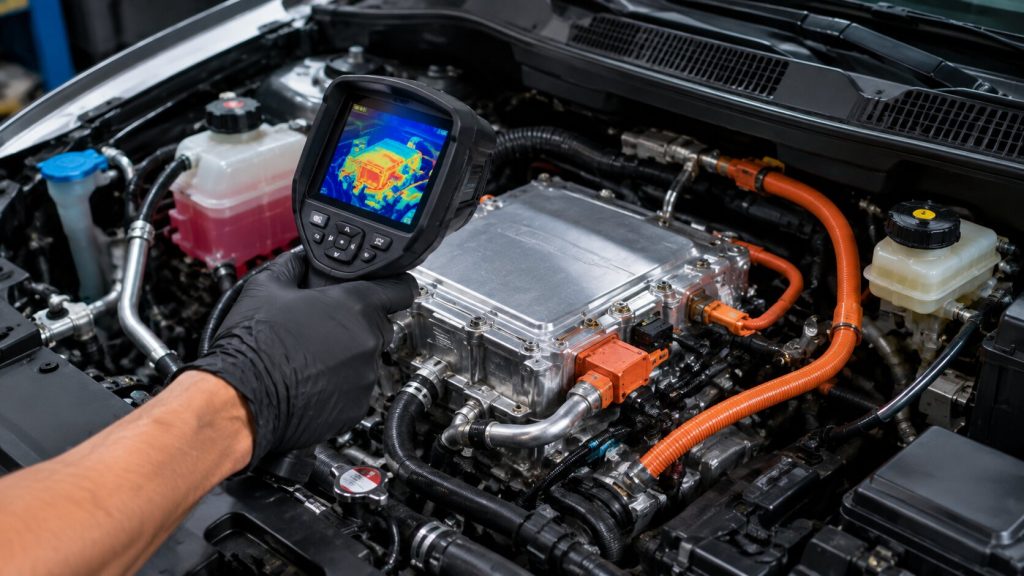
A thermal imaging camera can help show how heat moves through the cooling circuit.
With the pump running and the system warm, we compare the temperature of the inlet hose, outlet hose, power-control-unit housing, and heat-exchanger surface.
A large hot-to-cold separation may indicate reduced circulation or a restriction. An uneven heat-exchanger pattern may point to blocked internal passages, poor airflow, or debris between the condenser and cooling core.
The camera helps us find temperature differences, but scan data and circuit testing still determine the cause.
Coolant Condition and Air Entrapment
If the cooling circuit has been opened, repaired, or refilled, trapped air must be considered.
Air can reduce circulation through high points in the system and cause intermittent temperature problems. However, trapped air should not automatically be blamed on coolant cavitation.
We also look for
- External leaks
- Incorrect coolant type
- Low coolant level
- Contamination
- Improper bleeding
- Evidence of previous repair
- Hose damage or collapse
Coolant should be evaluated using the manufacturer’s service procedure. A voltage reading taken directly from the coolant should not be treated as proof that the fluid is acidic or electrically unsafe unless Honda specifically approves that method for the vehicle being tested.
What a Real Diagnostic Result Should Show
A credible inverter-cooling diagnosis should include more than a warning light and a parts recommendation.
The repair order should document
- Vehicle year and model
- Mileage
- Customer complaint
- Stored diagnostic trouble codes
- Conditions that triggered the warning
- Pump command and response
- Electrical test results
- Inlet and outlet temperature comparison
- Confirmed cause
- Repair performed
- Post-repair road-test result
For example, if a pump is commanded on but does not run, the next step is to verify power and ground. If the circuit is correct and the pump remains inactive, pump replacement may be justified.
If the pump runs but the outlet remains much cooler than the inlet, the technician must determine whether the circuit contains trapped air, low coolant, or a restriction before condemning the inverter.
Frequently Asked Questions
Does an inverter overheat warning mean the inverter has failed?
No. An inverter temperature warning does not automatically mean the inverter assembly has failed.
The fault may be caused by coolant loss, poor circulation, a weak pump, blocked airflow, damaged wiring, a faulty sensor, or air trapped after service. The inverter should not be replaced until those possibilities have been tested.
Can Jacksonville traffic trigger the problem?
Yes, but traffic is usually a trigger rather than the root cause.
Long periods of low-speed driving reduce airflow through the front cooling system. A weak inverter pump, restricted heat exchanger, low coolant level, or trapped air may then cause temperature to rise enough for the control system to reduce hybrid assist.
Can trapped air cause reduced cooling?
Yes, on Honda hybrid models with a liquid-cooled inverter circuit.
Trapped air can interrupt coolant movement, especially after the system has been opened or refilled incorrectly. A leak, weak pump, restriction, or electrical problem should still be ruled out.
Can the vehicle be driven with the warning on?
Continued driving is not recommended when the vehicle displays a hybrid-system temperature warning or repeatedly enters reduced-power mode.
The system may be limiting output to protect the high-voltage electronics. The vehicle should be scanned and tested before the fault is treated as a simple coolant issue or major inverter failure.
Honda Hybrid Cooling Diagnosis in Jacksonville
If your Honda hybrid loses electric assist or displays a hybrid-system warning during slow Jacksonville traffic, note when the warning appeared, how long the vehicle had been driven, and whether it cleared after cooling.
At Everything Automotive, the diagnostic process can include scan-tool testing, pump activation, loaded circuit checks, coolant-flow evaluation, and temperature comparison before parts are recommended.
Service is available at the 7624 Beach Blvd, Jacksonville, FL 32216 or 6211 Blanding Blvd, Jacksonville, FL 32244 locations. Customers receive a written estimate before repairs are performed, and qualifying services are backed by the shop’s nationwide 36-month or 36,000-mile parts and labor warranty through the Parts Plus Car Care Center network.
