
A Honda Civic can pull during braking when corroded caliper slide pins prevent the floating caliper from releasing evenly. In coastal Jacksonville, floodwater and salt exposure can accelerate slide-pin corrosion, causing brake drag, uneven pad wear, and excess wheel heat. Proper diagnosis requires temperature testing and brake inspection.
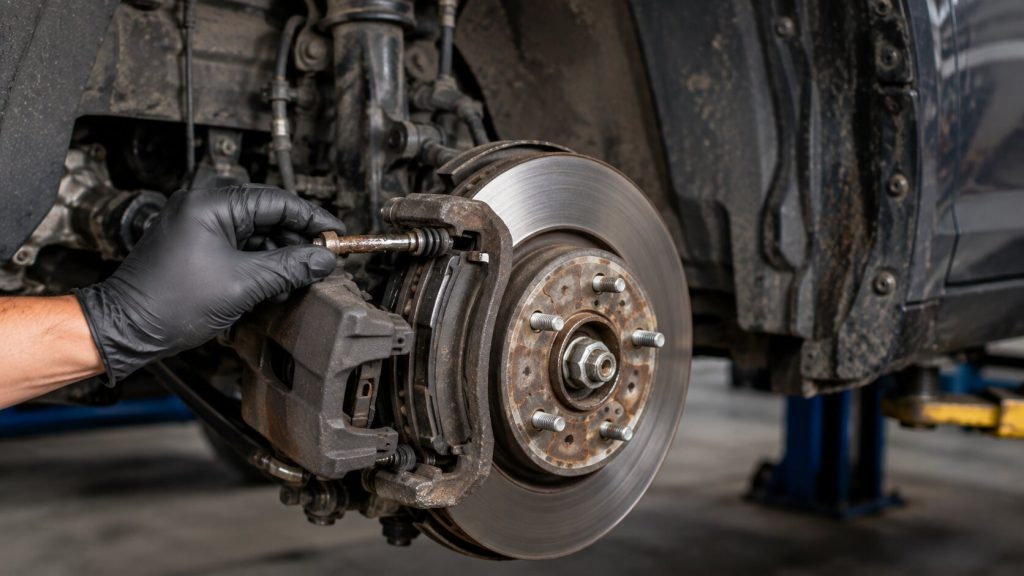
Brake Pull Warning Signs and Diagnostic Details
A Honda Civic may pull under braking when corrosion prevents the floating caliper from moving freely on its guide pins. In coastal Jacksonville, damaged slide-pin boots can allow salt-contaminated water into the bracket bore. Diagnosis requires a heat comparison followed by inspection of the pins, piston, pads, and brake hose.
| Field | Detail |
| Primary symptom | Vehicle pulling to one side under braking, metallic squealing, uneven pad wear, or excessive heat from one wheel |
| Target component | Caliper bracket guide bore, steel slide pins, rubber boots, and pad contact points |
| Diagnostic tools | Infrared thermometer, digital micrometer, and hand inspection |
| Local stressor | Brackish floodwater, coastal humidity, tidal flooding, and repeated wet-dry heat cycles |
| High-risk profile | Daily commuters near Jacksonville Beach, Southside, and low-lying sections of I-295 |
How the Floating Caliper Works
Most modern Honda Civics utilize a single-piston floating front brake caliper system.
When you press the brake pedal, hydraulic pressure pushes the inner pad against the rotor. The caliper body then slides across two lubricated guide pins and pulls the outer pad into the opposite side of the rotor.
Both pads must apply and release evenly.
The guide pins are protected by rubber boots and lubricated with brake-safe grease. When the boots are torn, dry, twisted, or poorly seated, water and contamination can reach the pin and bracket bore.
Once corrosion develops, the caliper may no longer slide smoothly.
Coastal Floodwater Makes the Problem Worse
Coastal floodwater creates a different corrosion risk than normal rain exposure because dissolved salts remain after the water dries.
Civics driven near Jacksonville Beach, through tidal flooding, or across roads exposed to coastal water face a higher corrosion risk. Water is thrown against the caliper and bracket when the vehicle enters standing water at road speed.
If a slide-pin boot is already damaged, contaminated water can remain around the pin and inside the bore. Brake heat then dries the moisture and leaves corrosive deposits behind.
The grease may become contaminated or displaced. Corrosion roughens the steel pin and creates scale inside the cast-iron guide bore. As corrosion builds inside the bore, the pin starts hanging up instead of sliding normally.
The caliper may still move slightly when the brake is applied but fail to return fully when the pedal is released.
That is when one pad starts riding against the rotor.
What the Driver Usually Notices
A sticking slide pin can produce several symptoms.
The Civic may pull to one side when slowing from highway speed on I-295. One wheel may smell hot after a normal commute. The affected brake may squeal at low speed or produce dark brake dust much faster than the opposite side.
In advanced cases, heat radiating from the wheel may be noticeable before the vehicle is parked.
Uneven pad wear is another strong clue. One pad may be worn almost to the backing plate while the pad on the opposite side of the same caliper still has usable material.
The Heat Check
I start by comparing the front brake temperatures under the same operating conditions.
An infrared thermometer can show whether one rotor is running significantly hotter than the other. A large temperature difference confirms that one brake is producing more friction, but it does not identify the failed part by itself.
A hot rotor can be caused by several issues, including:
- Seized slide pins
- A corroded caliper piston
- A restricted flexible brake hose
- Brake pads binding in the bracket
- Incorrectly installed hardware
- A bearing or mechanical fault
The temperature reading tells me where to inspect first. It does not replace disassembly.
The Mechanical Drag Test
After the vehicle is safely lifted, I rotate both front wheels by hand and compare resistance.
If one wheel stops abruptly or requires much more effort to turn, I remove the wheel and inspect the brake assembly.
The next step is to determine whether the drag is hydraulic or mechanical.
If the brake releases when the bleeder screw is opened, trapped hydraulic pressure becomes more likely. That can point toward a restricted brake hose, master-cylinder issue, or another pressure-retention problem.
If the brake remains tight after pressure is released, the fault is probably mechanical. I then inspect the slide pins, piston, pads, and bracket contact points.
This distinction prevents unnecessary caliper replacement.
On a Jacksonville Civic inspection, the right-front brake showed significantly more drag than the left after the same road test. Opening the bleeder screw did not release the wheel, which ruled against trapped hydraulic pressure. The lower slide pin showed corrosion behind the damaged boot, while the piston retracted normally. The repair required restoring the slide-pin movement and correcting the damaged hardware.
Inspecting the Slide Pins and Bracket
A healthy caliper should move across the guide pins with firm but smooth hand pressure.
Each pin should slide freely through the bracket without sticking, grinding, or catching.
After removing the pins, I look for
- Rust ridges
- Deep pitting
- Dried or contaminated grease
- Swollen rubber bushings
- Torn or loose boots
- Uneven wear along the pin shaft
A digital micrometer can be used to compare the pin diameter at several points. This can reveal heavy wear, corrosion loss, or an irregular shaft.
The micrometer does not accurately measure the inside of the bracket bore. Bore condition must be evaluated with the correct internal measuring tool, gauge, or service procedure.
Any model-specific clearance must come from the correct Honda service information or the brake component manufacturer. A universal clearance figure should not be applied to every Civic generation and caliper design.
Cleaning or Replacing the Bracket
Light surface corrosion may sometimes be cleaned, but the bore must not be enlarged during the process.
I clean loose corrosion from the guide area without removing material from the bore. If the pin still binds afterward, the bracket is replaced.
I replace the bracket when the bore is deeply pitted, enlarged, cracked, or still binds with a new pin.
Aggressive reaming is not a proper repair. Removing too much bracket material can create excessive pin movement, uneven pad application, and brake noise.
The replacement pin must be lubricated with a brake-safe product that is compatible with the rubber boots and any rubber pin bushings. Petroleum grease and incompatible lubricants can swell rubber components and create another binding problem.
Checking the Caliper Piston
A seized slide pin is not the only possible cause of a dragging brake.
The caliper piston must retract smoothly when compressed with the proper tool. A torn piston boot, visible corrosion, fluid leakage, or heavy resistance can indicate that the caliper itself requires replacement or rebuilding.
I also inspect the pads where they contact the bracket hardware. Rust beneath the stainless pad clips can lift the clips and squeeze the pad ears tightly enough to stop the pads from releasing.
That problem can imitate a seized caliper.
What Happens If You Keep Driving
A dragging brake creates continuous friction and heat.
That heat can glaze the pad surface, discolor the rotor, damage rubber components, and shorten the life of nearby brake and suspension parts.
The rotor may develop thickness variation or heat spots, leading to pedal pulsation. Continued overheating can also damage nearby rubber components and shorten wheel-bearing life.
A vehicle with severe brake pull, smoke, burning odor, or one wheel running much hotter than the others should not be driven until the cause is identified.
Honda Civic Brake Diagnosis in Jacksonville
Everything Automotive at 7624 Beach Blvd, Jacksonville, FL 32216 or 6211 Blanding Blvd, Jacksonville, FL 32244 inspects the full brake assembly before recommending repairs. The inspection includes the slide pins, bracket bores, pad fitment, caliper piston, flexible brake hose, rotor condition, and side-to-side temperature difference.
Customers receive a written estimate before approved work begins. Qualifying brake repairs are covered by a nationwide 36-month or 36,000-mile parts and labor warranty through the Parts Plus Car Care Center network.
Honda Civic owners near Beach Boulevard, Blanding Boulevard, Jacksonville Beach, Southside, and flood-prone commuter routes should have the brakes inspected if the vehicle begins pulling, squealing, producing excess brake dust, or radiating unusual heat from one wheel.
Frequently Asked Questions
Can a stuck slide pin make a Honda Civic pull while braking?
Yes. A seized slide pin can prevent the caliper from centering over the rotor. This can make one pad drag or apply unevenly, causing brake pull, excess heat, and uneven pad wear.
Does a hotter rotor prove that the slide pins are seized?
No. A hotter rotor confirms excess friction, but the cause may be a stuck slide pin, seized piston, restricted hose, pad binding, or another mechanical problem.
Can saltwater damage Honda Civic brake calipers?
Yes. Salt-contaminated water accelerates corrosion when it reaches exposed steel or enters damaged slide-pin boots. Repeated wetting, heating, and drying can leave corrosive deposits around the pins and bracket bores.
Should a corroded caliper bracket be cleaned or replaced?
Replacement is the better choice when the guide bore is deeply pitted, enlarged, cracked, or still binds after careful cleaning. Light surface corrosion may sometimes be removed without damaging the bore.
