
Keeping commercial fleets cooling in extreme Florida heat requires aggressive maintenance strategies and specialized component upgrades. Constant high idle times and high cabin dust quickly clog standard filters and overheat factory parts. Proactive heavy duty compressor retrofits and frequent cabin filter services ensure maximum uptime for local work service vans.
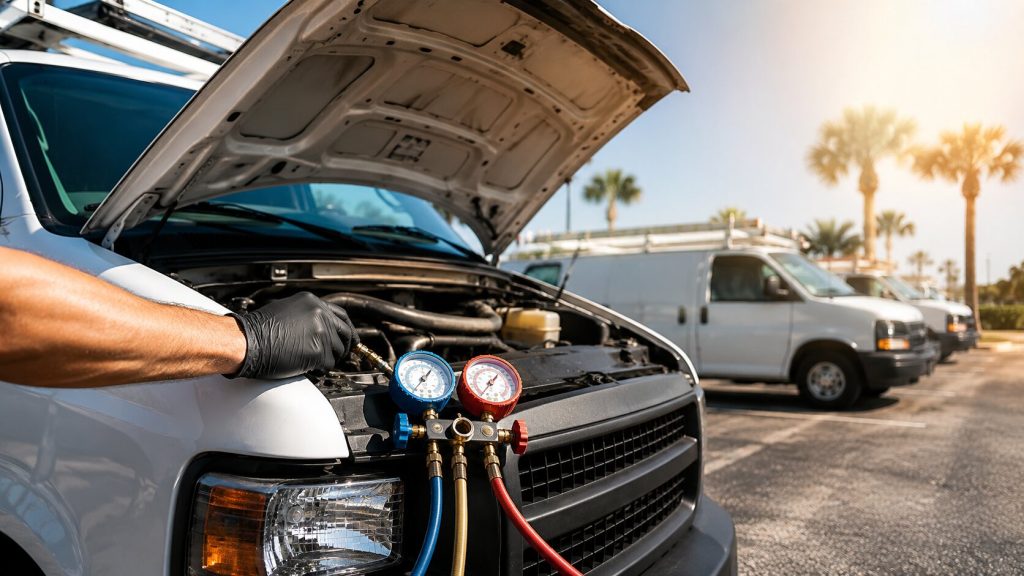
Constant Idling on Local Routes Cooks Standard Fleet HVAC Systems
I’ve been turning wrenches since 1983, and since establishing Everything Automotive in 2012, I’ve managed commercial fleets and service vehicles for contractors, plumbers, and HVAC technicians all across Jacksonville. By July, most fleet vans here are running AC systems 10 hours a day before they even hit afternoon dispatch traffic. With our A/C season running from March through November, local fleets require eight to nine months of near-continuous climate control—roughly three times the demand placed on vehicles in northern states.
When my fleet customers navigate busy, stop-and-go corridors like Blanding Boulevard or Southside Boulevard, their vans spend hours sitting in heavy traffic. I see condenser temperatures spike hardest when vans sit trapped on Southside Boulevard with ladder racks blocking airflow.
When your service technicians sit idling at a job site with the engine running and the A/C blasting, there is zero natural, convective wind passing through the grille to cool the condenser. Under-hood temperatures can easily soar past 130°F, forcing the A/C compressor to operate under extreme thermal loads without any cooling relief.
The Thermodynamics of High Idle Heat and Oil Return Failure
In my experience, spontaneous compressor failures on local work vans are rarely random. They almost always stem from a predictable lubrication failure caused by extended idling:
- Low Engine Speed Restricts Oil Return: Your vehicle’s A/C compressor relies on the continuous circulation of refrigerant to carry synthetic Polyalkylene Glycol (PAG) oil back to its crankcase . When a service van idles at low engine RPM, the refrigerant’s flow velocity drops significantly .
- Oil Becomes Trapped in the System: Because the refrigerant lacks the velocity to move the oil, the lubricant pools and becomes trapped in the low points of the condenser and evaporator .
- The Compressor Runs Dry: Deprived of its protective oil film, the high-speed compressor pistons scrape directly against the steel cylinder walls, causing severe metal-on-metal friction and heat .
- Varnish and Sludge Take Over: This extreme heat causes the remaining oil to oxidize, polymerize, and degrade into a thick, carbonaceous black sludge .
- Black Death Seizes the Compressor: If moisture seeps into the system, it reacts with the refrigerant to form highly corrosive hydrochloric and hydrofluoric acids. These acids dissolve internal components, turning the oil into a thick, abrasive black goo. The compressor suffers total mechanical seizure, often snapping the pulley hub limiter.
Upgrading to Heavy Duty Compressors and Robust Condensers
To prevent these costly, unscheduled fleet breakdowns, I recommend upgrading your commercial vehicles with heavy-duty components designed for continuous high-load and high-idle cycles:
| Upgrade Component | Technical Advantage | Operational Benefit for Local Fleets |
| Sanden SHD Compressor | Upgraded heavy duty internal swash plates and dual row ball bearings | Resists rotational fatigue and constant high speed belt stress during 24/7 service |
| Denso Heavy Duty Clutch | Upgraded high temp snap rings and PTFE treated pistons | Prevents clutch slippage and swash plate lockup under maximum high side thermal loads |
| Parallel Flow Condenser | Micro channel flat tube aluminum construction | Provides rapid heat rejection even when sitting stationary in 130 degree engine bays |
For fleet vans that idle all day, I avoid standard aftermarket compressors entirely.
Keeping Cabin Air Filters Clean in Dusty Work Environments
Another major threat to your fleet’s cooling performance is a clogged cabin air filter. Many commercial vehicle operators do not even realize their work vans have a cabin filter, leaving it to accumulate a thick layer of dust, leaves, and mold over years of service.
Jacksonville’s intense, year-round pollen seasons—oak in the spring, grass in the summer—combined with dusty construction sites and unpaved roads, clog these filters much faster than the manufacturer’s standard intervals assume.
A clogged cabin filter severely restricts the volume of air that the blower fan can push across your cold evaporator core . Because there is insufficient airflow to transfer heat from the cabin, the evaporator’s temperature drops below freezing, causing condensation to instantly freeze into a solid block of ice on the cooling fins . This ice block cuts off all cabin cooling, reducing refrigerant circulation efficiency and increasing compressor operating stress.
For our local commercial fleets, I mandate replacing cabin air filters every 12,000 miles to keep blowers running freely and keep your technicians comfortable in the field.
Proactive Fleet Maintenance Programs Prevent Expensive Down Time
At Everything Automotive, we have anchored the Duval County business community since 2012 by focusing on structured, diagnostic-led fleet maintenance. I know that a service van sitting idle at a job site with its engine running accumulates wear hours without adding miles to the odometer .
An engine idling for just four hours a day experiences the equivalent of 40 to 60 road miles of mechanical wear per session .
That is why I help local businesses implement dual-trigger maintenance schedules that trigger service based on whichever limit—engine hours or odometer miles—reaches its threshold first .
We connect advanced diagnostic tablets to monitor real-time high- and low-side pressures, check for microscopic refrigerant leaks with electronic halogen sniffers, and clean our clients’ condenser faces to ensure optimal airflow .
Fleet downtime costs contractors far more than compressor replacement ever will.
Don’t let a failed AC compressor or a clogged cabin filter sideline your work vans this summer. Contact me at Everything Automotive of Jacksonville, Inc. to schedule a professional commercial fleet AC diagnostic check.
- Visit us at our Eastside location (7624 Beach Blvd, Jacksonville, FL 32216 | 904-800-2714)
- Our Westside location (6211 Blanding Blvd, Jacksonville, FL 32244 | 904-813-7097)
Frequently Asked Questions
Will excessive idling cause my fleet vehicle AC compressor to fail?
Yes. Extended idling at low engine RPM slows down the refrigerant’s flow velocity, trapping vital lubricating oil in the system’s low points and starving the compressor of lubrication.
Can a dirty cabin air filter reduce my vehicle cooling performance?
Yes. A clogged cabin air filter restricts the volume of air passing over the cold evaporator core, reducing overall heat transfer and forcing the compressor to run under continuous, heavy thermal load.
Is it possible to flush a modern parallel flow condenser clean of sludge?
No. Modern parallel-flow condensers feature incredibly narrow micro-passages that permanently trap carbonized sludge and metallic debris, meaning they cannot be flushed and must be replaced to prevent ruining a new compressor.
