
Moisture absorbed from humid Jacksonville air degrades polyglycol brake fluid, lowering its boiling point and corroding internal ABS valves. This contamination causes a spongy pedal and dangerous vapor lock during sudden stops on JTB, requiring a professional pressurized system flush to restore stopping power and protect your critical safety modulators.
The Jacksonville Commute and the Threat of Vapor Lock
If you drive daily in Jacksonville, you are subjecting your vehicle to severe-service conditions that are far more intense than national averages assume.
Consider the high-speed geometry of J. Turner Butler Boulevard (JTB / State Road 202). On JTB commuter vehicles that see repeated 70–75 mph braking events, brake temperatures rise fast enough to accelerate moisture breakdown in older fluid. When traffic suddenly grinds to a halt at major bottlenecks like the San Pablo Road diverging diamond or the Southside Boulevard cloverleaf, you are forced to make a sudden, high-stress stop.
During these sudden deceleration events, your vehicle’s kinetic energy is instantly converted into intense thermal energy through the friction of your brake pads squeezing the rotors. Under repeated hard braking, rotor surface temperatures can vary widely depending on vehicle weight, pad type, and driving pattern, often reaching several hundred degrees Celsius in testing conditions.
If your brake fluid is healthy, it remains an incompressible liquid that safely maintains stopping power. However, if your fluid has been contaminated with water pulled from our humid Jacksonville atmosphere, that heat triggers a catastrophic failure mode known as Vapor Lock.
Because water boils at a much lower temperature than pure brake fluid, the intense heat causes the trapped water to instantly vaporize into steam inside your brake lines. Unlike liquid, gas is highly compressible. When you press the brake pedal in an emergency, your foot’s mechanical force is entirely wasted on compressing these steam bubbles instead of squeezing your brake pads. Your brake pedal sinks all the way to the floorboard with zero deceleration, which can significantly increase stopping distance and reduce braking confidence in emergency conditions.
The Chemistry of Moisture Absorption and Fluid Degradation
The reason glycol-based brake fluid absorbs moisture from ambient air over time is due to its chemical base. The vast majority of passenger vehicles on Duval County roads use polyglycol-ether-based fluids, categorized as DOT 3, DOT 4, or DOT 5.1. These glycol-ether fluids are highly polar organic compounds.
Glycol-based brake fluid has a chemical structure that naturally attracts and bonds with moisture from the air.
In high-humidity environments like Northeast Florida, in my experience, fluid in humid climates tends to reach elevated moisture levels sooner between service intervals.
To help you understand the limits of different fluid grades and how moisture impacts them, I have outlined their core characteristics below:
| Fluid Grade | Base Chemical | Minimum Dry Boil | Minimum Wet Boil | Typical Application |
| DOT 3 | Glycol Ether | 401 F | 284 F | Older commuter vehicles with moderate thermal braking loads |
| DOT 4 | Glycol Ether and Borate Ester | 446 F | 311 F | Modern ABS and traction control vehicles under heavy load |
| DOT 5.1 | Glycol Ether and Borate Ester | 500 F | 356 F | High performance sports vehicles and heavy duty towing trucks |
| DOT 5 | Diorgano Polysiloxane | 500 F | 356 F | Specialized classic cars and military vehicles without ABS |
Polyglycol-ether formulations rely heavily on borate esters to resist boiling point depression. These additives help slow the drop in boiling point as small amounts of moisture enter the system.
Content with water contamination increases rapidly as these protective additives are completely consumed—which in humid environments can occur sooner than typical manufacturer service intervals.
How Water Inside Your Lines Destabilizes the ABS Pump
When water contaminates your brake lines, it does more than just lower your fluid’s boiling point. Over my decades in the shop, I have seen moisture trigger a silent, highly destructive electrochemical process inside your vehicle’s safety systems. Here is exactly how water intrusion inside your lines disables your anti-lock brakes and creates a spongy pedal:
- The Battery-Like Chemical Reaction
Your vehicle’s Anti-Lock Braking System (ABS) and Electronic Stability Control (ESC) rely on a highly complex aluminum manifold block containing steel electromagnetic solenoid valves. When moisture is present, it can accelerate galvanic corrosion between dissimilar metals in the ABS assembly. The aluminum block acts as an anode and the steel acts as a cathode, which can accelerate galvanic corrosion between aluminum housing and steel components over time. - The Formation of Abrasive Sludge and Debris
As this internal galvanic corrosion progresses, the chemical reaction generates a thick, white, powdery or gelatinous aluminum-hydroxide precipitate. Simultaneously, the steel solenoid pintles undergo localized oxidation, producing corrosion byproducts that can circulate within the brake system over time. - Solenoid Valve Binding from Internal Contamination
The solenoid spool valves operate with very tight internal tolerances, making them sensitive to contamination. When scaly rust and white aluminum-oxide precipitates clog these tight clearances, which may contribute to intermittent solenoid sticking or delayed response. - Internal Pressure Bypass
During an active ABS event, a stuck solenoid cannot seal properly, causing hydraulic fluid to slowly leak or bypass internally from the high-pressure wheel circuits back into the low-pressure accumulator. This type of internal bypass can contribute to a soft or inconsistent brake pedal feel. - Wasted Stopping Power
Because of the leak past the eroded solenoid seats inside the ABS block, the fluid displaced by your master cylinder is wasted. This can affect hydraulic pressure consistency at the calipers, especially during ABS activation.
How We Test Brake Fluid Condition and ABS System Performance
At Everything Automotive, I do not believe in guessing or relying on cheap visual-only diagnostic checks. Fluid that looks clean on a basic visual inspection can still be heavily contaminated with water. When my technicians and I inspect your vehicle’s braking system at my Beach Boulevard or Blanding Boulevard locations, we utilize advanced quantitative diagnostic tools to measure the real-world condition of your fluid:
- Electronic Boiling Point Analyzers: Unlike basic conductivity tests, which only estimate contamination, boiling point testing measures actual thermal safety margin.This provides one of the most reliable indicators of brake fluid condition in service environments.
- Optical Refractometers: My team uses optical refractometers to measure the refractive index of the fluid, which changes predictably based on the exact concentration of water molecules dissolved in the polyglycol-ether base.
- Chemical Copper Strip Testing: To catch corrosion before scaly aluminum precipitates form, I use chemical test strips to measure the concentration of dissolved copper in the fluid. Copper is the first metal to corrode when the anti-wear and corrosion-inhibitor additives deplete, giving us an early warning of impending galvanic wear inside your expensive ABS block.
Complete Pressurized Fluid Exchange versus the Cheap Reservoir Siphon
Many generic quick-lube shops offer a cheap brake fluid exchange where they simply siphon the old fluid out of your master cylinder reservoir and pour in fresh fluid. This method typically leaves a significant portion of degraded fluid inside the system.
A basic reservoir siphon only replaces about 30% of the total fluid volume, leaving the most heavily degraded, water-logged, and acidic fluid trapped deep inside your steel brake lines, calipers, and the ABS modulator.
When I perform a professional brake fluid flush, my shop executes a complete, pressurized system exchange. We connect a specialized pressure-flushing machine directly to your master cylinder reservoir to continuously force fresh, clean fluid through the entire hydraulic loop.
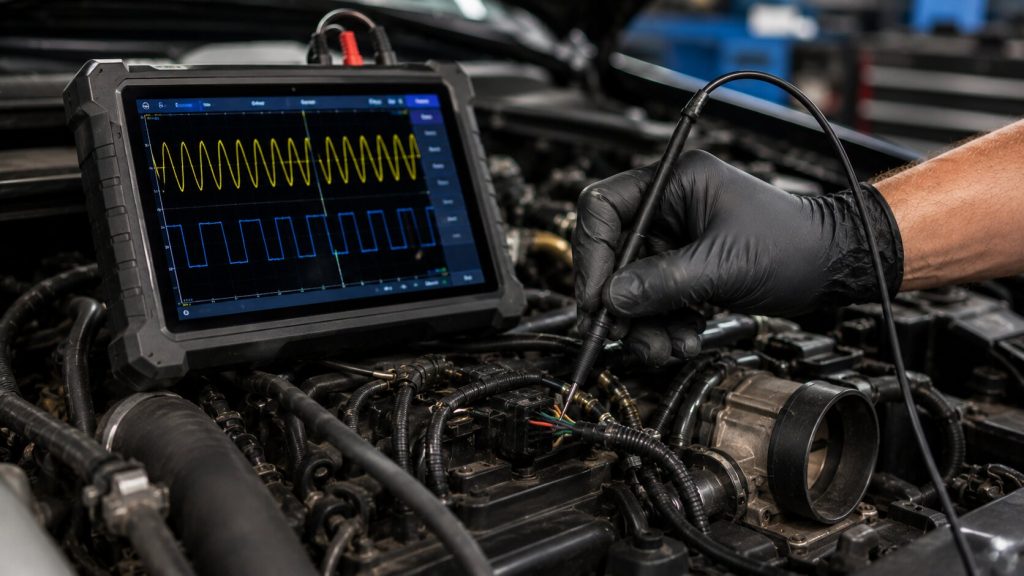
To do this correctly on modern vehicles, my technicians use professional-grade scan tools (like the Autel MaxiSYS or Snap-on platforms) to initiate an Automated ABS Bleeding Sequence. This automated sequence commands the internal solenoid valves inside the HCU block to cycle rapidly while running the electric return pump, helping purge old fluid, air, and contamination from the ABS hydraulic circuit.
During this computerized bleeding sequence, the rapid cycling of the ABS solenoids draws a massive electrical current, which can drop system voltage and interrupt the programming. To prevent micro-voltage drops from corrupting the ABS module’s memory, my shop connects your vehicle to a high-amperage battery maintainer (such as a DCA-8000) set to deliver a stable 12.6 to 13.6 volts throughout the entire procedure.
Once the system is flushed, I perform a digital reset of the Steering Angle Sensor (SAS) to ensure that your Advanced Driver Assistance Systems (such as Electronic Stability Control and Lane Keeping Assist) are perfectly aligned with your newly restored brakes. Brake fluid is exchanged using a full system bleed process that includes ABS activation when required by the vehicle platform.
Brake System Maintenance Tips for Humid Coastal Conditions
While you cannot change Jacksonville’s high humidity or the brackish air rolling off the St. Johns River, you can take several proactive steps to protect your braking system:
- Schedule Biennial Fluid Flushes: Have your brake fluid completely flushed and replaced every 2 years or 24,000 miles to keep water levels safely below the 3% critical threshold.
- Keep Your Undercarriage Clean: After navigating flooded streets or driving near the beaches, thoroughly rinse your wheel wells and brakes with fresh water. This flushes away the conductive salt residue before it can promote external galvanic corrosion.
- Never Open the Reservoir Unnecessarily: Keep your master cylinder cap tightly sealed. Opening the reservoir cap exposes the fresh glycol-ether fluid to the humid outside air, initiating early moisture absorption.
- Inspect Your Cap Diaphragm: During routine maintenance, ensure the rubber expansion diaphragm under your reservoir cap is intact and free of tears to prevent humid air from bypassing the seal.
If your brake pedal is feeling soft, spongy, or slow to respond during your daily JTB commute, do not wait for an emergency to find out your brakes are failing. Bring your vehicle to Everything Automotive for a professional diagnostic check and a complete pressurized system flush. Visit me at our Eastside location (7624 Beach Blvd, Jacksonville, FL 32216 | 904-800-2714) or our Westside location (6211 Blanding Blvd, Jacksonville, FL 32244 | 904-510-7299) to restore your stopping power today.
Frequently Asked Questions
Can high humidity in Jacksonville cause my brake pedal to feel spongy?
Yes. Glycol-based brake fluid is highly hygroscopic, meaning it absorbs water vapor from the humid air over time. This water contamination lowers the fluid’s boiling point, leading to vapor lock and a spongy pedal feel.
Will my regular brakes still work if my ABS light is turned on?
Yes. Your traditional mechanical brakes will still operate to slow the vehicle, but you will lose all anti-lock braking, traction control, and stability control features. This can result in dangerous wheel lockup during emergency stops.
Can a simple brake fluid top-off fix my spongy brake pedal?
No. Topping off the reservoir only mixes fresh fluid with heavily degraded, water-logged oil inside your lines, leaving the underlying water contamination and trapped air pockets unresolved. Only a complete system-wide flush can restore performance.
Does water in my brake fluid cause damage to the ABS pump?
Yes. Elevated moisture levels can contribute to internal corrosion and long-term wear in ABS hydraulic components.
