
Short school-run commutes in Jacksonville qualify as severe-service driving because the engine oil never stays hot long enough to evaporate moisture and fuel contamination. Repeated cold starts and prolonged idling accelerate sludge formation, oil dilution, and internal engine wear.
Carpool Queues and Duval Humidity Expose the Reality of Severe Service
When most Jacksonville parents hear the term “severe driving,” they picture heavy commercial towing or thrashing a truck on off-road trails. However, most severe-service engines we inspect belong to ordinary commuter vehicles. If you are a Deerwood Country Club family whose daily routine consists of driving your children to the Bolles Middle School Bartram Campus or the Upper School San Jose Campus, you are operating under severe-service conditions.
Consider the geography of this commute. You leave the gates of Deerwood, briefly accelerate down Southside Boulevard, merge onto J. Turner Butler Boulevard (JTB), and exit onto San Jose Boulevard. The entire trip is less than 5 miles. Once you arrive at the San Jose campus, you transition directly into the drop-off loop. You sit idling along the two-lane road next to Schultz Hall with your air conditioning running at maximum capacity to combat the oppressive Duval County heat.
The engine experiences a cold start, a few minutes under load, then extended idling in the pickup loop. Because the vehicle is shut off after just fifteen minutes, your motor oil never maintains its optimal thermal equilibrium. In our coastal climate, where relative humidity routinely exceeds 90 percent, the oil never stays hot long enough to purge moisture and fuel contamination.
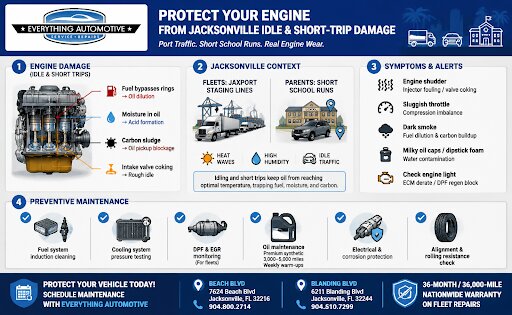
The Chemistry of the Cold Start and How Water and Fuel Invade Your Oil
At startup, the Engine Control Module (ECM) enriches the fuel mixture dramatically to keep a cold engine from stalling. These cold starts run rich on purpose to maintain stability.
Because raw gasoline does not vaporize well on cold cylinder walls, this excess fuel is necessary to prevent a cold-start stumble. However, this fuel-rich mixture has a severe drawback: the excess unburnt gasoline washes past the piston rings—a phenomenon known as cylinder wash—and flows directly into your crankcase oil.
Simultaneously, water enters the equation. Hydrocarbon combustion naturally generates water vapor as a byproduct. When your engine block is cold, this vapor condenses on the freezing steel walls of the crankcase and drips into the oil pan.
Normally, when a vehicle is driven for an extended stretch on I-95 or I-295, the bulk oil temperature reaches 212°F (100°C). This sustained heat boils off condensed water and evaporates raw gasoline. The positive crankcase ventilation (PCV) system then draws these volatile vapors out of the crankcase and routes them back into the intake to be burned.
But on the short Deerwood-to-Bolles run, the oil never gets hot enough to perform this self-cleaning cycle. While your dashboard coolant gauge might reach the middle, the thick mass of motor oil in the pan lags far behind. By shutdown, moisture and raw fuel remain suspended in the oil.
From Milky Caps to Metal Shavings and the Path to Engine Starvation
When water and unburnt fuel mix with motor oil, they form a highly destructive emulsion. The visual warning signs often start as a milky-white, mayonnaise-like foam coating the underside of your oil filler cap or the tip of your dipstick.
This emulsion thins the lubricant’s viscosity and destroys its High-Temperature High-Shear (HTHS) film strength. When you accelerate onto JTB, the compromised oil barrier fails to keep moving metal parts separated. The engine transitions into boundary lubrication, causing direct metal-on-metal friction.
- Acid Formation: Trapped water reacts with combustion blow-by gases to form sulfuric and nitric acids. These corrosive acids chemically attack the soft copper and lead alloys in your crankshaft main and rod bearings.
- Carbon Sludge Accumulation: Without high operating temperatures, the oil cannot keep contaminants suspended. Soot, dirt, and oxidized oil molecules settle out of the fluid, pooling in the bottom of the oil pan. This thick, black carbonaceous sludge eventually clogs the narrow screen of the oil pickup tube, starving the top end of the engine of lubrication.
- Intake Valve Carbon Coking: In modern direct-injection engines, the cold PCV system recirculates heavy, unevaporated oil mist directly into the intake tract. Without port fuel injectors to spray gasoline over the intake valves to wash them clean, these heavy vapors bake onto the metal, forming thick carbon buildup. This ruins your engine’s volumetric efficiency, leading to a rough idle and a noticeable drop in fuel economy.
The Diagnostic Verdict at Everything Automotive
I have been turning wrenches since 1983, and I have seen countless engines destroyed by simple maintenance neglect. At Everything Automotive, we do not believe in the generic, assembly-line approach you find at franchise quick-lube shops. They slap a standard 3,000-mile sticker on your windshield and send you on your way without ever looking at the physical health of your oil.
When a vehicle comes to our Beach Boulevard or Blanding Boulevard locations, we perform physical diagnostics to identify fluid degradation before it ruins your engine. Our diagnostic process includes:
- The Physical Crackle Test: We drop a sample of your oil onto a heated diagnostic plate. If the oil bubbles or pops violently, it confirms that suspended water has contaminated the oil column.
- Oil Filter Dissection: We do not just throw your old oil filter in the trash. We use a specialized non-shearing filter cutter to split the steel canister open, unroll the pleated paper element, and inspect it under direct light. If we see reflective metallic particles shimmering like glitter, we know the bearing clearances have already begun to shed metal.
- Mechanical Pressure Mapping: Deceptive dashboard sensors can fail or short to the chassis, giving false readings. We thread a calibrated Snap-on mechanical testing gauge directly into your engine’s oil gallery to measure the physical pressure of the oil column at full operating temperature, ensuring your oil pump is delivering adequate flow to protect your bearings.
Protecting Your Investment with Proactive Jacksonville Service
If your family’s daily driving fits the severe service profile, waiting for the manufacturer’s “normal” 10,000-mile interval is a gamble that risks expensive engine failure.
To protect your vehicle, we recommend several technician-level strategies:
- Utilize Premium Synthetics: Premium full-synthetic oils (Group III or Group IV base stocks) offer vastly superior thermal and chemical stability compared to cheap conventional mineral oils. They resist fuel dilution and maintain their molecular structure under extreme heat cycles.
- Shorten Your Service Intervals: For short-trip vehicles in Duval County, you must shorten your maintenance intervals to 3,000 to 5,000 miles (or every 6 months, whichever comes first). This ensures we drain the corrosive acids, raw fuel, and moisture out of your crankcase before they can form solid sludge blockages.
- Perform Weekly Highway Warm-ups: At least once a week, take your vehicle out on a sustained 30-minute drive along I-95 or I-295. Getting the oil up to full operating temperature for a continuous stretch allows the PCV system to boil off trapped moisture and evaporate fuel contaminants.
- Optimize Viscosity for the Summer Heat: For high-mileage engines (over 75,000 miles) operating in northeast Florida’s warm climate, we often recommend switching from standard synthetic 5W-30 to a high-mileage synthetic 10W-30. Because local winter temperatures rarely dip below freezing, the thicker cold-start viscosity of a synthetic 10W-30 is completely safe. It is formulated with heavier, more shear-resistant base stocks that require fewer polymer Viscosity Index Improvers (VIIs). This makes the oil highly resistant to permanent mechanical shearing, keeping your oil pressure stable during long idles in afternoon school traffic.
If your daily routine has turned your vehicle into a severe-duty commuter, do not wait for minor oil issues to turn into a major engine replacement. Bring your car to Everything Automotive for a comprehensive physical safety and fluid inspection.
- Visit us at our Eastside location— 7624 Beach Blvd, Jacksonville, FL 32216 | 904-800-2714
- Our Westside location— 6211 Blanding Blvd, Jacksonville, FL 32244 | 904-813-7097
Frequently Asked Questions
Is a short 5-mile commute really considered severe driving?
Yes. Short commutes under five miles are surprisingly rough on your car. Since the engine never gets hot enough to reach a steady balance, leftover water and raw gasoline stay trapped in the oil pan instead of evaporating.
Can I just wait for my car’s digital oil life monitor to reach 0 percent?
No. Most oil-life monitors cannot directly measure fuel dilution or moisture contamination; they assume you drive in perfect conditions. In reality, the constant idling found in Jacksonville traffic destroys additives at a rate the computer simply cannot track.
Will a standard windshield sticker interval from a quick-lube shop protect my warranty?
No. Generic quick-lube shops often apply a universal mileage interval that fails to account for the physical fuel dilution and acid formation caused by stop-and-go driving and high local humidity, which can void your powertrain coverage if sludge-induced damage occurs.
