
Brushless cooling fan failures in modern vehicles cause rapid and catastrophic engine overheating during stationary idles on the Buckman Bridge. Internal thermal fatigue and software errors disable critical cooling, triggering dashboard warning lights. Swift professional fan replacements at Everything Automotive prevent complete engine destruction and avoid expensive head gasket repairs.
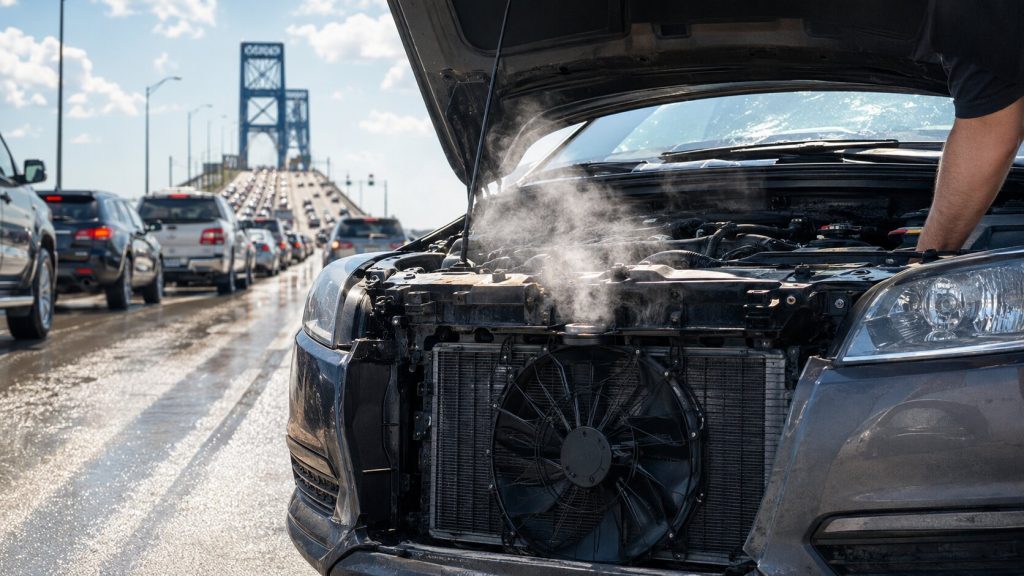
Bumper to Bumper Traffic on the Buckman Bridge Traps Crucial Engine Heat
I know firsthand how hard our local Jacksonville roads are on your cooling systems. Having run my shop, Everything Automotive, in Duval County since 2012, I’ve seen summer heat waves and gridlock destroy countless engines. The daily grind on our major commuter corridors, particularly the Interstate 295 West Beltway, puts immense stress on your drivetrain.
When you’re crossing the concrete-and-steel span of the Buckman Bridge, a sudden traffic bottleneck near Blanding Boulevard or Roosevelt Boulevard can slow you to a crawl. At highway speeds, natural convective airflow through your front grille is more than enough to keep your engine cool. But the second you hit a peak-hour traffic jam and your vehicle comes to a complete standstill, that natural cooling drops to zero.
Under this intense thermal load, your vehicle relies entirely on its electric cooling fan to reject heat. If you’re idling on a 95°F afternoon with your air conditioning blasting at maximum capacity, under-hood temperatures can easily soar past 130°F. If your fan has failed, the engine will suffer immediate thermal runaway, boiling over and trapping you on a three-mile bridge with extremely narrow shoulders.
The Technical Difference Between Legacy Brushed Motors and Modern Brushless Systems
In my decades of hands-on experience, I’ve watched cooling fan technology evolve from basic mechanical, belt-driven fans to advanced electric systems. Today, modern high-efficiency vehicles utilize brushless DC (BLDC) cooling fan motors instead of the older brushed designs.
Modern high-efficiency vehicles utilize brushless DC (BLDC) cooling fan motors .
- The Brushless Design: Instead of physical brushes, BLDC fans feature an integrated solid-state electronic control unit (ECU) mounted directly to the motor housing . This onboard controller sequentially switches current to the electromagnetic stator coils, spinning a permanent magnet rotor with zero physical contact, minimal friction, and quiet operation .
- The Signal Wire: The Engine Control Module (ECM) regulates the fan’s speed by sending a high-frequency Pulse-Width Modulation (PWM) duty cycle signal . The wiring to the fan assembly is remarkably simple: a heavy power wire from the fuse block, a chassis ground, and a thin PWM signal wire traveling directly from the engine computer .
- Duty Cycle Speeds: The ECM varies the fan speed by altering the signal’s pulse width . A signal of 10% tells the fan to stay in low-speed standby, while a signal of 90% commands maximum speed .
- The Emergency Default: If the thin PWM signal wire breaks or suffers from high electrical resistance, the fan’s integrated controller loses communication with the ECM . To prevent your engine from melting, the controller immediately activates an emergency failsafe mode, driving the fan at a continuous 100 percent speed the moment the ignition is switched on .
Physical and Chemical Stages of Electric Cooling Fan Degradation
In my forty-plus years of turning wrenches, I have watched how progressive heat and severe vibration systematically destroy these complex brushless fans. In my bays, I track this electrical and chemical degradation through four distinct phases:
| Failure Stage | Physical Progression | Observable Symptoms | Diagnostic Action |
| Stage 1 Thermal Fatigue | High current and heat cycles crack the controller PCB solder joints. | The engine runs slightly hotter than normal at long red lights. | Connect scan tool to monitor live engine coolant temperature. |
| Stage 2 Signal Loss | The PWM wire breaks or short circuits, interrupting communication. | The fan runs continuously at high speed in emergency mode. | Clear the open circuit fault code and test wire continuity. |
| Stage 3 Bearing Wear | Internal motor bearings degrade, introducing physical play. | Loud grinding, buzzing, or rattling noises from the grille. | Spin the fan blades manually by hand to check for binding. |
| Stage 4 Motor Seizure | The brushless driver fails completely, cutting power to the coils. | Rapidly rising temperature gauge and steam under the hood. | Verify battery voltage and ground at the fan plug connector. |
Precision Diagnostic Protocols to Isolate Fan Control Circuits and Signals
I don’t believe in guessing when your engine’s life is on the line. When you bring your vehicle to my shop with a potential cooling issue, we don’t just clear codes and hope for the best. I require my technicians to execute a precise, systematic diagnostic sequence to find the exact root cause:
- My Bidirectional Testing Protocol We connect our advanced Autel and Snap-on diagnostic tablets directly to your vehicle’s CAN bus network. I can bypass the engine’s sensors and send direct, bidirectional commands to the ECM, forcing the cooling fan to run at specific duty cycle percentages—such as 25%, 50%, and 90%. If the fan responds perfectly to our manual commands but fails to run during normal driving, I know the fan motor is healthy and the issue lies in a faulty coolant temperature sensor.
- My Oscilloscope Signal Verification If the fan remains completely dead under command, we back-probe the signal connector and connect a multi-channel digital oscilloscope, like a PicoScope. The scope acts as a high-speed camera, recording the electrical voltage of the PWM circuit in real time. This allows me to physically “see” the digital square-wave pulses sent by the ECM. If I observe a flat line on the scope, I know the signal wire is broken; if I see a perfect square wave but the fan is motionless, I have verified that the fan’s internal brushless controller is dead.
Replacing Failed Brushless Motors Over Cheap Relay and Wiring Guesswork
I hate seeing other shops fire the “parts cannon” at a cooling issue. When they see a P0480 (Fan 1 Control Circuit) or P0116 (Coolant Temperature Circuit Performance) trouble code, they immediately replace expensive external relays, coolant sensors, and fuses without ever testing the communication wire. When those new parts fail to solve the issue because the real culprit is a burned-out solid-state driver inside the fan motor housing, the customer is left with an unnecessary and expensive bill.
At Everything Automotive, we prioritize finding the exact root cause. Because the internal electronic components of a brushless fan motor are sealed in a protective housing at the factory, they cannot be repaired individually. If the internal circuit board or motor bearings are seized, the complete fan and shroud assembly must be replaced to guarantee long-term reliability. I only use premium, certified OEM or high-grade replacement fan assemblies that match your vehicle’s exact original engineering specifications.
Before a sudden temperature spike traps you on the highway, contact Everything Automotive of Jacksonville, Inc. to schedule a professional cooling system inspection.
- Visit us at our Eastside location (7624 Beach Blvd, Jacksonville, FL 32216 | 904-800-2714)
- Our Westside location (6211 Blanding Blvd, Jacksonville, FL 32244 | 904-813-7097)
Frequently Asked Questions
Will a bad cooling fan cause my engine to overheat at highway speeds?
No. At highway speeds exceeding 45 mph, convective airflow through the front grille is completely sufficient to cool the radiator without the fan’s assistance .
Can a disconnected signal wire cause the fan to run at high speed?
Yes. Modern brushless fans feature an emergency safety default mode that automatically drives the fan at maximum speed if the PWM signal wire is disconnected or loses communication .
Is a blown fuse the only reason a cooling fan stops spinning?
No. While a blown fuse cuts power completely, a failed internal brushless motor controller, corroded harness connectors, or a faulty coolant temperature sensor will also disable the fan.
