
Fuel dilution occurs when repeated cold starts and short drives allow unburned gasoline to pass the piston rings and mix with the engine oil. Common warning signs include a rising oil level, a gasoline odor on the dipstick, rough idling, or repeated misfires. Diagnosis should include scan-data review, injector testing, software-update verification, and laboratory oil analysis when precise fuel content must be measured.
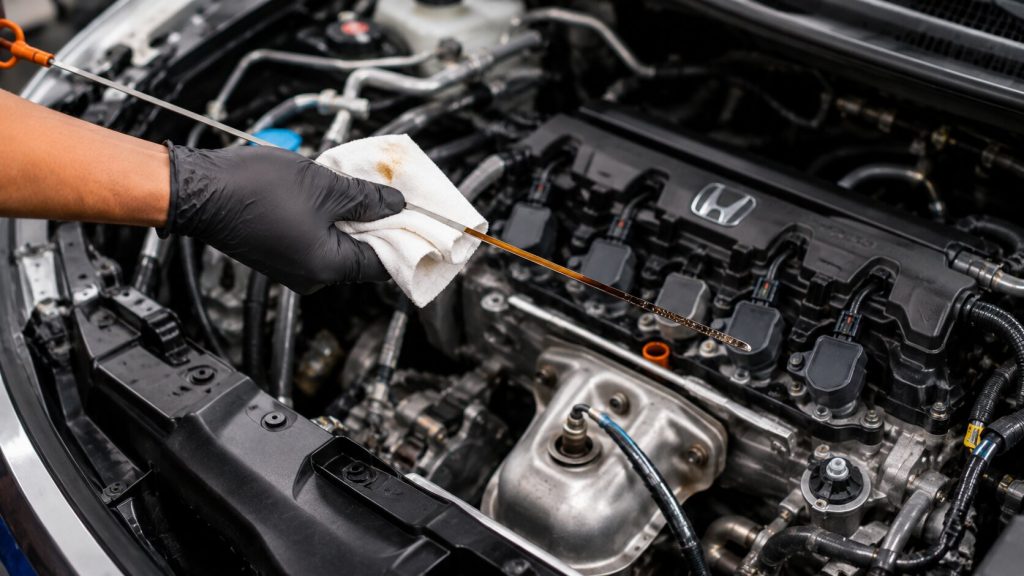
Key Signs of Honda Engine Oil Dilution
| Inspection Category | Details |
| Common warning signs | Oil rising above the upper dipstick mark, a strong gasoline odor in the oil, rough cold starts, intermittent misfires, or lubricant that appears unusually thin. |
| Components and systems to inspect | Direct fuel injectors, piston-ring sealing, cylinder-wall condition, positive crankcase ventilation operation, engine-control software, and the vehicle’s normal driving routine. |
| Diagnostic equipment | A factory-capable scan tool, fuel-pressure testing equipment, injector leak-testing tools, and a clean oil-sampling kit for laboratory analysis. |
| High-risk driving pattern | Repeated trips under five miles, school runs, grocery stops, delivery routes, and low-speed driving that ends before the engine oil remains fully warm. |
Short-Trip Driving and Fuel Dilution
Honda direct-injection engines spray fuel directly into the combustion chamber at high pressure. During a cold start, the engine commands extra fuel to stabilize combustion and warm the catalytic converter.
Some of that fuel can contact the colder cylinder walls before it burns completely. A small amount may move past the piston rings and enter the crankcase.
A small amount of fuel in the oil does not automatically mean the engine is damaged. The concern begins when the vehicle repeats the same short operating cycle several times a day.
A driver may start the engine, travel two or three miles, shut it off, and repeat the process later. The coolant gauge may reach its normal position, but the engine oil can still be below a temperature that supports effective evaporation of accumulated fuel and moisture.
During repeated cold starts, a small amount of fuel can contact the cylinder walls, move past the piston rings, and accumulate in the crankcase oil before normal operating temperatures are reached.
For Arlington-area drivers, this often occurs during repeated short trips between nearby neighborhoods, shopping centers, schools, and businesses around the Regency corridor. The primary issue is not simply traffic or environmental conditions; rather, it is the frequency of cold starts combined with trips that conclude before the oil reaches and maintains operating temperature for a sustained period.
Fuel Dilution to Engine Oil
Gasoline lowers the viscosity of the engine oil. As the oil becomes thinner, it may provide less protection at heavily loaded surfaces such as bearings, camshaft lobes, timing components, and turbocharger bearings on equipped models.
Fuel dilution does not guarantee immediate engine damage. The actual risk depends on the amount of fuel present, the oil grade, the duration of exposure, engine condition, and how the vehicle is driven.
A small amount may decrease during a sustained fully warmed drive. Repeated short trips, injector leakage, incorrect fuel control, or unresolved software issues can cause fuel to accumulate faster than the crankcase ventilation system removes it.
That is why a rising oil level matters. Engines do not create additional engine oil during normal operation. When the level climbs without oil being added, we first rule out overfilling and then investigate fuel or coolant contamination.
How We Diagnose Suspected Oil Dilution
We do not condemn an engine based on dipstick odor alone. Gasoline smell is a warning sign, not a measurement.
The inspection begins with the oil level, vehicle history, fault codes, software status, fuel trims, injector performance, and the owner’s actual driving routine.
Oil Level and Condition Check
We park the vehicle on a level surface and allow the oil to drain back into the pan before checking the dipstick.
We look for
- Oil above the upper dipstick mark
- A sharp gasoline odor
- Oil that appears unusually thin
- Moisture or emulsified residue under the oil cap
- Evidence that the engine was overfilled during its last service
A milky deposit under the oil cap does not automatically mean a failed head gasket. On vehicles used for repeated short trips, moisture can collect because the engine does not remain warm long enough to remove normal condensation.
Scan-Data Review
We use a factory-capable scan tool to inspect short-term and long-term fuel trims, coolant temperature, misfire data, fuel-pressure values, and other engine parameters.
Strongly negative fuel trims mean the engine computer is reducing commanded fuel because it detects a rich condition. That result does not prove that diluted oil is the source.
Possible causes can include
- A leaking direct injector
- Excessive fuel pressure
- A purge-system fault
- Incorrect sensor data
- Fuel vapor entering through the crankcase ventilation system
- A control-software issue
We compare readings at idle and at elevated engine speed before identifying the likely cause.
Injector and Fuel-System Testing
If scan data suggests excess fueling, the next step is to test the injectors and fuel-pressure system.
A leaking injector can continue releasing fuel after shutdown or deliver more fuel than commanded. That can increase cylinder-wall wetting, cause difficult starting, create misfires, and accelerate oil dilution.
We do not recommend injectors based only on a fuel smell or a single trim reading. The fault should be supported by pressure-decay testing, balance testing, misfire patterns, inspection results, or other repeatable evidence.
Software and Service Information Check
Some Honda models and model years have received updated engine-control software or manufacturer procedures related to cold-weather operation, warm-up strategy, or oil dilution concerns.
Applicability depends on the exact vehicle, engine, production date, and identification number. We verify the vehicle against current service information instead of assuming every small-displacement Honda direct-injection engine requires the same repair.
A software update may be part of the correction, but it does not replace mechanical testing when an injector, sensor, or internal engine problem is present.
Laboratory Oil Analysis
When an exact fuel-dilution percentage is needed, we send a properly collected oil sample to a qualified laboratory.
A standard automotive refractometer should not be presented as an exact gasoline-in-oil measurement tool. Laboratory methods such as gas chromatography are more appropriate for quantifying fuel dilution in used engine oil.
A useful laboratory report may include
- Fuel dilution percentage
- Oil viscosity at test temperature
- Water content
- Wear-metal levels
- Coolant indicators
- Comparison with the expected oil grade
We compare fuel percentage with viscosity, water, wear metals, and coolant indicators before reaching a conclusion.
From Inspection to Repair
When we see oil above the full mark, we first verify that the engine was not overfilled. We then document the driving pattern, inspect scan data, check for applicable software updates, and test for injector leakage when the evidence points toward excess fueling.
If the vehicle is mainly used for short trips and no mechanical fuel-system fault is found, the correction may include an oil and filter change, completion of any applicable software procedure, adjustments to the maintenance interval, and an early recheck.
We avoid selling injectors, internal engine work, or a major repair until testing supports it.
On a recent short-trip Honda inspection, we found the oil above the upper dipstick mark but did not find evidence of injector leakage. Fuel trims remained within normal operating range, and the vehicle’s history showed repeated trips under three miles. We serviced the oil, verified the applicable software level, and scheduled an early oil-level recheck before recommending additional parts.
What Honda Owners Can Do
Check the dipstick regularly if the vehicle is used mainly for short trips. Pay attention to an oil level that rises between services, a strong gasoline smell, repeated cold-start misfires, or oil that becomes noticeably thin.
Do not rely only on the dashboard maintenance reminder when contamination is suspected. The reminder estimates service needs from operating conditions, but it does not directly measure the percentage of gasoline in the oil.
Where practical, combine several short errands into one longer drive. Sustained operation at normal temperature may help the engine manage fuel and moisture accumulation, but it will not repair a leaking injector or another mechanical fault.
Do not attempt to correct severe dilution by adding thicker oil unless the manufacturer specifically approves a different viscosity for the vehicle and operating conditions.
Scheduling an Inspection
An inspection is appropriate when
- The oil rises above the full mark
- The dipstick has a strong gasoline odor
- The engine develops repeated cold-start misfires
- The oil level rises again soon after an oil change
- Fuel economy drops without an obvious explanation
- A warning light or fuel-system code appears
- The vehicle is driven almost entirely on short trips
Everything Automotive can inspect the oil level, review live engine data, check the fuel system, verify applicable service information, and recommend laboratory oil analysis when a measured result is necessary.
The shop brings more than 40 years of automotive experience to the diagnostic process and provides written estimates before approved repair work begins.
Service is available at the Beach Boulevard and Blanding Boulevard locations, 7624 Beach Blvd, Jacksonville, FL 32216 or 6211 Blanding Blvd, Jacksonville, FL 32244.
Repairs performed under qualifying conditions are supported by the shop’s stated 36-month or 36,000-mile parts and labor warranty through the Parts Plus Car Care Center network. Warranty terms and coverage should be confirmed on the repair order.
Frequently Asked Questions
Can short trips cause fuel dilution in a Honda engine?
Yes. Repeated cold starts and short drives can allow gasoline to enter the crankcase faster than normal warm operation removes it.
Do negative fuel trims prove that an injector is leaking?
No. Negative fuel trims indicate a rich condition, but additional testing is required to identify the cause.
Can an oil change fix the problem permanently?
No. An oil change removes contaminated lubricant, but the underlying driving pattern, injector fault, software issue, or mechanical condition must also be addressed.
Should every Honda direct-injection engine receive the same repair?
No. The correct procedure depends on the engine, model year, vehicle identification number, symptoms, test results, and applicable manufacturer information.
