
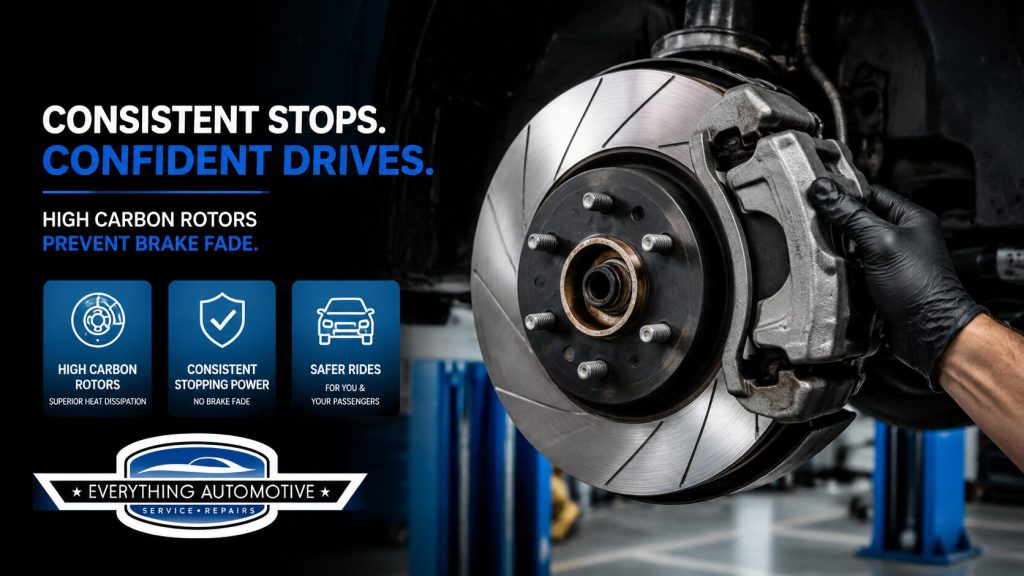
Continuous stop and go driving around the St. Johns Town Center generates extreme brake heat for rideshare vehicles. Standard cast iron rotors heat soak and warp during long shifts. Upgrading to High-Carbon rotors optimizes thermal dissipation and prevents dangerous brake fade, ensuring consistent stopping power and safety for local drivers.
Continuous Town Center Stop and Go Driving Punishes Standard Brakes
Rideshare driving in Northeast Florida is an intense, high-load job, particularly for Uber and Lyft drivers operating around the St. Johns Town Center. As Jacksonville’s premier shopping and dining district, the Town Center remains congested year-round, especially during holiday rushes and weekend shopping peaks. Circling the dense network of roadways around Gate Parkway, Town Center Parkway, and Big Island Drive means stopping every few hundred yards for pedestrian crosswalks, traffic signals, and tight speed bumps.
This demanding stop-and-go driving pattern is frequently interrupted by rapid transitions from the adjacent high-speed highway corridors. Commuters exiting Interstate 295 or J. Turner Butler Boulevard (JTB) must decelerate rapidly from 65 mph to a dead stop at busy retail intersections.
When you subject a standard braking system to a 12-hour rideshare shift under these conditions—especially during a brutal Jacksonville summer where road asphalt temperatures easily surpass 140°F—the brakes experience severe thermal stress. Because there are no long, open highway stretches to provide convective cooling, under-wheel temperatures spike, causing standard cast iron rotors to heat-soak.
The Technical Science of Brake Fade and Disc Thickness Variation
Every time you press your brake pedal, your vehicle’s braking system performs a fundamental energy conversion. It transforms the kinetic energy of your moving vehicle into thermal energy (heat) through friction. Standard brake rotors are cast from standard G3000 grey iron, which contains a baseline carbon content of 3.0–3.5 percent. Under continuous stop-and-go rideshare duty, this entry-level metallurgy is pushed past its thermal limits, initiating a predictable chain of failures:
- Outgassing and Spongy Pedal Feel: As rotor temperatures climb past 600°F, standard brake pads reach their thermal limit. The organic binding agents within the brake pad material begin to vaporize. This vaporization creates a micro-thin boundary layer of gas between the pad and the rotor—a phenomenon known as outgassing. The gas prevents the pad from making physical contact with the rotor, resulting in severe brake fade. You will feel this as a soft, spongy pedal that requires immense physical effort to slow the vehicle, increasing stopping distances dangerously.
- Material Transfer and Disc Thickness Variation: In reality, steel and iron brake rotors rarely warp. Instead, they suffer from Disc Thickness Variation (DTV). When you stop your superheated vehicle at a long red light on Gate Parkway, you must keep your foot firmly clamped on the brake pedal. This pressure causes the hot brake pad to transfer a microscopic, uneven layer of its own friction material onto the stationary rotor surface.
- The Resulting Judder: Over thousands of miles, these high spots on the rotor surface knock the brake pads back into the caliper pistons with every wheel rotation. This is the root cause of this shuddering—an intense mechanical vibration that shakes your steering wheel and brake pedal under load.
High-Carbon Grey Iron Outperforms Standard Cast Iron Rotors
To combat heat-soak, brake fade, and material transfer, professional rideshare and high-duty fleet operators must upgrade from entry-level G3000 iron to High-Carbon (HC) grey iron rotors. High-Carbon rotors (such as GG15HC certified castings) are formulated with a carbon content of 3.6 percent to 3.9 percent. This subtle chemical change introduces a dense graphite microstructure that fundamentally improves the rotor’s performance:
- Superior Thermal Conductivity: High-Carbon iron possesses exceptional thermal conductivity and thermal inertia. It absorbs and dissipates friction-induced heat much faster than standard cast iron, preventing the extreme under-wheel temperatures that trigger pad outgassing and brake fade.
- Excellent Thermal Stability: The graphite flakes inside the iron matrix allow the metal to expand and contract elastically without distorting. This structural stability prevents coning and resists thermal cracking or surface heat-checking under rapid cooling cycles, such as splashing through sudden afternoon downpours.
- Damping Capacity: High-Carbon metallurgy has a significantly higher vibration damping coefficient. The carbon compounds naturally absorb harmonic vibrations before they can resonate, eliminating annoying squeals, and providing a quiet, smooth ride for your passengers.
| Performance Parameter | Standard G3000 Grey Iron | High-Carbon Grey Iron (GG15HC) |
| Carbon Concentration | 3.0% to 3.5% | 3.6% to 3.9% |
| Thermal Conductivity | Baseline heat dissipation | Optimal heat transfer and cooling |
| Resistance to Thermal Cracking | Prone to surface micro-cracking | Superior resistance to thermal stress |
| Brake Noise and Squeal | High harmonic resonance | Natural dampening; quiet operation |
| Warping and Shudder Resistance | Vulnerable to DTV high spots | High dimensional stability under load |
Precision Diagnostics With Dial Indicators and On-Car Lathes
I have been turning wrenches since 1983, and I have seen too many general repair facilities treat brake maintenance like an assembly line. They throw a new set of cheap pads on a worn, dirty rotor—a shortcut known as a “pad slap”—without ever measuring the physical state of your braking system. This guesswork is incredibly dangerous for high-mileage vehicles operating in Duval County’s high heat and humidity.
At Everything Automotive, we prioritize systematic, diagnostic-led brake repairs. When your vehicle enters our bays with a pedal vibration or shifting stopping power, we execute a thorough diagnostic sequence:
- The Runout Test: We mount a high-precision digital dial indicator directly to your steering knuckle or caliper bracket. By rotating the wheel hub, we measure the lateral runout (side-to-side play) of the rotor face down to a fraction of a millimeter. If lateral runout exceeds 0.05 mm, brake judder is inevitable.
- On-Car Lathe Resurfacing If we detect minor lateral runout or uneven pad deposits on a premium rotor, replacement isn’t always necessary. We use our advanced Hunter on-car brake lathe, which mounts directly to your wheel hub. Resurfacing the rotor while it spins on the car allows the lathe to cut both sides simultaneously and compensate for microscopic play in the wheel bearing. This ensures a perfectly flat, zero-runout finish matched exactly to your vehicle’s spindle.
High-Carbon Brake Upgrades Outperform Cheap Friction Pads
If you are driving a rideshare vehicle 12 hours a day around Jacksonville, cutting corners on your brakes is a massive gamble. Cheap low-grade friction pads glaze quickly under extreme heat. They produce thick, corrosive black brake dust that chemically attacks alloy wheels and clogs the cooling vents of standard rotors.
At Everything Automotive, we design custom High-Duty Brake Maintenance Plans tailored specifically to your vehicle and daily route.
We only use premium, certified High-Carbon rotors—like those from ADVICS or ULTRAHC—and pair them with carbon-ceramic brake pads (such as Power Stop Z36 or premium OE-grade equivalents). These advanced carbon-ceramic compounds deliver fade-free stopping power, generate minimal dust, and resist wear far longer than standard semi-metallic pads.
Our technicians thoroughly clean your caliper brackets, lubricate the slide pins with high-temperature silicone grease, and install fresh, premium stainless steel hardware to ensure smooth caliper travel.
Do not let a soft brake pedal or violent steering wheel vibration compromise your safety during busy rideshare shifts. Bring your vehicle to Everything Automotive for a professional diagnostic check to restore peak safety and performance today.
- Visit us at our Eastside location (7624 Beach Blvd, Jacksonville, FL 32216 | 904-800-2714)
- Our Westside location (6211 Blanding Blvd, Jacksonville, FL 32244 | 904-813-7097)
Frequently Asked Questions
Can a Standard Brake Rotor Cause Pedal Vibration?
Yes. Standard G3000 cast iron rotors develop microscopic high spots from Disc Thickness Variation under repeated stop-and-go driving, causing pulsating brake pedals.
Are High-Carbon Rotors More Expensive Than Standard G3000 Rotors?
Yes. High-carbon rotors cost more due to advanced graphite metallurgy, but they deliver longer lifespan, quieter operation, and resistance to brake fade under extreme heat.
Will a Simple Brake Pad Replacement Fix Warped Rotors?
No. Installing brand-new brake pads on a rotor that suffers from Disc Thickness Variation or lateral runout will not fix the issue, as the uneven rotor face will quickly transfer that same pulsating wear pattern onto your new pads.
