
Sustained stop and go idling in extreme July heat rapidly degrades automatic transmission fluid, leading to friction loss and clutch wear. A professional fluid exchange at Everything Automotive completely replaces this contaminated oil, protecting sensitive valve bodies and preventing expensive mechanical failures on heavily congested Northeast Florida commuter highway routes.
Stop and Go Commuting in July Heat Acts as a Drivetrain Oven
I have been working as a professional diagnostic technician and mechanic since 1983. Since establishing Everything Automotive of Jacksonville, Inc. back in 2012, I’ve watched our brutal Florida summers cook countless gearboxes. July in Northeast Florida brings an oppressive combination of 95°F+ temperatures and relative humidity levels exceeding 70 percent. Radiant heat from the road asphalt easily passes 140°F. Underbody temperatures stay elevated for a long time after shutdown.
Jacksonville humidity slows underbody heat dissipation after shutdown, so transmission temperatures stay elevated longer during repeated short-trip commuting.
For local commuters, this extreme thermal environment becomes highly destructive during daily bumper-to-bumper gridlock. If you are regularly navigating the heavily congested intersection of Southside Boulevard and Touchton Road near the Deerwood business parks, your vehicle spends significant time idling in stationary traffic.
Because your car is not moving, there is zero natural, convective airflow passing beneath the chassis to cool your transmission pan.
Worse, keeping your foot pressed firmly on the brake pedal while your automatic transmission remains in the Drive position forces your torque converter to continuously churn the fluid. I regularly see pan temperatures spike past 230°F during extended Jacksonville gridlock.
The Technical Relationship Between Fluid Temperature and Clutch Plate Lifespan
Automatic transmission fluid (ATF) is the hardest-working fluid in your entire vehicle. It serves as a hydraulic medium to execute gear shifts, a gear lubricant to prevent scoring, and a coolant to manage system heat. However, its chemical and physical health degrades exponentially once operating temperatures cross the 200°F (93°C) threshold.
Once ATF crosses 220°F, deterioration accelerates fast.
Under the extreme thermal load of stop-and-go summer traffic, ATF starts oxidizing fast once temperatures stay above 220°F:
| Fluid Temperature | Physical and Chemical State | Transmission Lifespan Impact |
| 175°F to 200°F | Optimal operating range; fluid flows and lubricates without breaking down. | Normal service life up to 100,000 miles or more. |
| 220°F | Additives begin to break down; fluid oxidation accelerates. | Lifespan cut in half; early varnish begins to form. |
| 240°F | Additives boil off; heavy varnish and lacquer coat high-precision valves. | Lifespan reduced to one quarter of its designed limit. |
| 260°F | Internal rubber seals and gaskets harden, dry out, and crack. | Lifespan reduced to one eighth; internal pressure leaks cause slippage. |
| 295°F and above | Complete molecular breakdown of fluid; lubricating film collapses entirely. | Catastrophic failure; paper-based clutch plates burn up and disintegrate. |
As the fluid thins under intense heat, it loses its viscosity, causing a severe drop in hydraulic line pressure. This pressure drop prevents the internal clutch packs from engaging tightly.
Instead of locking together instantly, the clutch plates slip against each other, generating intense localized frictional heat. This creates a destructive thermal runaway loop: slipping clutches create more heat, which further thins the fluid, leading to even lower pressure and more slippage until your entire transmission is destroyed.
A Simple Fluid Top Off Leaves Severe Contamination Behind
Many generic quick-lube shops will recommend a basic “drain and fill” or “top off” service. During a standard pan drop, a technician simply drains the fluid from the bottom of the transmission pan, replaces the filter, and tops up the level. While this sounds simple, I must warn you that it is a highly incomplete service.
A standard drain and fill only replaces about 30 to 50 percent of your total transmission fluid. The remaining 50 to 70 percent of the highly degraded, dirty, and oxidized fluid remains permanently trapped inside your torque converter, the internal valve body, and the external cooling lines.
Mixing fresh transmission fluid with heavily contaminated old fluid is a complete waste of your money. The severe contaminants and depleted additives in the remaining old fluid will quickly overwhelm the new fluid, degrading its lubricating and friction properties almost instantly.
Furthermore, a basic top off does not flush out the heavy varnish and carbonaceous sludge that has already settled inside your delicate shift solenoids and valve body passages.
High Precision Fluid Exchanges Restoring Total Hydraulic Efficiency
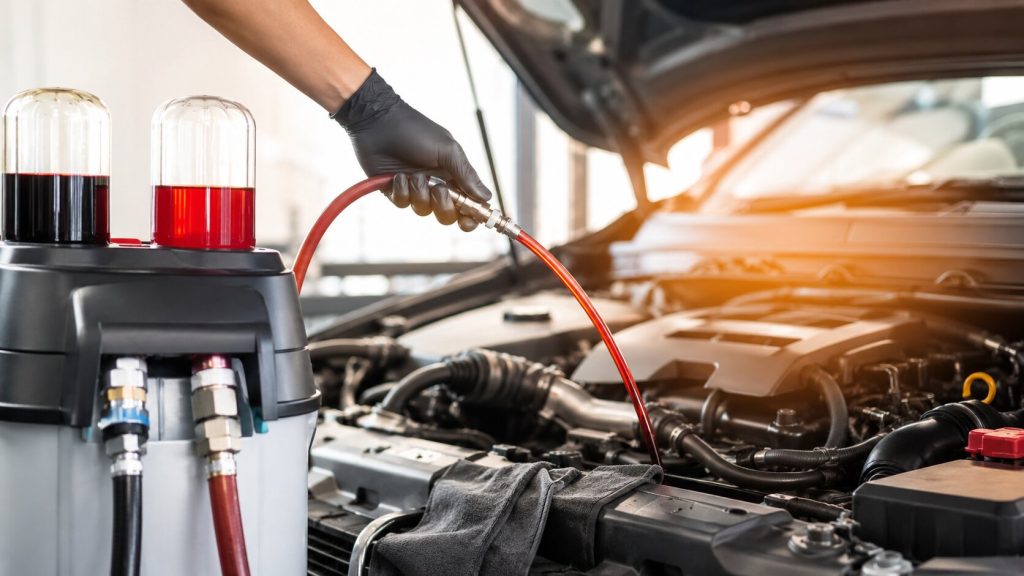
I can tell you that the only way to properly protect modern transmissions from heat-induced sludge is with a complete fluid exchange. At Everything Automotive, we utilize professional-grade fluid exchange machinery to perform this service.
Our advanced fluid exchangers connect directly to your vehicle’s transmission cooler lines. Rather than using high-pressure external pumps that can blow out old internal rubber seals, our equipment works in harmony with your vehicle. It utilizes your transmission’s own internal oil pump to naturally push out the old, dirty fluid while simultaneously injecting fresh, high-quality synthetic fluid in equal volumes.
This professional process is exceptionally thorough:
- Near Total Replacement: Our advanced machinery achieves a fluid exchange rate of over 90 percent in under 20 minutes.
- Torque Converter Purge: It completely extracts the degraded fluid trapped deep inside the torque converter, which a standard pan drop can never reach.
- System-Wide Flush: The continuous fluid exchange washes away accumulated carbon sludge, metallic wear particles, and varnish from the cooler lines, the external radiator cooler, and the intricate passages of the valve body.
Proactive Preventative Maintenance Saves Jacksonville Drivers
For standard step-gear automatic transmissions, I recommend a complete fluid exchange every 30,000 to 60,000 miles. If your vehicle is used for severe-service driving—such as daily rush-hour idling on I-295 or commercial fleet towing—this interval should be shortened to 15,000 to 30,000 miles.
How we approach your service depends entirely on what type of transmission you drive:
- Step-Gear Automatics: These conventional transmissions benefit immensely from a high-efficiency machine fluid exchange to clean out internal clutches and valve bodies.
- Nissan CVTs: Continuously Variable Transmissions (such as those requiring Nissan NS-3 fluid) are highly sensitive to fluid levels and flow pressures. For these vehicles, I favor a series of gentle, manual drain-and-fill services rather than high-flow machine flushes to protect their delicate internal seals and solenoids.
- Limits of a Flush: If your transmission is already experiencing severe mechanical slipping, delayed shifting, or grinding noises, a flush will not fix the problem. These symptoms point to physical clutch wear or internal damage.
- Remanufactured Solutions: When physical wear is too severe for maintenance, we offer professional, high-quality Jasper remanufactured transmission replacements. These units are designed to restore factory-new performance and are backed by our robust 36-month / 36,000-mile nationwide warranty on both parts and labor.
We operate on a strictly non-commissioned diagnostic basis. My technicians use advanced scan tools to monitor your live transmission temperature, fluid pressure, and solenoid operation, ensuring we only recommend the exact service your vehicle needs to run safely.
Before extreme summer heat and heavy stop-and-go traffic destroy your transmission, contact me at Everything Automotive of Jacksonville, Inc. to schedule a professional transmission service and protect your drivetrain investment today.
- Visit us at our Eastside location (7624 Beach Blvd, Jacksonville, FL 32216 | 904-800-2714)
- Our Westside location (6211 Blanding Blvd, Jacksonville, FL 32244 | 904-813-7097)
Frequently Asked Questions
Will a transmission flush fix a slipping transmission?
No. A transmission flush is a preventative maintenance service rather than a corrective fix; if your transmission is already slipping due to worn clutches or physical gear damage, a fluid change cannot restore the lost friction material.
Is a full fluid exchange safe for all types of transmissions?
No. While standard step-gear automatic gearboxes benefit greatly from machine flushes, delicate Continuously Variable Transmissions—especially Nissan CVTs requiring NS-3 fluid—are best maintained with manual drain-and-fill services to avoid over-pressurizing internal seals.
Does extreme heat shorten the lifespan of automatic transmission fluid?
Yes. High operating temperatures accelerate the chemical process of fluid oxidation, with every 20°F (11°C) increase in fluid temperature above the normal operating threshold cutting the fluid’s remaining service life in half.
