
Coastal salt air and brackish floodwaters in Duval County accelerate underbody corrosion, compromising suspension safety and structural integrity. Proactive under-car inspections and specialized lanolin-based Woolwax barrier treatments provide a self-healing shield that hermetically seals metal surfaces, preventing expensive steering, suspension, and brake line failures for local residents.
Jacksonville Coastal Humidity Accelerates Underbody Rust
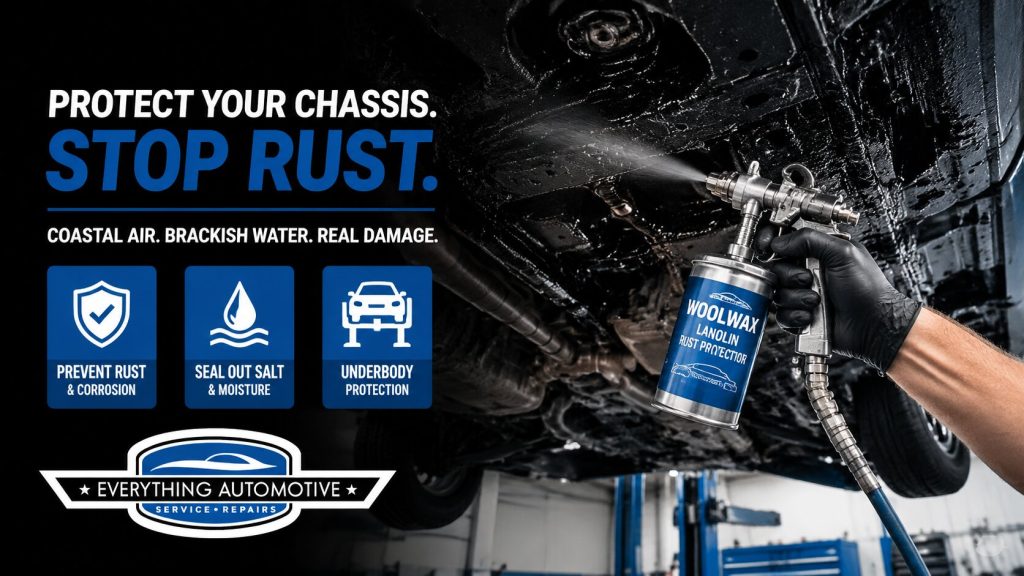
Jacksonville’s coastal geography creates a highly brackish estuarine environment where the St. Johns River meets the Atlantic Ocean, with river salinity fluctuating from 8.25 ppt to 35.45 ppt. For families commuting through low-lying San Marco or Mandarin, daily high tides and heavy storms flood streets like LaSalle Street, Hendricks Avenue, and San Jose Boulevard, splashing a highly corrosive chloride and sulfate brine directly into hard-to-reach undercarriage crevices. This chemical threat is intensified by Jacksonville’s average relative humidity, which exceeds 70 percent year-round. Because salt is highly hygroscopic, trapped underbody salt crystals continuously draw moisture from the humid air, keeping the corrosive reaction active and eating away at raw steel long after the vehicle has been parked.
The Electrochemical Process of Salt-Induced Corrosion and Suspension Wear
Undercarriage rust is not a simple cosmetic blemish. It is an aggressive electrochemical reaction that physically destroys your vehicle’s foundation. Here is how coastal salt air and brackish water destroy your chassis from the inside out:
- Brackish Spray Acts as an Electrolyte When salty road spray coats your chassis, it forms a highly conductive salt brine. This electrolyte solution dramatically speeds up the electrochemical reaction between steel, oxygen, and moisture, turning solid iron into weak, flaky orange rust.
- Crevices Trap Destructive Salt Salt-rich dirt and brackish moisture settle in hidden undercarriage crevices, seams, and boxed frame rails where they stay wet and active much longer than open panels.
- Galvanic Corrosion Freezes Fasteners When dissimilar metals meet—such as steel mounting bolts threaded into aluminum suspension control arms—brackish moisture bridges the gap. This triggers rapid galvanic corrosion, welding the bolts solid and making future alignments impossible without physically cutting them off.
- Steel Brake Lines Undergo Pinhole Thinning Thin-walled steel brake lines run the full length of your chassis, leaving them constantly exposed to road spray and salt air. Rust eats away at these lines from the outside in, thinning the steel until they develop pinhole leaks or catastrophically rupture under braking pressure.
Diagnostic Signs of Underbody Rust and Suspension Bushing Failure
Because of this constant salt exposure, suspension and steering components on the First Coast fail up to 40 percent sooner than those on vehicles driven inland. When you are driving across Jacksonville, you should monitor your vehicle for several clear warning signs of underbody decay:
- Suspension Groaning and Clunking: A dry, metallic squeaking or a heavy clunking sensation felt through your floorboards when crossing the concrete expansion joints of the Buckman Bridge on I-295 or the Fuller Warren Bridge on I-95 indicates that rust has invaded your ball joints and sway bar links, stripping away internal lubricating grease.
- Wandering or Loose Steering: A vague, unstable steering response when cruising at 65 mph on J. Turner Butler Boulevard (JTB). When salt corrosion weakens the subframe and control arm mounting brackets, your front-end alignment angles shift constantly under load, causing the car to pull or wander.
- Bubbling Paint and White Crust: Sighting a powdery white salt crust or bubbling paint along your vehicle’s metal rocker panels and suspension arms when looking behind the wheels. This is visual proof that oxidation has already crept beneath the surface coatings.
The Danger of Hard Rubberized Coatings Versus Soft Self Healing Lanolin
Many well-meaning drivers attempt to protect their vehicles by applying cheap, hard-drying rubberized or bitumen-based undercoatings. As a Master Technician who has been turning wrenches since 1983, I strongly advise against this.
Hard rubberized coatings dry to a rigid, non-porous shell. Over time, road gravel and expansion joints chip this hard shell, creating microscopic cracks. Brackish water and humid salt air seep into these cracks, where they are trapped directly against the raw steel. Because the outer shell remains intact, the rust eats away at your frame completely hidden from view, only revealing itself when the structural subframe suffers a major collapse.
At Everything Automotive, we utilize soft, non-drying, lanolin-based Woolwax barrier treatments to protect our customers’ vehicles. Lanolin is a natural, non-toxic substance derived from raw sheep’s wool. Unlike rigid rubberized undercoatings, Woolwax does not dry or harden; it remains active, soft, and pliable.
| Barrier Type | Physical Behavior | Seam Penetration | Self-Healing | Corrosion Risk |
| Hard Rubber | Cures to solid hard shell | Poor; sits on surface | No; chips and cracks | High; traps moisture |
| Soft Lanolin | Remains soft and tacky | Excellent; creeps | Yes; self heals | Low; seals metal |
Because Woolwax is formulated to be highly viscous—applying with the thickness of a heavy paint—it resists water wash-off from road slush and heavy rains. Its soft composition allows it to “self-heal” over rock chips and scrape marks. Furthermore, it actively creeps and migrates deep into tight chassis joints, welds, and boxed frame sections, hermetically sealing the metal from oxygen and water.
Advanced Underbody Cleaning and Lanolin-Based Woolwax Barrier Applications
At Everything Automotive, we have provided honest, transparent auto repair across Duval County since 2012. We do not believe in basic “spray-and-go” services. Our dedicated under-car inspection and Woolwax preservation service is a thorough, master-tech process designed to extend the life of your vehicle:
- De-Salting High-Pressure Wash: We hoist the vehicle on our lift and perform a high-pressure underbody wash using specialized cleaning solutions to dissolve and strip away stubborn, bonded salt crust, sand, and road grime.
- Detailed Under-Car Inspection: We inspect your entire suspension, checking steering linkages, suspension arms, stabilizer bars, chassis mounting points, and steel brake and fuel lines for wear, rust perforation, or loose bushings. This is our diagnostic moment of clarity, where we pinpoint early-stage wear before it compromises your safety.
- Loose Rust Prep: We carefully scrape away any loose, flaking surface scale. Because lanolin acts as an active moisture barrier, it can be safely applied directly over tight surface rust, soaking into the porous metal to starve the underlying steel of oxygen and halt the corrosion process.
- Precision Woolwax Application: Using specialized high-pressure spray guns equipped with long, flexible 360-degree internal frame wands, we inject a heavy coat of Woolwax deep into your vehicle’s frame rails, sills, subframe cavities, and body mounts. We apply a uniform, thick barrier across all exposed metal parts beneath the vehicle, taking care to avoid hot exhaust pipes.
Do not let coastal salt air and brackish floodwaters quietly eat away at your vehicle’s safety. Bring your car to Everything Automotive for a professional under-car inspection to protect your chassis today.
- Visit us at our Eastside location: (7624 Beach Blvd, Jacksonville, FL 32216 | 904-800-2714)
- Our Westside location: (6211 Blanding Blvd, Jacksonville, FL 32244 | 904-813-7097)
Frequently Asked Questions
Is brackish water more corrosive to a vehicle chassis than freshwater?
Yes. Brackish water contains dissolved chloride and sulfate ions that create a highly conductive electrolyte, which dramatically accelerates the electrochemical oxidation process of steel underhood.
Can I use a pressure washer to clean lanolin undercoating?
No. Lanolin-based Woolwax is designed to remain soft, tacky, and active, meaning direct high-pressure power washing can strip the protective chemical film off the metal and expose the raw steel to salt air.
Is it safe to apply Woolwax over existing surface rust?
Yes. Soft lanolin-based barrier treatments do not trap moisture like dry rubberized coatings; instead, they penetrate deep into the porous structure of existing rust, displacing trapped oxygen and moisture to halt the corrosion process.
