
Submerging hot axles during Jacksonville trail rides creates a sudden vacuum, drawing water past seals into the differential housing. This water emulsifies the gear oil, destroying film strength and causing destructive metal wear. Immediate fluid inspections and flushes prevent gear pitting, protecting expensive 4×4 transfer cases and differentials from failure.
Florida Trail Water Crossings Expose Axles to Severe Vacuum Pressure
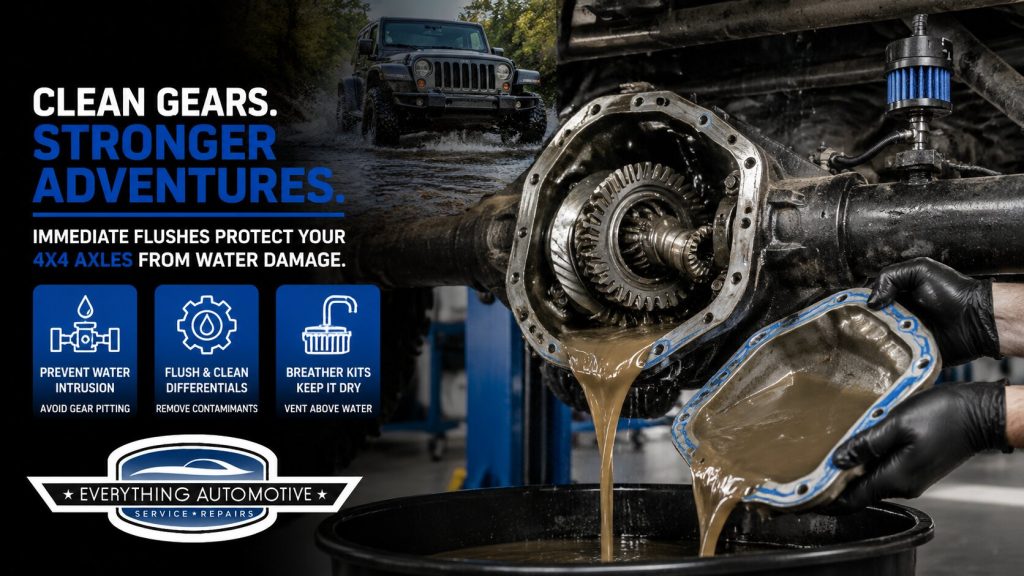
Jacksonville trails like Jennings State Forest and Osceola National Forest frequently submerge axles in cold water, creating vacuum pressures that risk gear pitting. On any given weekend, local truck and SUV enthusiasts head west of the city to tackle the swampy, challenging trails of Jennings State Forest, navigating sand and mud bogs along Scrub Road and Rattlesnake Road. Others head toward Osceola National Forest to test their rigs on the deep water holes of Bear Branch.
While splashing through these bogs is a massive part of the off-road appeal, it subjects your 4×4’s mechanical foundation to extreme physical stress. Driving these trails puts a continuous, heavy workload on your front and rear differentials and transfer case, generating immense internal friction and heat.
When your axle housing—operating at high temperatures—is suddenly plunged into a cold, swampy creek or a deep mud hole, the metal cools instantly. This rapid temperature drop causes the air trapped inside the casting to contract violently, creating a powerful internal vacuum.
The Thermal Physics of Cold Water Dips and Emulsified Gear Oil
To understand how water invades a sealed axle and destroys your gear oil, it helps to look at the process of thermal vacuum contraction step-by-step:
- Friction Expands Under-Body Air: Under normal off-road load, the rotating gears inside your axles and transfer case generate heat, which expands the air inside the housing and builds internal pressure.
- Rapid Cooling Shrinks the Air Volume: When your hot axles meet cold water, the housing cools rapidly, shrinking the air inside and creating a strong vacuum effect.
- The Factory Breather Fails: Most factory breathers utilize a simple one-way check valve mounted directly to the axle tube. The vacuum pulls this valve tightly shut, preventing the differential from venting naturally.
- Moisture is Sucked Past the Seals: Because the axle cannot breathe through its vent, the vacuum seeks the next weakest link—drawing water directly past the rubber axle shaft seals or pinion seals, which are submerged under the waterline.
- The Oil Emulsifies Into a Low-Lubricity Slurry: Once water enters, the rotating ring and pinion gears churn it directly into your high-viscosity gear oil. This transforms your clean, golden fluid into a frothy, milky-white or coffee-colored emulsion.
From Milky Oil to Pitted Gears and Axle Seizure
Water-contaminated gear oil is a catastrophic threat to your 4×4 drivetrain. Water cannot support the intense load-bearing demands of your differential’s meshing gear teeth.
The consequences of ignoring water intrusion include:
- Loss of Film Strength: The thin, emulsified oil barrier collapses under torque, leading to direct metal-on-metal friction.
- Gear Pitting and Spalling: This friction creates intense, localized heat that tears microscopic metal particles off the ring and pinion gear teeth. This wear process, called gear pitting or spalling, permanently ruins the gear face.
- Speed-Dependent Howling: As the pitted gear teeth mesh unevenly, they generate a loud, speed-dependent howling or whining noise that you will easily hear under your floorboards while driving down Cassatt Avenue or Blanding Boulevard.
- Mechanical Binding: Worn gears and damaged carrier bearings alter your axle’s backlash tolerances, leading to a distinct mechanical binding, chattering, or shuddering sensation when making tight turns.
- Drivetrain Seizure: Left untreated, the damaged bearings will eventually collapse or a gear tooth will shear, locking the differential entirely and leaving you stranded on the trail.
Relocating Vents to the Engine Bay with Extended Breather Kits
For local off-roaders who refuse to let water crossings cut their trail days short, installing an extended differential breather kit is a highly effective, low-cost modification.
A standard factory breather sits low on the axle tube where it is easily submerged, blocked, or damaged. An extended breather kit replaces this low-mounted vent with continuous, oil-resistant hoses connected directly to the axle housing.
We route these flexible hoses carefully along your brake lines and frame, anchoring them high up on the engine firewall—well above your vehicle’s maximum wading depth. This high-mounted termination allows the axle to vent safely to the atmosphere through a non-restrictive, water-resistant filter cap.
By equalizing internal axle pressure safely above the water line, we eliminate the vacuum that draws mud and water past your rubber seals.
Diagnostic Differential Service Over the Quick Lube Drain and Fill
I have been turning wrenches since 1983, and I have seen too many off-roaders make the mistake of taking their water-logged 4x4s to cheap quick-lube facilities. A generic “drain and fill” only drains what sits in the bottom of the pan. It leaves up to 30 percent of the contaminated, milky slurry trapped in the axle tubes and behind the carrier bearings.
At Everything Automotive, we have served Jacksonville and Duval County drivers with honest, diagnostic-led auto repair since 2012. Our complete 4×4 differential service is a meticulous, master-tech process:
- Cover Removal and Gear Inspection: We do not just pull a drain plug. We physically unbolt your differential cover. This allows us to inspect the ring and pinion teeth for spalling and check the magnetic drain plug for excessive metal shavings.
- Light Motor Oil Flush: To ensure all moisture and sand are completely removed, we temporarily fill the housing with a light motor oil, elevate the axle, and run the gears in a low-speed spin to wash out any trapped emulsified water.
- Thorough Cleaning: We wipe down the housing with specialized solvents and clean off the old gasket material.
- Premium Re-assembly and Lube: We reseal the cover with high-temp RTV silicone and fill the housing to the correct level with premium, heavy-duty synthetic gear lube.
Whether you drive an everyday commuter SUV or a heavily modified trail rig, our professional 4×4 differential services and repairs are backed by our signature 36-month / 36,000-mile nationwide warranty through the Parts Plus Car Care Center network.
- Visit us at our Eastside location (7624 Beach Blvd, Jacksonville, FL 32216 | 904-800-2714)
- Our Westside location (6211 Blanding Blvd, Jacksonville, FL 32244 | 904-813-7097)
Frequently Asked Questions
Does water-contaminated gear oil always look milky?
Yes. When water is drawn into your differential, the rotating ring and pinion gears churn the water and gear oil together, transforming the fluid into a thick, milky-white, or coffee-colored emulsion.
Is a differential breather kit necessary for occasional off-roaders?
Yes. Deep mud and water can destroy your drivetrain if you aren’t prepared. A breather kit keeps your axle from sucking in dirty water when the metal cools down suddenly during a submerged crossing.
Can I ignore water intrusion if I only crossed a shallow creek?
No. Even shallow water crossings can completely submerge your axle housings. Splashing cold water on hot parts sucks moisture deep into the machinery. You must flush the unit instantly to stop gears from pitting and bearings from seizing up.
